







We are currently beyond the safety zone for seven of the nine boundaries.
Naturally, the framework is a work in progress, subject to human error and misunderstanding. Still, it may be the best understanding we have, both in metrics and more critically, in its effort to set global limits before it’s too late.
The tragedy of the commons – the tendency for individuals to deplete commonly held resources – is arguably the defining concept of our age. Since none of us acting individually can meaningfully slow planetary transformations, our motivations to adopt more earth-friendly behaviors must essentially be moral ones. A nature-based morality, eventually leading to cultural shifts, may be the only antidote to the seemingly endless human quest for more convenience and consumption.
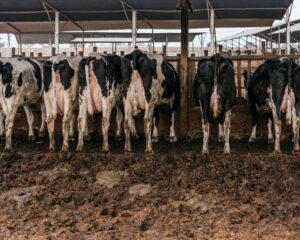
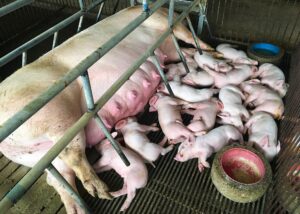
Although mostly unacknowledged, the factory farming system is a central factor, sometimes the central factor, in the transgression of boundaries. Many are aware that factory farming is hell on earth for animals. Less commonly understood is that the ecological waves emanating from industrial animal ag are turning into tsunamis, with their interactions amplifying the speed and intensity of the transgressions.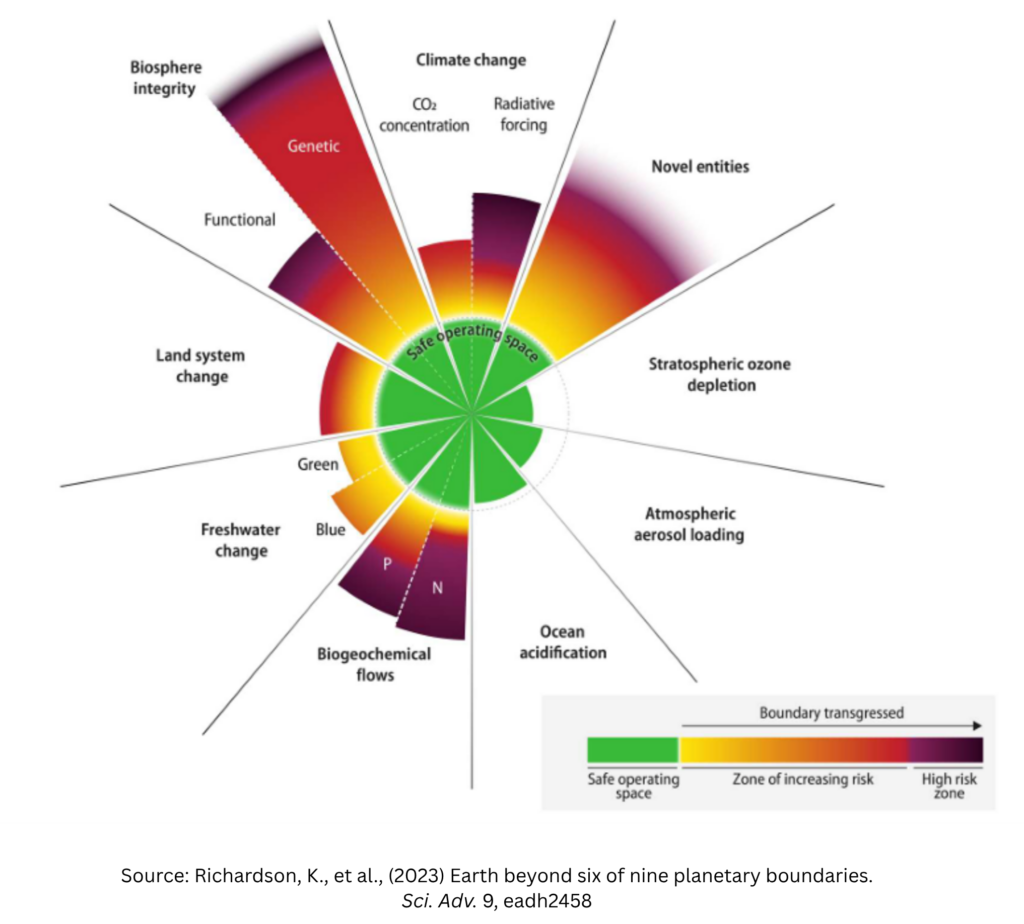
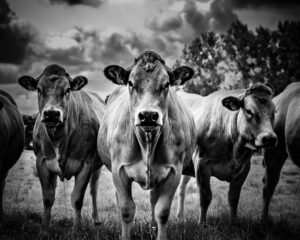
 Biodiversity Loss – Humans and farmed animals have taken over the Earth, with livestock at ~55% of land mammal biomass compared to ~2% for wild land mammals.
Nutrient Pollution – Factory farms and feed crops are the key drivers of polluting nutrients, with excess nitrogen most definitively in the planetary high-risk zone.
Water pollution – Industrial animal ag is the primary driver of the pollution of waterways in the U.S., and likely in many other nations.
Water depletion – An astonishing 40% of national water consumption is attributable to industrial animal agriculture, drying rivers, depleting aquifers, and stressing myriad species.
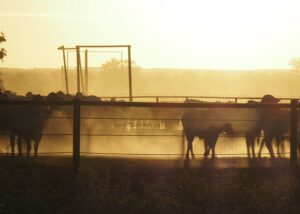
Land and forest transformation – Animal ag is the largest user and abuser of land on the planet, in the U.S. using close to half of the land for grazing and feed crops.
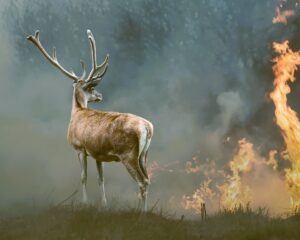
Climate change – Livestock and feed crops are critical factors warming the planet, thereby intensifying all other stresses.
Factory farming is the ultimate manifestation of our disconnection from nature. Our apparent willingness to sacrifice so much for so little — our daily cheap meat — reflects this growing schism. We’ve forgotten that humans are part of the natural world. As much as we need affordable housing, electricity, and the internet, we need birds, pollinators, healthy soil, and clean water even more.
Nature is the ultimate teacher on this Earth. Organized religions that ignore nature’s ways are no longer up to the task. Nature tells us what truly matters. The message is not hidden in ancient texts or traditions. It is right in front of us, in the ravaged forests and rivers, the miraculous abilities of animals, and the beauty of wild landscapes.
The Planetary Boundary framework is a warning system blinking red. We can continue to abuse the commons for individual gain at the cost of our future. Or we can find a new morality that redefines the Anthropocene, not by the damage done but by a new culture of respect for nature and sacrifice for the common good. A decision to stop supporting factory farms is a good place to start. For the animals, for our long-term survival, and for this miraculous planet upon which we all depend.