
Industrial animal agriculture is the primary contributor to the failing grades of U.S. waterways, responsible for about 50% of nutrient pollution – the leading cause of U.S. water pollution.[1]
As noted in previous pages of this section: U.S. waterways have received failing grades from the EPA for many years. Nutrient pollution leading to eutrophication is the primary cause. Agriculture is the driver of ~70-75% of nutrient pollution.
Animal ag is responsible for ~70% of agriculture’s contributions and thus the driver of about half of all nutrient pollution.[2,3]
U.S. animal agriculture is the largest contributor to nutrient pollution. And nutrient pollution is the largest factor in water pollution. Both points are documented throughout these pages. It should be common knowledge that factory farming is the central driver of U.S. water pollution, due to massive amounts of unusable manure, chemical fertilizers on feed crops, and the increased production of nitrogen-fixing crops, mostly for feed. However, for all the reasons documented here, this connection between animal ag and water pollution is mostly hidden, and to-date that pollution has been intractable. See, Water Pollution & Animal Ag Overview [question, Why is nutrient pollution from factory farms apparently intractable?]
This point is explored throughout this page. [Calculation: Agriculture = 70-75% of total nutrient pollution. Animal ag is about 70-75% of agriculture’s contributions. Our best estimate is .73 x .73 which we broadly estimate at ~50%. For agriculture’s contribution of ~73%. See, Agriculture’s Contributions to Water Pollution.
For spreadsheet of animal ag contributions, see, https://docs.google.com/spreadsheets/d/16vc25ZTFcsp-IBDewc6zXcN8aAAbTHRJa92lFaQ0wpw/edit?gid=0#gid=0
Globally, there is strong evidence that animal ag is the primary driver of water pollution.
According to the FAO, “The livestock sector is probably the largest sectoral source of water pollution, contributing to eutrophication, ‘dead zones’ in coastal areas, degradation of coral reefs, human health problems, emergence of antibiotic resistance and many others.”[1]
A global mega study, reviewing more than 500 scientific reports, estimates that animal ag (feed, livestock, and aquaculture) accounts for ~43% of all eutrophication.[2] Other studies support the conclusion that livestock production drives nutrient pollution and eutrophication globally.[3,4]
Eutrophication is considered the largest water pollution problem worldwide.[5-7]
Food and Agriculture Organization of the United Nations (2018). More people, more food, worse water? A global review of water pollution from agriculture. FAO, Water, Water, Land and Ecosystems (WLE) Program of the CGIAR, International Water Management Institute (IWMI), p. 68.
Poore, J. & Nemecek, T. (2018). Reducing food’s environmental impacts through producers and consumers. Science (American Association for the Advancement of Science), 360(6392), 987–992, Table S17.
Bouwman, L., et al., (2013). Exploring global changes in nitrogen and phosphorus cycles in agriculture induced by livestock production over the 1900–2050 period. PNAS, 110(52), 20882–20887, p. 20882. [“Therefore, it is, in fact, global livestock production that drives the nutrient cycling in the total agricultural system.”]
Li, Y., et al., (2022). Multi-pollutant assessment of river pollution from livestock production worldwide. Water Research (Oxford), 209, 117906, p. 7. [“The inputs to rivers are around 22 Tg Total Dissolved Nitrogen, 1.8 Tg Total Dissolved Phosphorus, and (large amounts of) oocysts in 2010. Cattle, pigs, and chickens are responsible for 74–88% of these pollutants in rivers.”]
Smith & Schindler, D. W. (2009). Eutrophication science: where do we go from here? Trends in Ecology & Evolution (Amsterdam), 24(4), 201–207, p. 201. [“Cultural eutrophication (excessive plant growth resulting from nutrient enrichment by human activity) is the primary problem facing most surface waters today.”]
Eutrophication: Causes, Consequences and Control, Volume 2 (Ansari & S. S. Gill , Eds.; 1st edition. 2014) Springer Netherland, p. 1.1. [“On the hydrological map of the world eutrophication has become the primary water quality issue.”]
Kleinman, P.J.A., et al., (2020). Managing Animal Manure to Minimize Phosphorus Losses from Land to Water, In Animal Manure (H.M. Waldrip, et al., eds.), p. 201. [“Eutrophication is the most pervasive concern to freshwater and estuarine water bodies worldwide, with phosphorus (P) pollution continuing to expand the extent of eutrophication, its impacts on aquatic life and its disruption of the benefits of ecosystems to humankind.”]
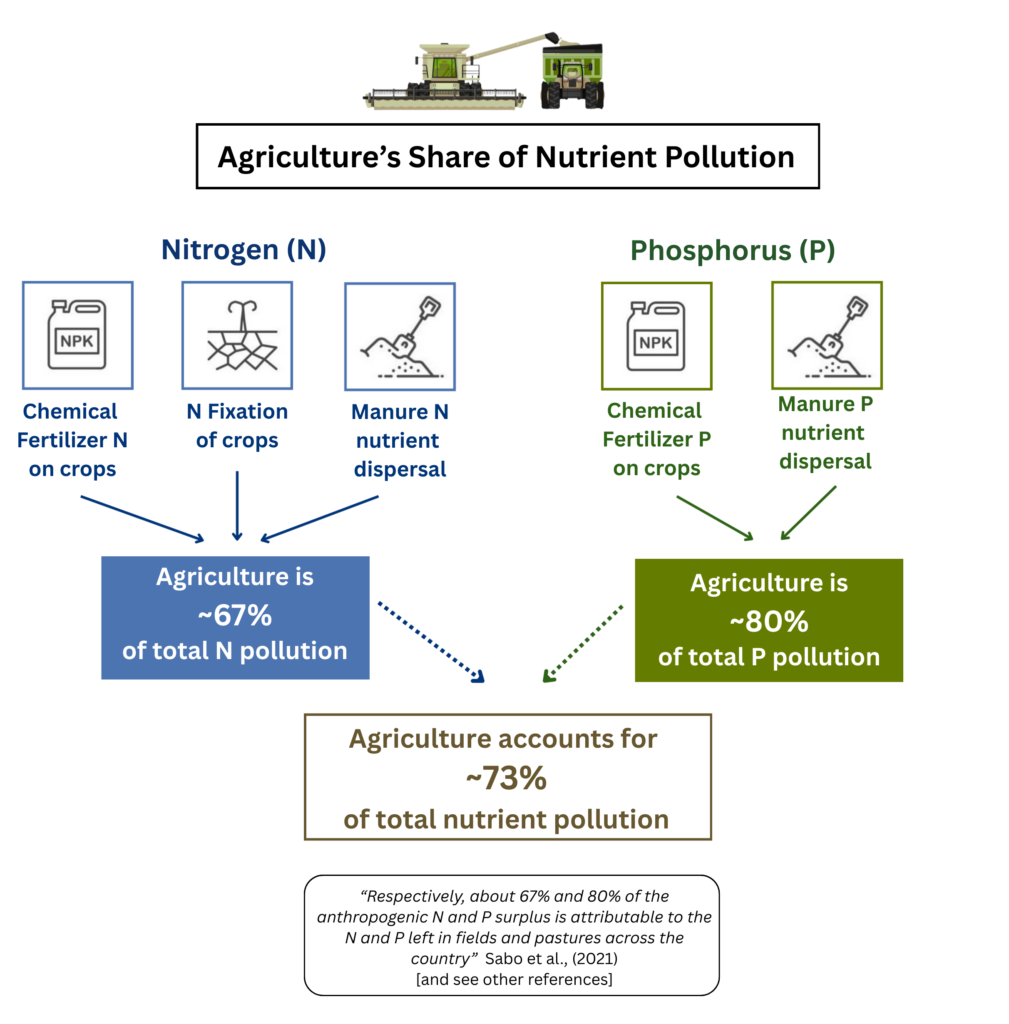
As a broad estimate, ~70-75% of total U.S. nutrient pollution is generated by agricultural systems from chemical fertilizers, crop fixation, and manure.[1]
We broadly estimate that ~67% of total agricultural nitrogen pollution comes from animal ag. Therefore, ~45% of total N nutrient pollution comes from animal ag.[1-3] The estimated shares of the 3 major sources of nitrogen pollution are as follows:
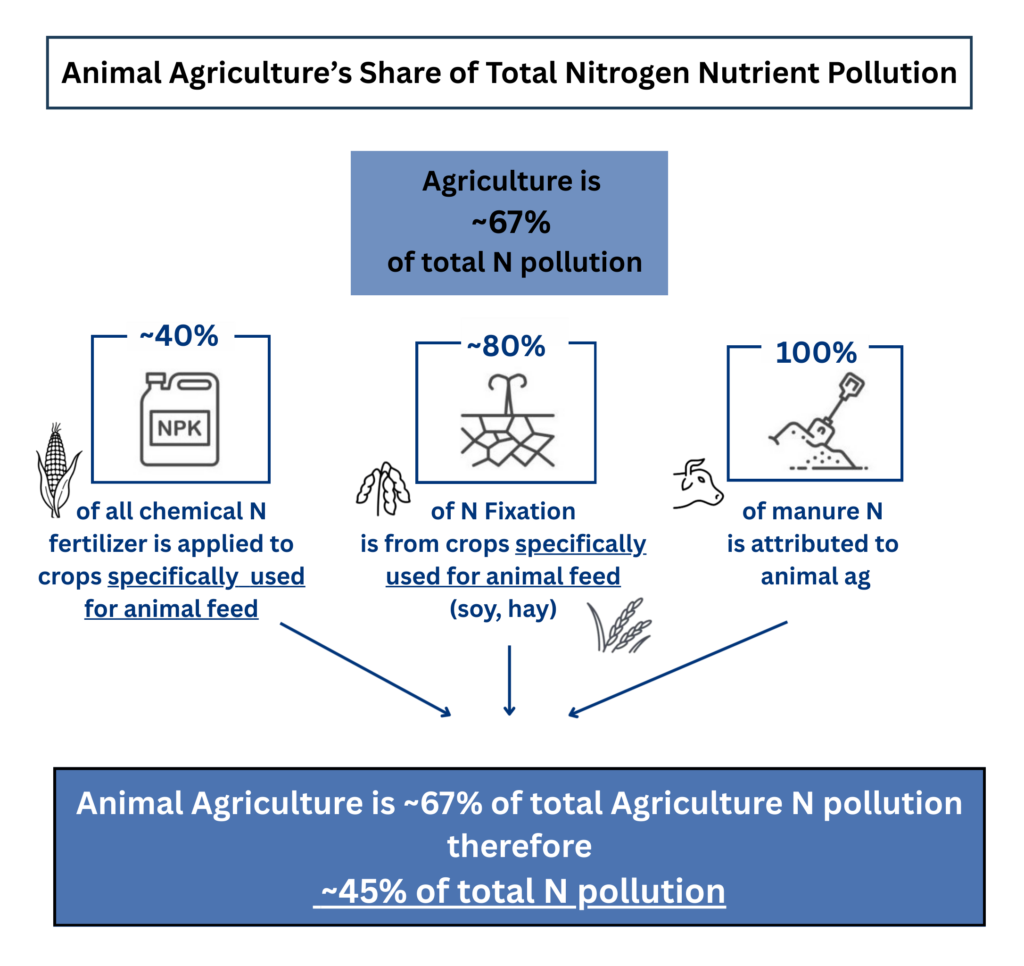
Chemical fertilizer on feed crops – Broadly estimated, ~40% of chemical fertilizer N goes specifically on crops grown for animal feed.[4,5] Corn uses almost half of total nitrogen and the share on corn specifically for feed is over 30%.[6]
Crop fixation by feed crops – Broadly estimated, ~80% of the crop fixation of nitrogen is attributed specifically to animal feed.[7,8]
Manure – Naturally, 100% of the manure N is attributed to animal ag. Huge shares of manure nitrogen end up as pollutants, through volatilization, storage losses, leaching, planned and unplanned releases, accumulations in the soil, and ineffective crop application.[9]
For spreadsheet on animal ag’s contributions, see https://docs.google.com/spreadsheets/d/16vc25ZTFcsp-IBDewc6zXcN8aAAbTHRJa92lFaQ0wpw/edit?gid=0#gid=0 [Calculation: Total agricultural share of N = 67%. Animal ag’s share of agriculture also = 67%. Therefore, .67 * .67 = ~45%. Agriculture’s share of nutrient inputs based on: Brehob, M. M., et al., (2025). The US EPA’s National Nutrient Inventory: Critical Shifts in US Nutrient Pollution Sources from 1987 to 2017. Environmental Science & Technology, Table 3]
Note: We base our estimates of animal ag’s share of agricultural nutrient pollution on the respective inputs of chemical fertilizers, crop fixation, and manure. We are not aware of national figures that can be used to assess the shares of pollution by specific sources. We believe that using the shares of inputs is a reasonable proxy for pollution outputs. Due to the very high losses of N from manure, it is possible that our final figures for animal ag’s N pollution are underestimated. However, the proportionally lower losses from N crop fixation may be an offsetting factor. For an exploration of the very high expected manure nutrient losses, see, Total Manure Nutrient Pollution.
Note: To improve this estimate one might devise a national average for “expected nitrogen pollution intensity per pound” from the 3 types of inputs. However, this is a difficult calculation to make with little data on which to base figures. In general, fixation probably has the least polluting tendencies, and manure has the largest per unit of input. Our best guess is that if chemical fertilizers were considered the baseline, then fixation would be somewhat lower and manure much higher. If this were accurate, the N pollution share of animal ag could be higher than estimated here. Some back-up for this assumption comes from: Robertson, D. M., & Saad, D. A. (2021). Nitrogen and phosphorus sources and delivery from the Mississippi/Atchafalaya River basin: An update using 2012 SPARROW models. JAWRA Journal of the American Water Resources Association, 57(3), 406-429, figure 5, p. 418. They calculate that across the MARB, agricultural sources contributed, “73.2% of the N (25.9% — fertilizers, 28.9% — manure, and 18.4% — fixation)…” Despite probably being a much smaller input than chemical fertilizers, manure is the largest N pollutant. And surprisingly, fixation is a very significant factor, again probably being a much smaller input than chemical fertilizers. It’s a complicated subject where we make assumptions due to limited data, and do not attempt to assign polluting intensities.]
See, Chemical Fertilizer Use on Feed Crops [We estimate nitrogen chemical fertilizer use on crops specifically grown for feed at ~40%. The share on harvested corn is about 31%. Adding animal feed usage of soybeans and several secondary crops takes the share to ~35%. Adding corn silage, other secondary crops and usages, and untallied usage of N on forage crops and pastureland, likely adds at least an additional 5%.]
Eshel, G., et al., (2014). Land, irrigation water, greenhouse gas, and reactive nitrogen burdens of meat, eggs, and dairy production in the United States. PNAS, 111(33), 11996, p. 11998. [Support for the estimate of about 40% of fertilizer N from animal ag comes from this report, which estimates that feed production “uses ˜6 million metric tons of Nr fertilizer annually, about half of the national total.”]
For key calculation that ~64% of corn production goes to animal feed, see, Share of Corn Crop for Feed
U.S. EPA (2011) Reactive Nitrogen in the United States, p. ES-5. [Report estimates the share of various types of crops fixing nitrogen, with ~99% from crops used primarily for feed. See, Table 4, p. 22. After updating some of these acreage figures, we broadly estimate that ~80% is specifically for animal feed. We use 58% as the portion of soybeans used for animal feed (see, Share of Soybean Crop for Feed for 2025). We revise some of the acreage figures based on updated reports (see USDA Crop Production (April 10, 2025) ISSN: 1936-3737. Legumes for human food consumption are now ~5M acres instead of ~2M acres, soybean acres have increased, and alfalfa/hay are decreased. Assuming soybeans contribute ~48% (up from 42%) of total N fixation (28% direct to animal feed or .58 * .48) then hay and pasture combined = ~45% (down from 50%) plus 5% for Eastern and Western pasture = ~78%. Note that “Management of biologically fixed N, insofar as it is possible, is proportionally as critical a task as the management of synthetic N because Nr from BNF is prone to the same loss pathways as Nr from commercial fertilizers.” At p. 22.
Pandit, M., et al., (2026). Biological Nitrogen Fixation in Soybean: Mechanisms, Benefits, Sustainability, and Future Prospects. Agronomy, 16(10), 946. [“Overall, BNF plays a critical role in nitrogen recycling, but the total impact is dependent on the post-nitrogen-fixation fate of nitrogen. Fixed nitrogen is still subject to the same loss pathways as synthetic fertilizers. While legume-based cropping exhibits low amounts of N2O and NH3 emissions due to BNF, post-harvest decomposition of residues can create nitrate pools that are vulnerable to losses.”]
For the estimated share of manure nutrients dispersed, see, Total Manure Nutrient Pollution
We broadly estimate that animal ag is the source of ~79% of total agricultural phosphorus. Therefore, ~63% of total P nutrient pollution comes from animal ag.[1,2]

Chemical fertilizer on feed crops – About 55% of chemical fertilizer P is applied to that share of crops specifically used for animal feed.[3-5]
Manure – Naturally, 100% of the manure P is attributed to animal ag. Huge shares of manure phosphorus end up as pollutants, through leaching, storage losses, planned and unplanned releases, accumulations in the soil, and ineffective crop application.[6]
For spreadsheet on animal ag’s contributions, see, https://docs.google.com/spreadsheets/d/16vc25ZTFcsp-IBDewc6zXcN8aAAbTHRJa92lFaQ0wpw/edit?gid=0#gid=0 [[Calculation: Agriculture’s total share = 80%. Animal ag’s share of agriculture = 79%. Therefore, .80 * .79 = ~63%. Agriculture’s share of nutrient inputs based on: Brehob, M. M., et al., (2025). The US EPA’s National Nutrient Inventory: Critical Shifts in US Nutrient Pollution Sources from 1987 to 2017. Environmental Science & Technology, Table 3]
Note: As explored above for nitrogen, we base our estimates of animal ag’s share of agricultural nutrient pollution on the respective inputs of chemical fertilizers and manure. We are not aware of national figures that can be used to assess the shares of pollution by specific sources. We believe that using the shares of inputs is a reasonable proxy for pollution outputs. We do not assign different “pollution intensities” to the different types of inputs. Since manure P likely has a much higher loss ratio than chemical fertilizer P, our final figures for animal ag’s P pollution share may be underestimated, perhaps significantly.]
For calculation that ~58% of soy production (by value) goes to animal feed, see, Share of Soybean Crop for Feed
See, Chemical Fertilizer Use on Feed Crops [We estimate phosphorus chemical fertilizer use on crops specifically grown for feed at ~55%. The animal feed share on harvested corn and soybeans is about 46%. Adding animal feed usage of secondary crops takes the share to ~49%. Corn silage adds another 2-3%, while untallied secondary crops and usages, along with usage of P on forage crops and pastureland likely brings final tally to ~55%.]
MacDonald, G. K., et al., (2012). Embodied phosphorus and the global connections of United States agriculture. Environmental Research Letters, 7(4), 044024, p. 8. [Support for the estimate of about 55% of P from animal ag comes from this report, which estimates “About 56% of the P fertilizer requirement for US food was for livestock products…”]
For the share of manure nutrients dispersed, see, Total Manure Nutrient Pollution
We estimate that ~70% of agriculture’s nutrient pollution comes from animal ag.[1] This calculation is based on the above estimates for N and P individually.[2-4]
This broad estimate aligns with an analysis of U.S. per capita N and P impacts from animal-sourced food production.[5] A European study also found that more than 70% of total agricultural N and P impacts on water pollution was due to the livestock sector.[6]
For spreadsheet on animal ag’s contributions, see, https://docs.google.com/spreadsheets/d/16vc25ZTFcsp-IBDewc6zXcN8aAAbTHRJa92lFaQ0wpw/edit?gid=0#gid=0
Calculation: Animal ag N broadly estimated at 67% of agricultural N. Animal ag P broadly estimated at 79% of agricultural P. Therefore, 67 + 79/ 2 = ~73%. We use 70% as the final figure to reflect the broad estimate and to offer a conservative assessment.
For animal ag’s share of total nutrients in chemical fertilizers (share used specifically on crops for feed), see, Chemical Fertilizer Use on Feed Crops. As tallied there, we estimate the share of N at ~40% of total nitrogen in chemical fertilizers and the share of P at ~55% of total phosphorus in chemical fertilizers.
Note: we weight N and P the same based on our understanding that both are critical components of nutrient pollution, with P probably more impactful in inland water pollution. See for example, Jarvie, H. P., et al., (2013). Phosphorus mitigation to control river eutrophication: murky waters, inconvenient truths, and “postnormal” science. Journal of environmental quality, 42(2), 295-304, p. 295. [“For watershed management, P is regarded as the primary limiting nutrient for nuisance algal growth in fresh waters, and over the last 40 years, mitigating P inputs from wastewater (point) and agricultural (nonpoint) sources has been adopted as the main watershed management tool to control freshwater eutrophication.”] And see, Schindler, D. W., et al., (2008). Eutrophication of lakes cannot be controlled by reducing nitrogen input: results of a 37-year whole-ecosystem experiment. PNAS, 105(32), 11254-11258. [“To reduce eutrophication, the focus of management must be on decreasing inputs of phosphorus.” Abstract] Note that nitrogen is considered more damaging to coastal zones. See for example, Howarth, R. W., et al., (2002). Sources of nutrient pollution to coastal waters in the United States: Implications for achieving coastal water quality goals. Estuaries, 25(4), 656-676. [“…although for most coastal systems N additions cause more damage.” Abstract]
Metson, G. S., et al., (2020). The US consumer phosphorus footprint: where do nitrogen and phosphorus diverge? Environmental Research Letters, 15(10), 105022. [“Animal products comprise 78% of the average per capita P footprint and 72% for N.” p. 7. “We define the P footprint as the amount of P released to the environment associated with the production and consumption of major food groups for one person annually.” p. 2]
Leip, A., et al., (2015). Impacts of European livestock production: nitrogen, sulphur, phosphorus and greenhouse gas emissions, land-use, water eutrophication and biodiversity. Environmental Research Letters, 10(11), 115004, pp. 6-7 [“Diffuse N losses from agricultural systems were estimated at 6.0 Tg N yr… 73% of these emissions were associated with livestock, which was dominated by feed production… Phosphorus losses from livestock were entirely attributed to feed production, with livestock DIP (dissolved inorganic phosphorus) representing 73% of total agricultural losses, even though some additional losses from animal housing or manure storage systems might occur.”]
Considering N and P together and weighted equally, we broadly estimate that ~50% of total U.S. nutrient pollution is from animal ag.[1]
Animal agriculture is without question the primary driver of nutrient pollution in the U.S.[2]

For spreadsheet on animal ag’s contribution, see, https://docs.google.com/spreadsheets/d/16vc25ZTFcsp-IBDewc6zXcN8aAAbTHRJa92lFaQ0wpw/edit?gid=0#gid=0
Calculation: Broadly estimated, agriculture is responsible for about 70-75% of nutrient pollution. Animal agriculture is responsible for ~70-75% of agriculture’s contributions. Our best estimate is .73 (total agriculture) * .73 (animal ag share of agriculture) = ~54% of total nutrient pollution as noted on the spreadsheet. We use 50% as the final figure to reflect the broad estimate and to offer a conservative assessment.
Yes. Industrial animal agriculture is the primary driver of U.S. water pollution. This understanding is based on the following, as explored throughout these pages:
Animal ag is the primary driver of U.S. nutrient pollution.[1] Nutrient pollution is the #1 cause of U.S. water pollution.[2]
Industrial animal agriculture is the primary driver of the pollution of U.S. waterways.[3]
As noted on this page.
See, Nutrient Pollution of Waterways [question: Is nutrient pollution the leading cause of U.S. water pollution?]
Note: Theoretically, these two statements do not directly establish U.S. animal ag as the primary source of U.S. water pollution. However, if the two statements are true, as we demonstrate here and throughout these pages, there is no plausible scenario under which the final conclusion is not accurate. Since nutrient pollution is such a large part of the impacts in waterways, and since most of the EPA’s other indicators (i.e., pesticides, microcystins, enterococci) are assessed as significantly less polluting and also are highly impacted themselves by animal agriculture and, in many cases, by nutrient pollution from animal agriculture, there is no possible state in which some other source, such as industrial pollutants, human wastewater, or the portion of agriculture that is not animal ag, is the primary driver of U.S. water pollution.
The USGS, in one of the few large regional evaluations of nutrient pollution sources, documents the primary role of agriculture. The report covers all or parts of 31 states including the Mississippi River Basin and the Corn Belt.[1] Although it does not specifically analyze animal ag contributions, they can be reasonably extrapolated.
Nitrogen – The report estimates that in the studied region, ~73% of total N is from agriculture. 25.9% from chemical fertilizers. 28.9% from manure. 18.4% from crop fixation.
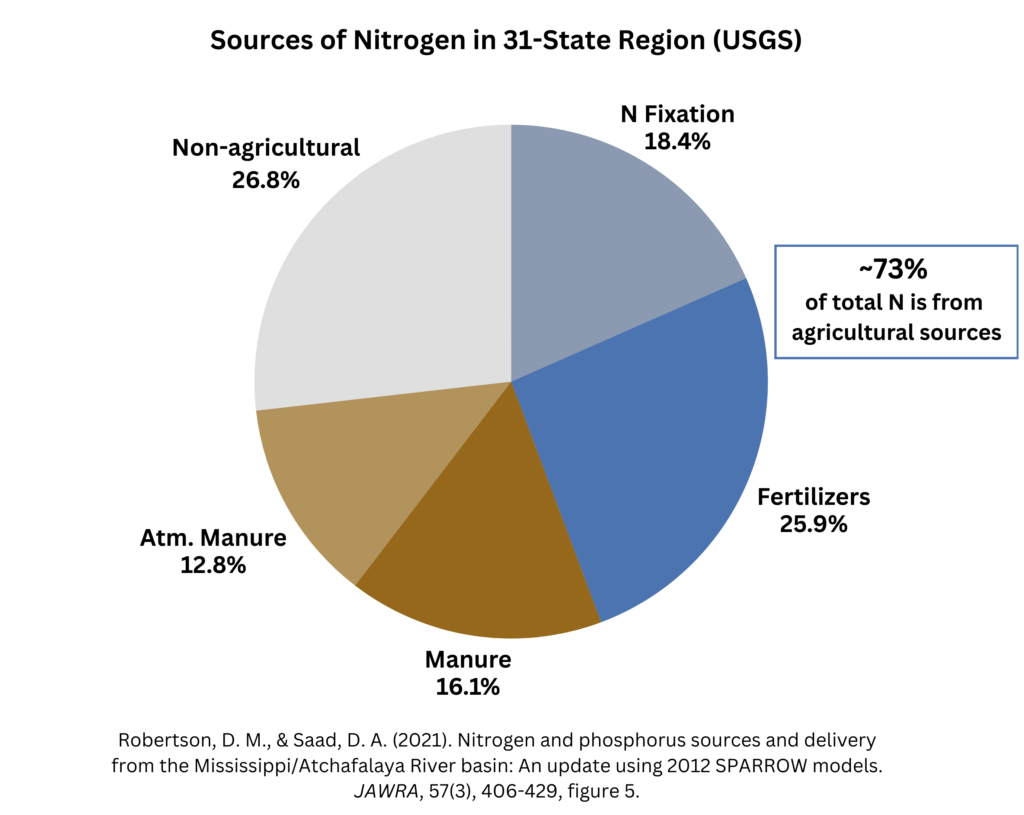
Our broad estimate, based on this data, is that animal ag contributes ~74% of all agricultural N, and therefore ~54% of total N in this region.[2]
Phosphorus – The report estimates that ~72% of total anthropogenic P is from agriculture. 48.9% from chemical fertilizers 23.5% from manure

Our broad estimate, based on this data, is that animal ag contributes ~70% of agricultural P, and therefore ~50% of all anthropogenic P in this region.[4]
Although the report covers all or parts of 31 states, it is not a nationwide evaluation that attributes nutrient pollution to specific sources; as far as we know, nationwide assessments are not available.[5]
The report highlights the large impact of manure, especially on the nitrogen cycle, where it is the number one source.[6]
Robertson, D. M. & Saad, D. A. (2021). Nitrogen and phosphorus sources and delivery from the Mississippi/Atchafalaya River basin: An update using 2012 SPARROW models. JAWRA Journal of the American Water Resources Association, 57(3), 406-429, figure 5, p. 418. [Agricultural sources contributed, “73.2% of the N (25.9% — fertilizers, 28.9% — manure, and 18.4% — fixation)…”]
Calculation: 25.9% from fertilizers * .40 specifically for feed = 10.4%; 28.9% from manure is all animal ag; 18.4% from fixation * .80 specifically for feed = 14.7%. Therefore, 10.4 + 28.9 +14.7 = 54.0%. (54/73.2) = 73.7%. For the estimated shares specifically for feed, see question above: What share of total U.S. nitrogen nutrient pollution comes from animal ag?
Robertson, D. M., & Saad, D. A. (2021), figure 5. [“For the entire MARB, agriculture was the dominant general source contributing 56.0% of the P (37.8% – fertilizers; 18.2% – manure)…” Since 22.7% of the total is from “natural sources” we adjust these figures to focus on anthropogenic sources. 37.8/77.3 = 48.9% from fertilizers. 18.2/77.3 = 23.5% from manure.]
Calculation: 48.9% from fertilizers * .55 specifically for feed = 26.9%; 23.5% from manure is all animal ag; Therefore, 26.9 + 23.5 = 50.4%. (50.4/72.4) = 69.6%. %. For the estimated shares specifically for feed, see question above: What share of total U.S. phosphorus nutrient pollution comes from animal ag?
Rotz, A., et al., (2021). Environmental assessment of United States dairy farms. Journal of Cleaner Production, 315, 128153. [“…there are no national estimates of total reactive N loss… For total reactive N loss, national estimates were not available for comparison.” Abstract and p. 6]
Robertson, D. M., & Saad, D. A. (2021), figure 5, p. 418. [Agricultural sources of nitrogen: “73.2% of the N (25.9% — fertilizers, 28.9% — manure, and 18.4% — fixation)…”]
Along with nutrient pollution, the other major water pollutants from animal ag come from factory farm manure and from pesticides on feed crops.
Manure – There are so pollutants in manure that the subject can become overwhelming. Along with nutrient pollution, the range of pollutants includes antibiotics, hormones, pathogens, and heavy metals.[1-4]
There is little information on which to base estimates of the relative risks of these various pollutants. It is dependent on the areas of focus, including human health risk, economic impact, or ecosystem damage and biodiversity loss. The two largest risks to humans are likely:[5] Antimicrobial resistance from the immense share of total antibiotic usage on factory farms.[6] Pathogens with zoonotic potential, i.e., that can be transferred to humans from animals.[7]
Pesticides – This also a complex subject due to the number of herbicides and insecticides, their varied impacts on humans, other animals, and ecosystems, along with their myriad and unstudied interactions. However, it can be said with certainty that an immense share of these pesticides are applied to feed crops, including:
Glyphosate – about 70% of total glyphosate usage is applied to the 2 largest feed crops, corn and soybeans.[8] Atrazine – about 80% or more of total atrazine is applied to corn.[9] Neonics – about 75% of total neonic applications are on corn and soybeans.[10]
Damages to plants and animals are well documented.[11]
U.S. EPA (2013) Literature Review of Contaminants in Livestock and Poultry Manure and Implications for Water Quality, 820-R-13-002, Key pollutants from livestock operations and animal manure, p. 1 and Table 1-1. [“Manure often contains pathogens (many of which can be infectious to humans), heavy metals, antimicrobials, and hormones that can enter surface water and ground water through runoff and infiltration potentially impacting aquatic life, recreational waters, and drinking water systems.”]
Animal Manure: Production, Characteristics, Environmental Concerns and Management (2019). Waldrip, H.M. et al., (eds.) American Society of Agronomy, Special Publication 67, Madison, WI, p. vii. [“…inappropriately managed animal manure may present significant environmental risks, including eutrophication/contamination of surface and subsurface water sources, emissions of greenhouse gases and air pollutants, contamination of ecosystems with antibiotic residues, antibiotic-resistant microbial genes and pathogens, as well as other health and quality-of-life-related issues.”]
Rogers, S. & Haines, J. (2005). Detecting and mitigating the environmental impact of fecal pathogens originating from confined animal feeding operations, U.S. EPA, 600/R-06/021, p. 1. [“Animal wastes contain zoonotic pathogens, which are viruses, bacteria, and parasites of animal origin that cause disease in humans. Diseases that can be caused by zoonotic pathogens include Salmonellosis, Tuberculosis, Leptospirosis, infantile diarrheal disease, Q-Fever, Trichinosis, Cryptosporidiosis, and Giardiasis to name a few.”]
Hubbard, L. E., et al., (2020). Poultry litter as potential source of pathogens and other contaminants in groundwater and surface water proximal to large-scale confined poultry feeding operations. Science of The Total Environment, 735, 139459, p. 6. [USGS scientists report: “Our results are consistent with previous studies that have demonstrated that surface water is susceptible to a wide variety of contaminants from confined animal feeding operations…”]
U.S. EPA (2013). Literature Review of Contaminants in Livestock and Poultry Manure and Implications for Water Quality. For a review of each category of pollutants, see: Chapter 6, pp. 47-63.
See, Antibiotic Resistance and Animal Ag
See, Zoonoses & Animal Ag
See, Herbicide Use on Feed Crops [question: What share of glyphosate is applied to corn and soybeans?]
See, Herbicide Use on Feed Crops [question: What share of atrazine is applied to corn?]
See, Neonics Use on Feed Crops
See, Herbicide Harm to Biodiversity and Insecticide (Neonics) Harm to Biodiversity