










One might assume that reducing antibiotic usage on factory farms would be relatively straightforward given the dire human health implications, the unchallenged ability of government to regulate usage, and successful reduction models in other countries. In fact, U.S. factory farm usage of medically important antibiotics dramatically increased in 2024, now accounting for more than two-thirds of total antibiotic usage.
Given the stakes, factory farming’s continuing abuse of antibiotics surely ranks high among the most irrational and dangerous practices of industrial animal agriculture. Our government’s enabling of this profligate usage is a serious dereliction of duty.
Human Health Impacts
Antibiotic resistance occurs when bacteria undergo changes that enable them to resist antibiotics that previously were effective treatments. Overuse drives the evolution of resistance, making certain bacterial infections difficult to overcome, including in humans. Based on CDC data, about 2.8 million Americans experience antimicrobial-resistant infections annually. More than 35,000 die as a result, with many more suffering from long-term disabilities.
Growing resistance means that older, less effective techniques for treating infections are often used, though they take longer, are more invasive, and are less successful (such as surgical incisions, amputations, and patient isolation). As the CDC explains, “Even when alternative treatments exist, research has shown that patients with resistant infections are often much more likely to die, and survivors have significantly longer hospital stays, delayed recuperation, and long-term disability.”
Increase in Animal Usage
Globally, about three-quarters of total antibiotic usage goes to animal agriculture. 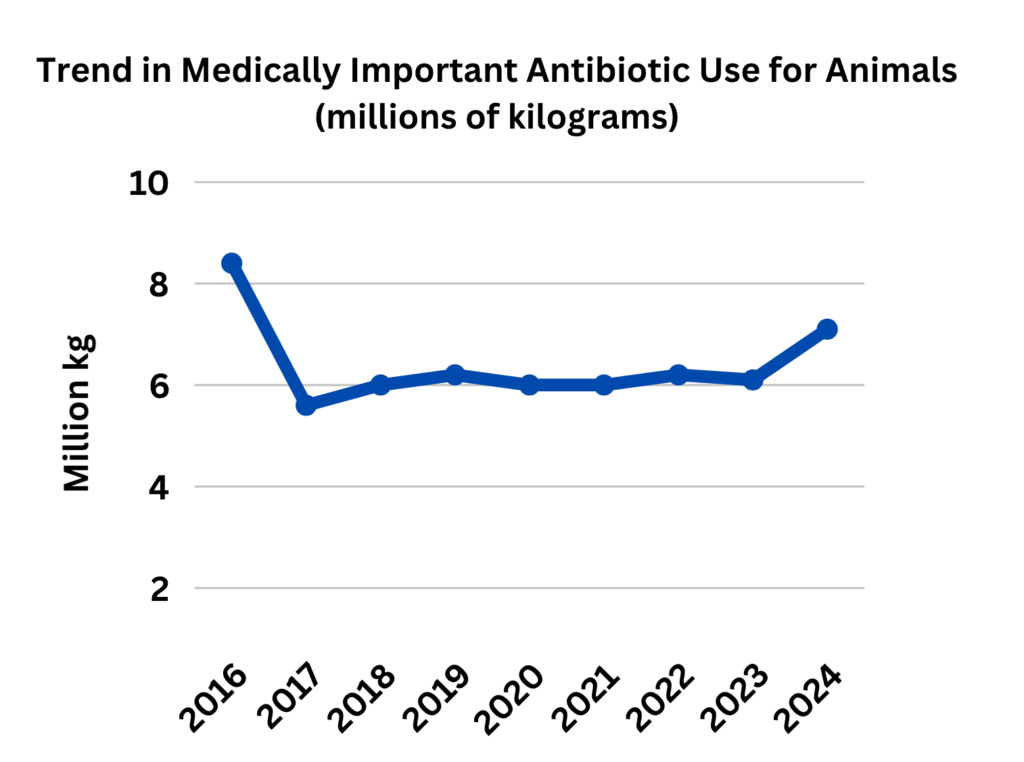 Until recently, the most credible estimate was that almost two-thirds of all U.S. antibiotics deemed medically important were used in the factory farming system. This is now an underestimate, given the FDA’s report of a 16% increase in animal usage from 2023 to 2024. (The sharp drop in 2017 occurred due to FDA regulations requiring veterinary oversight and disallowing usage for growth promotion.)
Factory Farm Conditions Create Disease
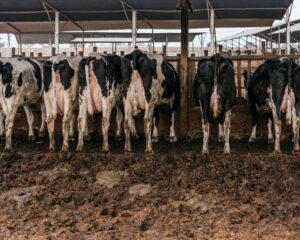
Factory farms confine highly stressed, densely packed, genetically homogenous animals eating unnatural diets and living in their own waste – ideal conditions for the spread of disease. Because of these conditions, antibiotics are considered an integral component of industrial animal agriculture, keeping animals healthy enough to make it to slaughter.
The most common factory farm applications include repeated exposure to low doses, a practice that encourages the emergence and persistence of antimicrobial resistant bacteria. Of the medically important antibiotics given to farmed animals, more than 90% are given in water or feed.
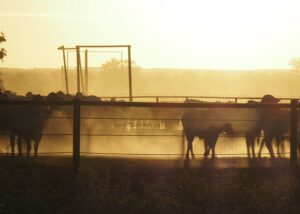
Cattle are predictably sickened by unnatural corn-based diets, stressful transport, and high-density comingling in feedlots. The primary health conditions are bovine respiratory disease and liver abscesses – both of which respond to antibiotics.
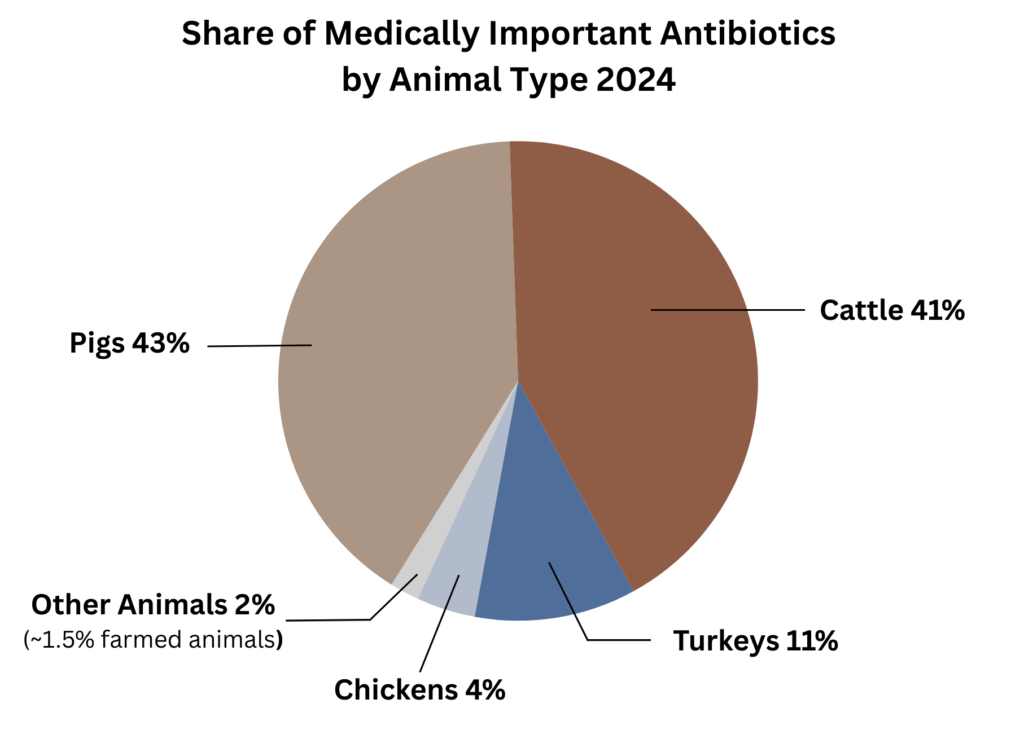 The pig industry is dependent on antibiotics to address respiratory disease and diarrhea. Despite the FDA’s 2017 ruling that pigs (and other farmed animals) can no longer be given antibiotics for growth promotion, some surveyed operations continue to offer that as their primary reason for giving antibiotics to young pigs. (There is no clear delineation between drugs used for disease treatment and those used for growth.)
Until recently, the broiler industry was a comparative success story due to consumer demand for antibiotic-free chicken, the short lifespan of broilers, and the industry’s use of non-medically important alternatives. However, the 2024 data shows an astonishing 79% year-over-year increase. This may be partially due to increasing rates of avian metapneumovirus, which causes bacterial infections.
The Tradeoff
From the perspective of human health, antibiotic resistance is a major externality of animal ag. Remarkably, the high levels of suffering and financial stress imposed on millions of Americans have not yet spurred a reevaluation of the animal conditions and mass production systems that make antibiotics essential. We accept unusually high levels of health risks to maintain the availability of inexpensive meat.
At Inside Animal Ag, we sometimes assign rankings to factory farming’s externalized costs, foisted on non-consenting, usually unsuspecting, and often powerless third parties. Of course, none top the torture of billions of animals. Still, the intensification of antibiotic resistance ranks high on the long list.
Recently, a group of 65 organizations representing health professionals, farmers, and environmental groups, signed a petition urging the FDA to withdraw approval for the unsafe use of antibiotics for farmed animals. Hopefully, challenges from multiple sectors of society will lead to a more rational approach to this major health threat.