








A new report from EPA scientists on nutrient pollution sources prompted our recent reassessment of factory farming’s share of nutrient pollution and its impacts on U.S. waterways. Our takeaway is an important one: industrial animal agriculture is the primary driver of the pollution of U.S. waterways. Anti-factory farming advocates have intuited this fact for many years; we get deep into the data. Our conclusions, based on government and independent research reports:
1. The largest U.S. water pollution problem is nutrient pollution – the excess of nitrogen and phosphorus in waterways.
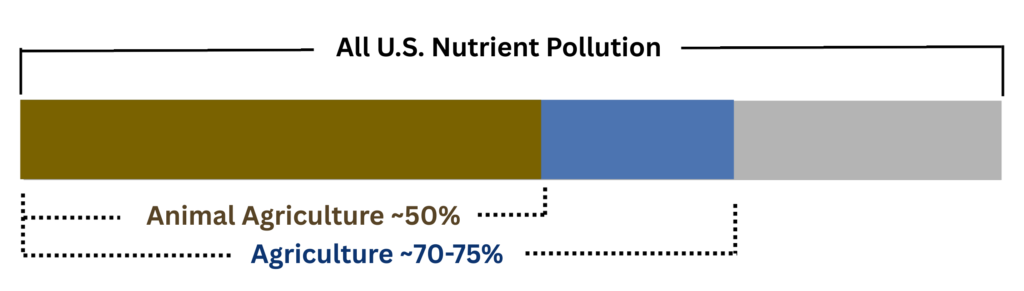
2. U.S. agriculture is the primary driver of nutrient pollution, broadly estimated at ~70-75% of anthropogenic sources.
3. Industrial animal ag is responsible for ~70% of agriculture’s contributions, and therefore about half of all nutrient pollution.
4. Animal ag is the primary driver of water pollution in the U.S.
For decades, the EPA has issued failing grades for U.S. lakes, rivers, streams, and coastal zones. Less than half of lakes and less than a third of rivers and streams are in good biological condition. The Gulf of Mexico dead zone is 2.5 times the size of the target set back in 2001. Nitrates in drinking water are a national concern.
The EPA knows what the problem is, regularly noting that nutrient pollution is the most widespread stressor in waterways, as well as the one most closely linked to poor biological condition – the primary metric for water health. They clearly note that the reduction of nutrients would deliver the greatest benefits to national water conditions. However, they rarely state the obvious conclusion: nutrient pollution is the primary water pollution problem in the U.S. We can also say with confidence that animal ag is the primary driver of nutrient pollution in this country.
Federal agencies tend to obscure agriculture’s central role in water pollution. Assessments of the specific impacts of animal agriculture are rare. As a result, animal ag’s impacts on water pollution are largely hidden from the public and there is little pressure on legislators to address the causes.
 Enormous volumes of concentrated factory farm manure, about four times total human outputs, are likely the central pollutant. Chemical fertilizers on feed crops and the nitrogen fixation of soybeans and forage crops are the other major components.
Sadly, the impacts of nutrient pollution from factory farming are not limited to water pollution. Other harmful impacts include air pollution, climate change, water scarcity, land and soil degradation, and biodiversity loss especially for aquatic species. Scientists view nutrient pollution as one of 9 planetary boundaries that define a safe living space for humanity. Of all the boundaries, it is considered the most definitively transgressed.
Societal concerns about nutrient pollution may eventually outweigh concerns about climate change due to the severe and steadily increasing damages. Unlike GHG emissions, the regional and national impacts of nutrient pollution can be mostly mitigated through regional and national efforts. In other words, reducing the size and impacts of factory farming would directly translate into cleaner waterways and more thriving species.
But you can’t address a problem until you know what the problem is. Given the high stakes, it’s time to pull back the curtain and look squarely at the fact that industrial animal ag is the central driver of the pollution of U.S. waterways.