
1. About 56% of all harvested cropland is devoted to crops specifically used for animal feed – 175 million acres.
2. Including grazing, ~80% of all agricultural land is devoted to animal agriculture.
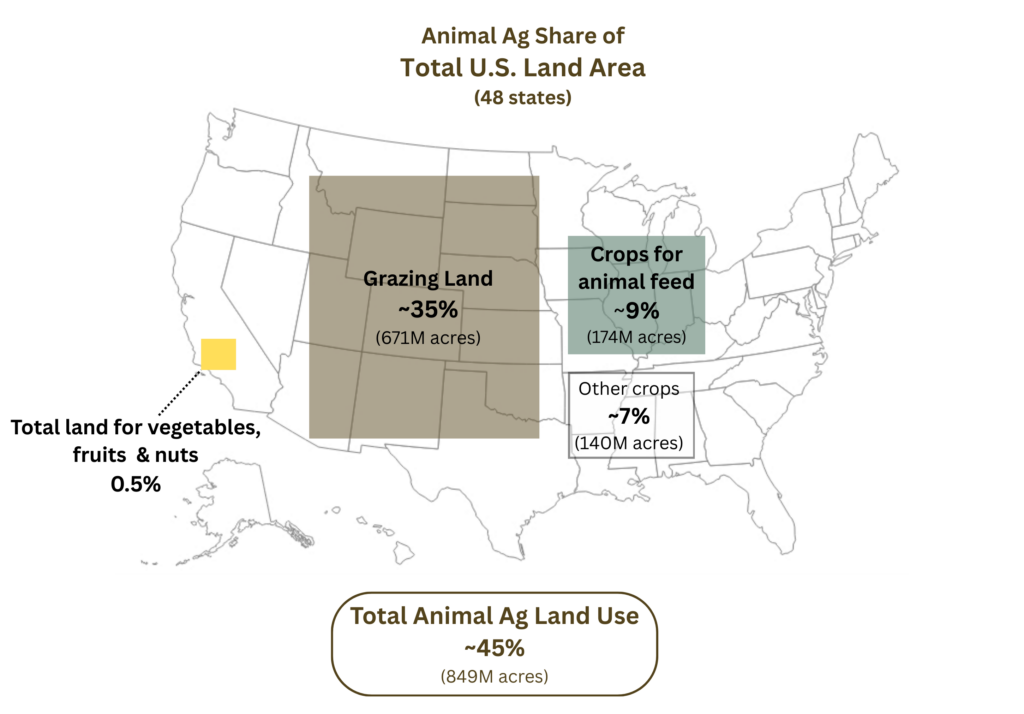
3. About 45% of the total land area of the lower 48 states is used by animal ag for grazing and feed crops.
4. Crops going to animal feed are almost 10% of total land area (48 states) and grazing is about 35%.
5. Land used for growing vegetables, fruits, and nuts – about 10 million acres – is about 6% of the size of cropland specifically used for animal feed.
The U.S. has the some of the most fertile land on earth, along with ideal climate conditions for growing crops. Yet we use much of our cropland to grow the cheapest “food” ever produced, unsuitable for humans and unnatural for animals.
On that land, we generate massive environmental externalities. We kill wildlife, deplete aquifers, pollute waterways, fuel climate change, degrade soil, and disperse pesticides and excess nutrients throughout the nation. The environmental costs are likely ten times larger than the paltry returns.
Grazing is by far the largest land use in the nation, and the damages to vulnerable landscapes are well documented. While much of the grazed land may not be suitable for food crops, it could be allowed to recover, improving soil carbon storage, water retention, erosion control, and native biodiversity. Together, feed crops and grazing use almost half the nation’s acreage to support the factory farming system.
The bounty of America’s land was millions of years in the making. It is threatened by our system of raising and feeding confined animals. The use of land is a central part of that system. We take a closer look at land use here.
In 2025, ~56% of total crop acres harvested were used specifically for animal feed.[1-6]
Of 313 million total harvested acres, ~175 million acres were used for animal feed production.
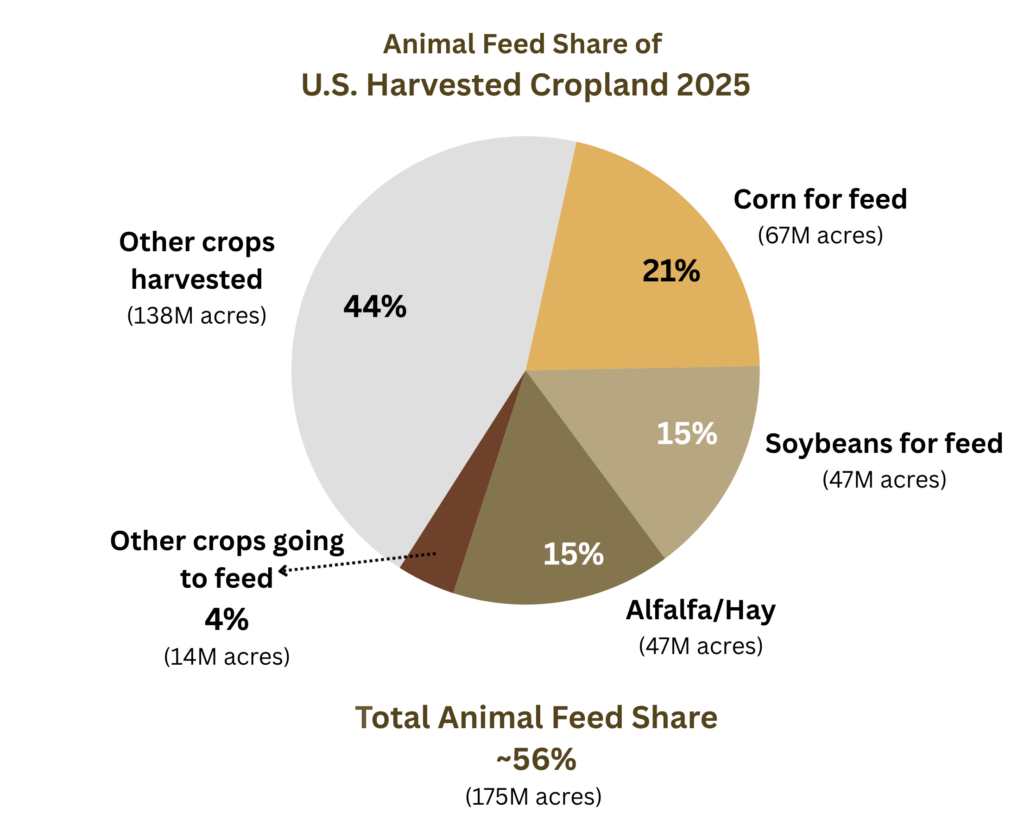
This is a conservative estimate as it does not include several harvested crops (e.g., cotton, oats, rye, sunflower seeds, peanuts), some portion of which are used for farmed animal feed but for which there is little data. And it does not include some animal feed usages of primary feed crops, such as corn and soy oil used as feed additives. Nor does it include acres that were planted but failed, some of which were likely used for forage but are still considered unharvested.[7,8]
For analysis, see https://docs.google.com/spreadsheets/d/1JMEcLM6P02YH_AgGxQ__fzb9rVhd7bt2BYT_xhjGz-E/edit?gid=0#gid=0
For the share of crops used for animal feed for 2025, see, Total Feed Crops Share. For acres harvested by individual crop [USDA NASS (2026) Acreage, p. 32.
Total Cropland Harvested: USDA Major Land Uses, Summary Tables, Summary Table 3, Col. B – Total crops harvested = 313M acres. [Note: This category is the acreage of total crops harvested and includes double-cropped acres. However, animal feed shares are not inflated due to double cropping because, a) double cropping occurs only on ~2% of harvested cropland (6M acres) and, b) the primary feed crops (corn, soybeans, and hay) are not double cropped to follow each other. See: USDA (2018) Claassen, R., et al., Tillage intensity and conservation cropping in the United States. Economic Information Bulletin Number 19. p. 10. [“Double cropping is highest in Southern States with longer growing seasons. Corn and soybeans are the most common spring-planted crops in these rotations, while winter wheat and rye are the most common fall-planted crops.”]
For all other total land use figures, we use Winters-Michaud, C. et al., (2024) Major Uses of Land in the United States, 2017, which refers to 2017 as the baseline year. Figures for grazing, farmsteads & roads, and total agricultural land have fluctuated only slightly across all land use reports from 2007-2017.
Note: For this question, it is not necessary to distinguish between “48 states” and “50 states” since total harvested cropland in Alaska and Hawaii is less than 0.1% of total U.S. harvested cropland.
See, Total Feed Crops Share [question: Why are these percentages underestimated?]
Note: A commonly quoted figure for acreage devoted to feed crops comes from: Merrill, D., & Leatherby, L. (2018). Here’s how America uses its land. Bloomberg, July, 31, 2018. The article includes a visual representation and is mostly based on an earlier Major Uses of Land report with 2012 as the baseline year (Bigelow, D., & Borchers, A. (2017) Major uses of land in the United States, 2012). There is no explanation of the calculations or sources behind the feed crop figure of 127.4 million acres. Exports are not included in the figure.
About 670 million acres are used for grazing as their “primary use.” This is ~35% of the contiguous U.S.[1] The acreage by category is broadly estimated as follows:
Rangelands (~540 million acres)  About 400 million acres are privately-owned rangelands.[2] About 140 million acres are federally owned rangelands.[3]
Pastureland (~130 million acres) About 120 million acres are privately-owned pastureland.[4] About 10 million acres are privately owned croplands used for pasture.[5]
Rangelands make up the bulk of grazing lands, ~540 million acres. They are mostly in Western states.[6]
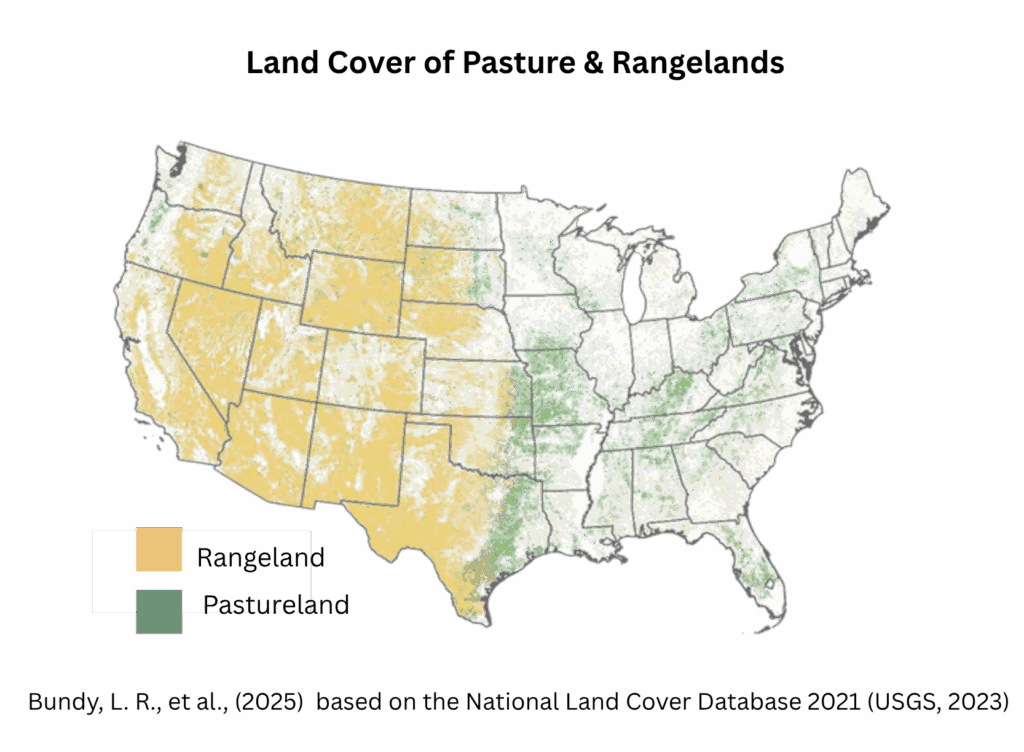
Winters-Michaud, C., et al., (2024) Major Uses of Land in the United States, 2017. USDA ERS Bulletin No. 275, Table 1, p. 5. [Total land area contiguous U.S. = 1,891.1M acres; Grazing land = 671M acres. We do not include 132M acres of “forest-use land” categorized by Winters-Michaud as grazing land since it is not the “primary use.” Of these acres, broadly estimated, ~70M acres are federally owned (see, USDA Forest Service (2021) Grazing Statistical Summary Fiscal Year 2021, p. 5.) and ~60M acres are privately owned forest lands (estimated from Winters-Michaud, Figure 11, p. 36.)
USDA (2020) Summary Report: 2017 National Resources Inventory, NRCS and Center for Survey Statistics and Methodology, Iowa State University, p. 2-1. [Non-federal rangeland = 403.9M acres. Note: chart includes Hawaii and Caribbean islands at ~1M acres]
Note: Between the BLM and the Forest Service, about 213M acres were actively grazed in 2017. See, Grazing on Federal Lands [question “How many federal acres are actively grazed?”] We are not aware, however, of the BLM or US Forest Service breaking down their active grazing acreage into rangelands and grazed forests. Therefore, we use the “total grazed forest-use” figure from Winters Michaud (Table 9, p. 32.) and subtract the estimate of “private forest land grazed” (estimated from Winters-Michaud, Figure 11, p. 36) to arrive at ~70M acres for federal grazed forest (which coincides with Forest Service use of 74M acres). That puts grazed federal rangelands at ~140 million acres (213M – 70M = ~140M) which seems reasonable.
USDA (2020) Summary Report: 2017 National Resources Inventory, p. 2-1. [Non-federal pastureland = 121.6M acres. Note: chart includes Hawaii and Caribbean islands at ~.5M acres]
Winters-Michaud, C., et al., (2024), Table 1, p. 5. [Cropland used for pasture = 13M acres]
Grazing map: Bundy, L. R., et al., (2025). United States pasture and rangeland conditions: 1995–2022. Agronomy Journal, 117(1), e21736, Figure 1, p. 3.
About 81% of total agricultural land in the contiguous 48 states is used for animal agriculture – either for crops going specifically to animal feed or for grazing.[1]
Of 1,053 million acres of agricultural land, ~850 million acres were used for animal ag production.[2,3]
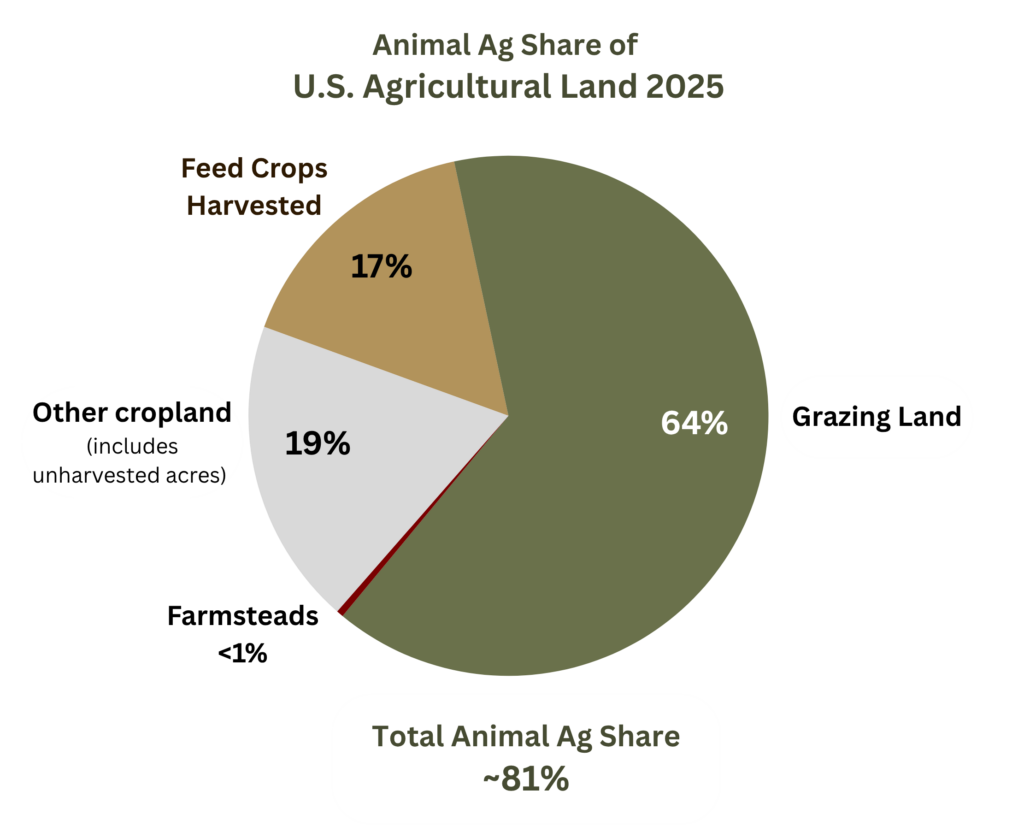
Agricultural land is made up of: Land used for grazing, the largest share. Crop acreage used specifically for animal feed. Farmsteads and roads used for animal ag production. Other harvested crops (not for feed). Unharvested cropland, e.g. crops that failed, were fallow or idle, including land in conservation programs, (and including a small share of non-animal ag farmsteads).[4]
See, https://docs.google.com/spreadsheets/d/1JMEcLM6P02YH_AgGxQ__fzb9rVhd7bt2BYT_xhjGz-E/edit?gid=0#gid=0
Winters-Michaud, C., et al., (2024) Major Uses of Land in the United States, 2017. USDA ERS Bulletin No. 275, Table 1, p. 5. [Report shows total agricultural land (48 states) at 1,186M acres. We do not include 132M acres of forested grazing land where grazing is not the “primary use” and thus not used for agricultural purposes. Also, this report counts 13M acres of “cropland pasture” as both grazing land as well as cropland. In the primary listing (Table 1, p. 5) it is included in grazing land, which is where we place those acres, since that is the use of the land in 2017, the baseline year.]
These figures are almost identical for 48 states and 50 states, since agricultural land in Alaska and Hawaii is ~.1% of all agricultural land. Total agricultural land for 50 states is 1,187M acres.
There are 5.97M acres of land in “farmsteads and farm roads.” We assign 4.5M acres to animal ag with calculations as follows: of all farms, .99M farms raise livestock, while 1.25M raise crops (based on USDA Census of Ag 2022). Of the farms that raise crops, we assign 55% to feed crops (per the previous question). Therefore .44 * 5.97 (livestock) + .55 * .56 * 5.97 (feed crops) == 2.63 +1.84 = 4.47M acres of farmsteads for animal ag versus 1.5M acres associated with crops other than feed crops.
Of the total land area of the contiguous 48 states, ~45% is used for animal ag. This includes: Land for grazing livestock at ~35%. Land for crops going specifically to animal feed at ~9%. Animal ag farmsteads at <1%.[1-3]
Out of a total land area of 1,891 million acres, 849 million acres were used for animal ag production.
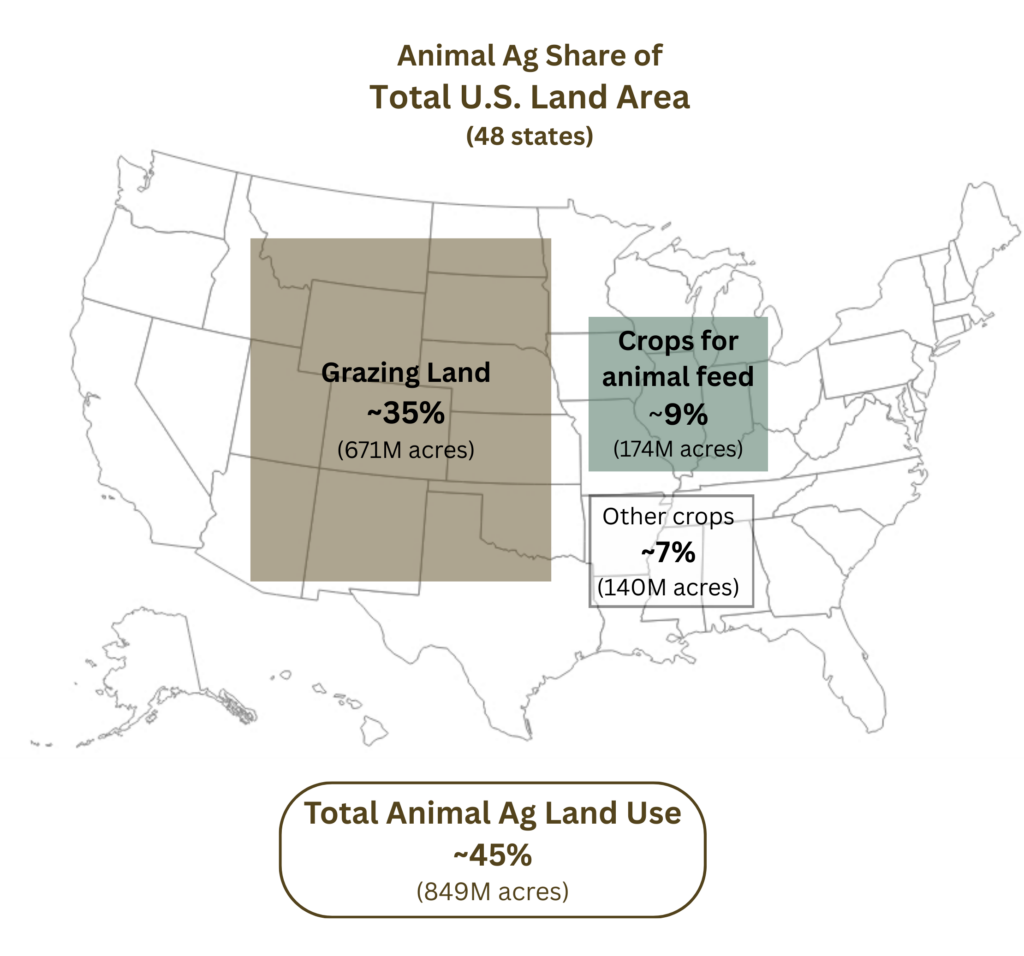
See, https://docs.google.com/spreadsheets/d/1JMEcLM6P02YH_AgGxQ__fzb9rVhd7bt2BYT_xhjGz-E/edit?gid=0#gid=0
Winters-Michaud, C., et al., (2024) Major Uses of Land in the United States, 2017. USDA ERS Bulletin No. 275, Table 1, p. 5. [Total land area contiguous U.S. = 1,891M acres; Grazing land = 671M acres. [Note: in the final figure of 849M acres, we include 4.5M acres used for farmsteads and roads used for animal ag production out of a total 6M acres, as calculated in the previous question.]
For share of harvested crop acreage going to animal feed, see question 2.
Total land use for all vegetables, fruits, and nuts equals ~10 million acres. This is:
About 1% the size of land devoted to animal agriculture. About 6% the size of land used for crops going to animal feed. About 3% of total harvested cropland. About .5% of total land in the 48 states.
USDA (2024) 2022 Census of Agriculture, AC-22-A-51, Tables 35-37 [Vegetables, potatoes and melons = 4.365M acres; Non-citrus fruit = 2.161M. Citrus fruit = .757M + .068M. Berries = .302M. Nuts = 2.179 + .501. Total = 10.333M acres.]