



Corn is the largest U.S. crop by acreage and production volume. It is the quintessential industrialized monoculture crop, mostly grown on tracts of more than 500 acres. The corn production system has enormous negative impacts on land, water, soil, and biodiversity. We pay this environmental toll mostly in the service of factory farming.
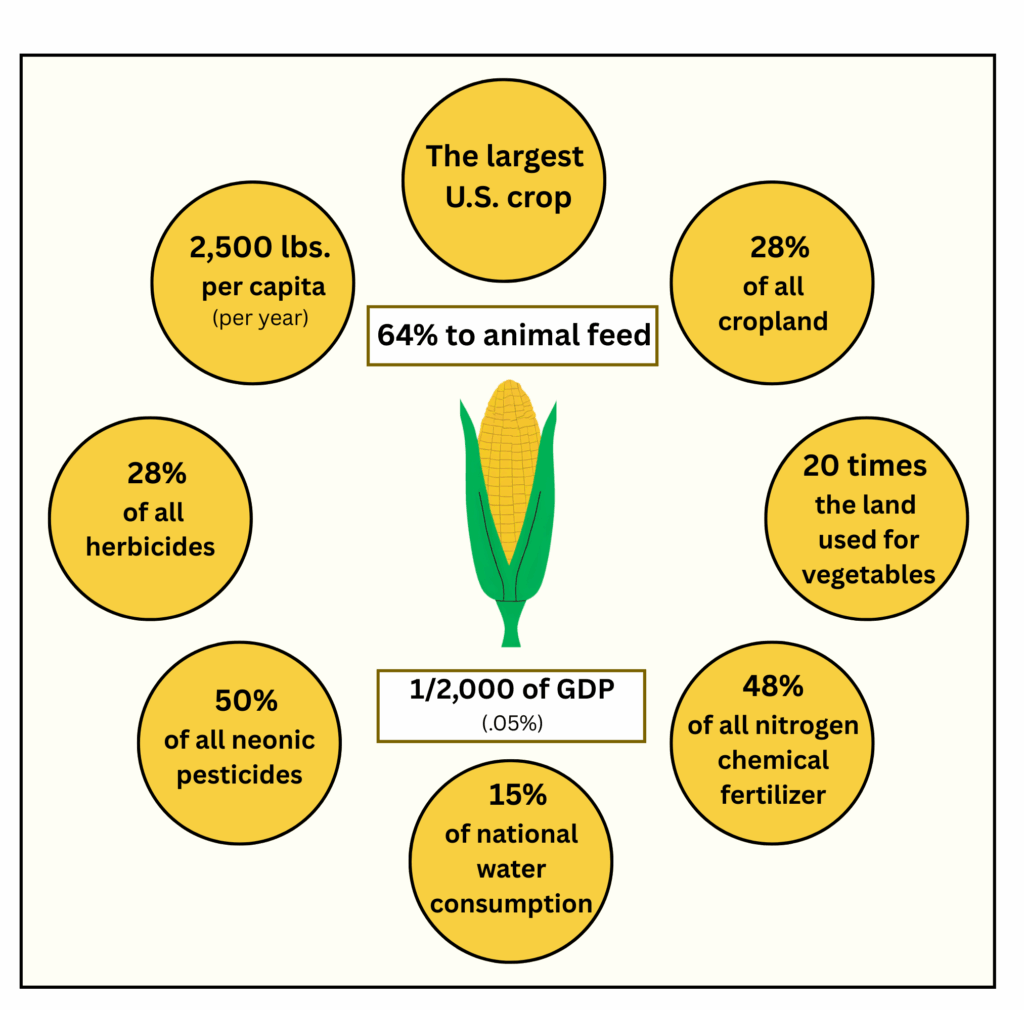
Almost two-thirds of U.S. corn production is used for animal feed, though you won’t learn that from the USDA. They regularly report that animal feed “accounts for about 40 percent of total domestic corn use.” This stat often gets picked up as the share of all corn going to animal feed when, in fact, it refers only to the portion of harvested corn grain fed to animals in the U.S.
The USDA tally doesn’t include: 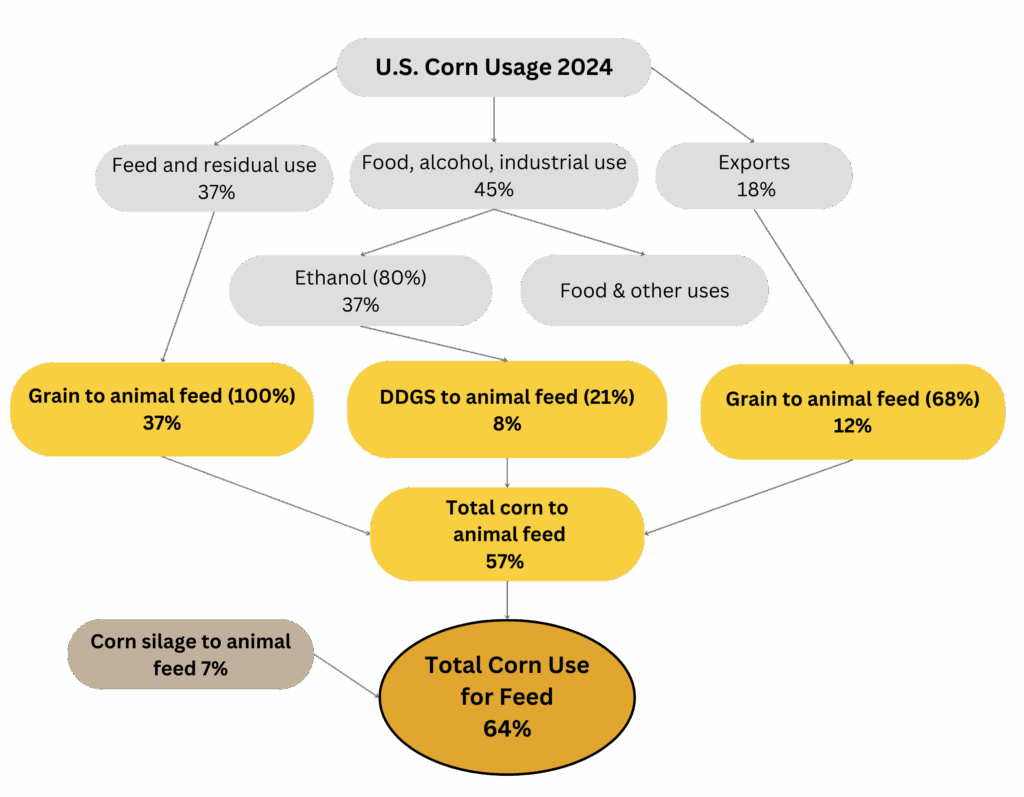
 Corn silage – whole plants, cobs and all, fed to farmed animals from millions of acres. DDGS – the key co-product of ethanol, making up about 20% of its total value. Exported corn – more than two-thirds is used for animal feed.
Counting these uses, the share of corn going to farmed animals is about 64%.
A true accounting of corn’s environmental costs would likely be a sum at least ten times larger than farmers’ profits, when including the impacts on water and air pollution, biodiversity loss, climate emissions, land and soil degradation, pesticide contamination, and water scarcity. Selling for about 7 or 8 cents a pound, corn is one of the world’s cheapest foods, grown on some of the most fertile land on earth.
Nutrient pollution is the primary cause of pollution in U.S. waterways and is a source of air pollution, GHG emissions, and biodiversity loss. Corn uses nearly half of all chemical fertilizers – the central source (along with factory farm manure) of nutrient pollution.
Pesticide use is a key driver of biodiversity loss. We are losing pollinators, insects, birds, and aquatic species at unprecedented rates. Many pesticides are a human health threat. Corn uses almost 30% of all herbicides and 80% of all atrazine (banned in Europe for more than 20 years). Corn uses about 50% of the nation’s neonicotinoids, the most widely used and most damaging insecticide.
Groundwater and aquifer depletion is threatening agriculture, public water supplies, and aquatic species which now face the highest risks of extinction. Corn accounts for about 15% of national water consumption, mostly sourced from groundwater.
Corn uses about 20 times more land than all vegetable production. Per capita volume is a remarkable 2,500 pounds per year. Corn receives the largest share of agricultural subsidies, averaging about $3.5 billion in crop insurance subsidies alone, over the last 3 years. The share of U.S. GDP is one-twentieth of one percent.
Corn production uses a huge portion of the nation’s most valuable resources and generates a remarkably wide range of negative externalities. It’s important to put the entire picture together and recognize that the main purpose of growing all this product is to support the factory farming system.