
The pivotal chemical element in animal ag air pollution is nitrogen (N). Nitrogen emissions are at the center of many of the most damaging environmental impacts of animal ag and the most critical issues of global health.[1]
Excess nitrogen leads to nutrient pollution, commonly associated with water pollution, while also causing air pollution and associated health risks for humans and other animals.[2]
Large quantities of excess nitrogen turn into ammonia (NH3) – the primary air pollutant from animal agriculture.[3-5]
Erisman, J. W., et al., (2013). Consequences of human modification of the global nitrogen cycle. Philosophical Transactions of the Royal Society B: Biological Sciences, 368(1621), 20130116, Abstract. [“Many thresholds for human and ecosystem health have been exceeded owing to Nr (reactive nitrogen) pollution, including those for drinking water (nitrates), air quality (smog, particulate matter, ground-level ozone), freshwater eutrophication, biodiversity loss, stratospheric ozone depletion, climate change and coastal ecosystems (dead zones).”]
For an overview of nutrient pollution, see, Nutrient Pollution of Waterways [Nutrient pollution = an excess of nitrogen and phosphorus in air, water, soil, and land.]
Liu, L., et al., (2022). Exploring global changes in agricultural ammonia emissions and their contribution to nitrogen deposition since 1980. PNAS, 119(14), e2121998119, p. 1. [“Nr compounds (reactive nitrogen) in the atmosphere are mainly controlled by the emissions of nitrogen oxides (NOx) and ammonia (NH3); NOx is mainly from the burning of fossil fuels for energy production and NH3 is mostly from agricultural sources including volatilized livestock waste and nitrogen (N)-based fertilizers.”]
U.S. EPA (2024). 2020 NEI Supporting Data and Summaries – Data Queries for Sector Summaries. [Total nitrous oxide from all agriculture at ~1.1 million tons versus ~5.5 million tons ammonia (mostly from animal ag)]
Rotz, C. A., et al., (2014). Ammonia emission model for whole farm evaluation of dairy production systems. Journal of environmental quality, 43(4), 1143-1158, p. 1143. [“Emissions (from animal agriculture) include greenhouse gases, volatile organic compounds, and specific toxic compounds, of which ammonia (NH3) is the most important.”]
Of the 9 identified “planetary boundaries,” the nitrogen flow boundary (i.e., nitrogen released into the environment) is most clearly in the “high-risk” zone, potentially threatening “the resilience of the earth system.”[1-3]
While the impacts of escaped nitrogen do not receive close to the share of attention given to climate change, some researchers are asking, “Is nitrogen the next carbon?”[4] Others are pleading for a full reckoning of the damages, noting that “Many are aware of nitrogen as one of the most transgressed ‘planetary boundaries’. What is less widely understood is that nitrogen also affects the exceedance of all of the other planetary boundaries.”[5]
Globally, nitrogen-related emissions (into air and water) from livestock production “represents about one-third of global human-induced N emissions.”[6]
The impacts of nitrogen air and water pollution on the U.S. population and environment are wide-ranging.[7,8]
Steffen, W., et al., (2015). Planetary boundaries: Guiding human development on a changing planet. Science, 347(6223), 1259855.
Richardson, K., et al., (2023). Earth beyond six of nine planetary boundaries. Science advances, 9(37), eadh2458, Figure 1. [Six boundaries identified as “transgressed.” Proposed annual boundary of 62 Tg N is overshot by ~3 times.]
Kitzmann, N., et al., (2025). Planetary Health Check 2025: A scientific assessment of the state of the planet. Potsdam Institute for Climate Impact Research (PIK), Potsdam, Germany. Figure ES-1 p. 11. [“…intentional nitrogen fixation is at about 165 Tg N/year (over two times the Planetary Boundary and beyond the high-risk threshold).”]
Battye, W., et al., (2017). Is nitrogen the next carbon? Earth’s future, 5(9), 894-904.
Sutton, M. A., et al., (2021). The nitrogen decade: mobilizing global action on nitrogen to 2030 and beyond. One Earth, 4(1), 10-14, p. 10. [“By massively increasing the supply of nitrogen compounds, humans are worsening air and water quality, contributing to climate change and stratospheric ozone depletion, and thereby threatening health, biodiversity, and livelihoods.”]
Uwizeye, A., et al., (2020). Nitrogen emissions along global livestock supply chains. Nature Food, 1(7), 437-446, p. 438.
Sobota, D. J., et al. (2015). Cost of reactive nitrogen release from human activities to the environment in the United States. Environmental Research Letters, 10(2), 025006, Table A1.
U.S. EPA (2011) Reactive Nitrogen in the United States: An Analysis of Inputs, Flows, Consequences, and Management Options, A Report of the EPA Science Advisory Board, Table ES-1.
Reactive nitrogen (Nr) includes any nitrogen compound on earth that is not N2, the nitrogen that makes up ~78% of the air.[1] Nitrogen in the air (N2) is considered inert; nitrogen in any other form is highly reactive and combines with other elements and gases to create a variety of compounds.
Once the Haber-Bosch process was invented, nitrogen could be taken out of the air and used for other purposes, mostly for chemical fertilizer. The nitrogen in chemical fertilizer is the main reason that crop yields have increased many times over since pre-industrial days and human populations have soared.[2] Reactive nitrogen is also created by nitrogen-fixing crops, primarily soybeans and alfalfa/hay.[3]
Once reactive nitrogen is created, it is hard to put back in the box.[4] Although some reactive nitrogen is temporarily incorporated into plant or animal biomass, it can often escape again on destructive paths.[5]
Davidson, E. A., et al., (2011). Excess nitrogen in the US environment: trends, risks, and solutions. Issues in ecology, (15). Glossary, p. 14. [“Reactive nitrogen. All forms of N other than N2.”]
U.S. EPA (2011) Reactive Nitrogen in the United States: An Analysis of Inputs, Flows, Consequences, and Management Options, A Report of the EPA Science Advisory Board, p. ES-1. [“Without the creation of N fertilizer by an industrial process (the Haber-Bosch process) and the increased cultivation of leguminous crops, the world could not support the current human population or its projected increase.”]
Davidson, E. A., et al., (2011), p.3. [“Soybean production has been increasing, which increases biological nitrogen fixation in croplands.”]
Liu, L., et al., (2022). Exploring global changes in agricultural ammonia emissions and their contribution to nitrogen deposition since 1980. PNAS, 119(14), e2121998119, p. 1. [“Our analyses of Nr have shifted from how to increase food production to a realization that agricultural intensification adds excess Nr that damages environmental systems and degrades human health.”]
Houlton, B. Z., et al., (2013). Intentional versus unintentional nitrogen use in the United States: trends, efficiency and implications. Biogeochemistry, 114, 11-23, p. 20. [“Eventually all of the N2 fixed (intentionally or unintentionally) will affect the environment, and so even Nr incorporated into products has long-term effects.”]
A single newly created reactive nitrogen atom released into the environment can go through many transformations over time, causing damage over and over in different ecosystems, moving from air to water to soil and back to air or water again. This is called the nitrogen cascade.[1,2]
As the EPA notes, “most N used in food production, and all of the new Nr produced by fossil fuel combustion, is lost to the environment where it circulates through the earth’s atmosphere, hydrosphere, geosphere, and biosphere. During this circulation, Nr contributes to a wide variety of consequences, which are magnified with time as Nr moves through the environment.”[3]
Galloway, J. N., et al., (2003). The nitrogen cascade. Bioscience, 53(4), 341-356. [“The same atom of Nr can cause multiple effects in the atmosphere, in terrestrial ecosystems, in freshwater and marine systems, and on human health. We call this sequence of effects the nitrogen cascade.” Abstract]
U.S. EPA (2011) Reactive Nitrogen in the United States: An Analysis of Inputs, Flows, Consequences, and Management Options, A Report of the EPA Science Advisory Board, p. 4. [“Unlike other element-based pollution problems, the N cascade links the negative impacts, where one N-containing molecule can in sequence contribute to all the environmental issues mentioned above.”]
U.S. EPA (2011) Reactive Nitrogen in the United States, p. ES-1.
The Haber Bosch process is the industrial method for producing ammonia (NH3), mostly used to produce chemical fertilizers. Using large amounts of fossil fuel energy, nitrogen gas (N2) is combined with hydrogen gas (H2), which makes the nitrogen usable for plant growth. Some of the nitrogen in fertilizers and manure is emitted as atmospheric ammonia.
In volume, importance, and damage, ammonia (NH3) is the central air pollutant of animal ag.[1-5] It is a colorless gas with a strong odor.
Animal agriculture is the largest source of ammonia, with vast amounts released from factory farm manure and feed crop production.[6,7]
U.S. EPA (2024) 2020 NEI Supporting Data and Summaries – Data Queries for Sector Summaries. [Total nitrous oxide from all agriculture at ~1.1 million tons versus ~5.5 million tons ammonia (mostly from animal ag)]
Rotz, C. A., et al., (2014). Ammonia emission model for whole farm evaluation of dairy production systems. Journal of environmental quality, 43(4), 1143-1158, p. 1143. [“Emissions (from animal agriculture) include greenhouse gases, volatile organic compounds, and specific toxic compounds, of which ammonia (NH3) is the most important.”]
Giannadaki, D., et al., (2018). Estimating health and economic benefits of reductions in air pollution from agriculture. The Science of the Total Environment, 622–623, 1304–1316, p. 1305. [“The main pollutant from agricultural activity is ammonia (NH3)…”]
Ni, J. Q., et al., (2020). Nine Decades of Scientific Research on Air Pollution Related to Food Animal Health and Welfare. In 2020 ASABE Annual International Virtual Meeting (American Society of Agricultural and Biological Engineers), p. 1. [“…based on 167 journal research publications… Ammonia (NH3) was the primary pollutant reported in about 70% of the studies…”]
Hill, J., et al., (2019). Air-quality-related health damages of maize. Nature Sustainability, 2(5), 397-403. [Report estimates the PM2.5 pollution costs of corn production (the primary animal feed) at about 8 times the GHG damages of corn production. This is essentially a comparison of the health impacts of agricultural nitrous oxide on climate change versus the impacts of agricultural ammonia on PM2.5.]
Giannadaki, D., et al., (2018), p. 1305. [The sources are “mainly from animal husbandry and its associated manure processing, and to a lesser extent from fertilizer use.”]
U.S. EPA (2024) 2020 NEI Supporting Data and Summaries – Data Queries for Sector Summaries. [Query: National/Ammonia NH3/Livestock Waste (49.2%), fertilizer application (33.5%) of total (5,482,484 tons)]
Broadly estimated, ~15-20% of the total nitrogen leaked to the environment is ammonia.[1-4] This makes ammonia a major conduit of nutrient pollution.[5]
Ammonia is generally considered the most damaging air pollutant from agriculture (followed by nitrous oxide, a significant factor in climate change).[6-8]
Houlton, B. Z., et al., (2013). Intentional versus unintentional nitrogen use in the United States: trends, efficiency and implications. Biogeochemistry, 114, 11-23, Figure 3, p. 18. [Estimate is 13% of total N is lost to the environment via NH3. Of anthropogenic N creation this would be about 16%.]
Sobota, D. J., et al., (2015). Cost of reactive nitrogen release from human activities to the environment in the United States. Environmental Research Letters, 10(2), 025006, pp. 6-7. [At the national scale, anthropogenic N leakages per year = 4.8 surface freshwater, 4.2 groundwater, 3.0 ammonia, 1.9 coastal zones, 1.4 fossil fuel combustion (p. 6). Calculation: 3.0 Tg N / 15.3 = 19.6%. Ammonia emissions have grown to ~5.5 million tons (~5 Tg N) per the EPA, so the 15-20% figure could be an underestimate.]
Liu, L., et al., (2022). Exploring global changes in agricultural ammonia emissions and their contribution to nitrogen deposition since 1980. PNAS, 119(14), e2121998119. [Notes that 17% of N in fertilizer applications (the largest N input) is lost to NH3 in the U.S. Does not appear to give total NH3 lost from manure, except as kilograms per head (Supporting information Table S-3.)]
Note: National figures on total escaped N are not regularly calculated. According to USDA researchers, “there are no national estimates of total reactive N loss…” [See: Rotz, A., et al., (2021). Environmental assessment of United States dairy farms. Journal of Cleaner Production, 315, 128153, Abstract.]
For an overview of nutrient pollution, see, Nutrient Pollution of Waterways [Nutrient pollution = an excess of nitrogen and phosphorus in air, water, soil, and land.]
Rotz, C. A., et al., (2014). Ammonia emission model for whole farm evaluation of dairy production systems. Journal of environmental quality, 43(4), 1143-1158, p. 1143. [“Gaseous emissions from animal agriculture have become an important issue in the United States and in many other countries. Emissions include greenhouse gases, volatile organic compounds, and specific toxic compounds, of which ammonia (NH3) is the most important.”]
Hill, J., et al., (2019). Air-quality-related health damages of maize. Nature Sustainability, 2(5), 397-403. [Calculates that the economic damages of ammonia emissions from corn production far exceed those of nitrous oxide (Figure 6)]
U.S. EPA (2024) 2020 NEI Supporting Data and Summaries – Data Queries for Sector Summaries. [Total nitrous oxide from all agriculture at ~1.1 million tons versus ~5.5 million tons ammonia (mostly from animal ag)]
About 70% of anthropogenic ammonia emissions (NH3) comes from animal ag.[1] The sources are primarily manure on factory farms (both livestock and poultry) and secondarily fertilizer application on crops that go to animal feed.[2]
See calculations in Agriculture / Animal Agriculture Share of Anthropogenic Ammonia Emissions 2020. https://docs.google.com/spreadsheets/d/1naMuMuWYGUU9cvN8FoXni9TkfM65s85DGajbWqSP7xw/edit?gid=0#gid=0
Giannadaki, D., et al., (2018). Estimating health and economic benefits of reductions in air pollution from agriculture. The Science of the Total Environment, 622–623, 1304–1316, p. 1305. [“The main pollutant from agricultural activity is ammonia (NH3), mainly from animal husbandry and its associated manure processing, and to a lesser extent from fertilizer use.”]
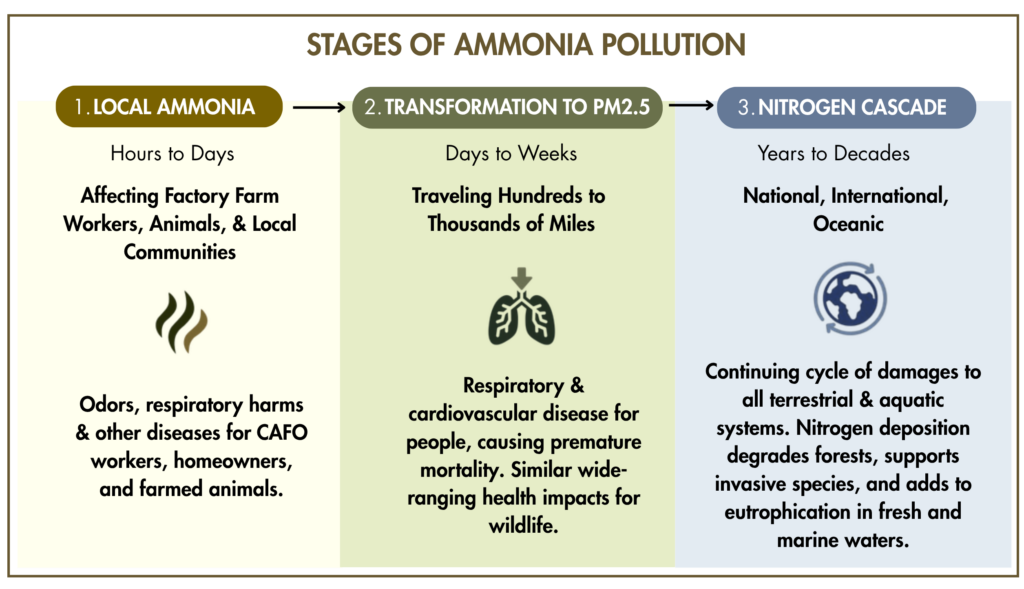
Ammonia has negative impacts at local, regional, and global levels. Significant human health losses have been widely documented, especially due to ammonia’s conversion to PM2.5.
Ammonia is a form of nutrient pollution, thereby affecting all terrestrial and aquatic ecosystems. Societal attention to most forms of nutrient pollution has been limited, despite the major risks to planetary health.[1]
For information and references for all these points, see, Air Pollution & Animal Ag Overview