
1. As of 2024 there were ~400 manure biogas digesters on commercial livestock operations in the country.
2. About 84% of digesters are on dairy farms, with ~140 dairy digesters in California.
3. About 21% of completed digesters have been shut down.
4. Manure digesters reduce some portion of the methane in manure management systems on factory farms; the total methane from manure management equals about 1.3% of U.S. total GHG emissions (CO2eq).
5. The total annual reduction due to biogas digesters equals about 0.2% of all U.S. GHG emissions.
6. Pasture-raised farmed animals generate little or no methane from manure.
Manure biogas refers to the mixture of gases that are produced after manure’s organic materials are broken down in a process called anaerobic digestion.[1] Most factory farms mix manure with large volumes of water and store the liquid or slurry in sealed containments (such as covered manure lagoons) which produces the methane required for biogas production.[2]
Manure biogas contains about two-thirds methane along with CO2, and small amounts of hydrogen sulfide, water vapor, and other gases.[3,4] Biogas can be used directly to produce electricity or heat, or the biogas can be upgraded by removing hydrogen sulfide, CO2, and moisture to produce renewable natural gas (RNG).[5]
David, P., et al., (2020). Anaerobic Digester/Biogas system operator guidebook. U.S. EPA Flagstar, Washington, DC, USA, p. 2-1. [“The anaerobic digestion process occurs when microorganisms break down organic matter—such as animal manure and food wastes—in the absence of oxygen. Anaerobic digestion for biogas production takes place in a sealed vessel called a reactor, which is designed and constructed in various shapes and sizes specific to the site and feedstock conditions. These reactors contain complex microbial communities that break down (or digest) the waste and produce resultant biogas and digestate (the solid and liquid material end-products of the AD process) which is discharged from the digester.”]
U.S. EPA (June 2018). Market Opportunities for Biogas Recovery Systems at U.S. Livestock Facilities, EPA-430-R-18-006, p. 5. [“Because the vast majority of large dairy and swine operations in the United States use liquid or slurry manure management systems, biogas production potential at these operations is high…”]
David, P., et al., (2020), p. 2-2. [“Biogas is composed of CH4, which is the primary component of natural gas, at a relatively high percentage (50 to 75 percent), carbon dioxide (CO2), hydrogen sulfide (H2S), water vapor, and trace amounts of other gases.”]
U.S. EPA (June 2018). Market Opportunities for Biogas Recovery Systems at U.S. Livestock Facilities, p. 5. [“Biogas typically contains 60 to 70 percent methane, the primary constituent of natural gas.”]
David, P., et al., (2020), p. 2-2. [“ The energy in biogas can be used like natural gas to provide heat, generate electricity, and power cooling systems, among other uses. Biogas can also be purified by removing the inert or low-value constituents (CO2, water, H2S, etc.) to generate RNG. This can be sold and injected into the natural gas distribution system, compressed and used as vehicle fuel, or processed further to generate alternative transportation fuel, energy products, or other advanced biochemicals and bioproducts.”]
Sure. The term biogas has a long history of use, associated with organic materials of many kinds.[1] Manure is one of many types of organic materials that can be used to generate biogas.[2]
Because the term biogas carries an aura of sustainability, it is ideal for greenwashing tasks. Objections to those uses are quite reasonable.[3] Still, manure biogas is an accurate term for describing the gas being generated from vast amounts of manure on factory farms.
Knol, W., et al., (1978). Biogas production by anaerobic digestion of fruit and vegetable waste. A preliminary study. Journal of the Science of Food and Agriculture, 29(9), 822-830.
U.S. Dept. of Energy (2023). Renewable Gas Production, Alternative Fuels Data Center. https://afdc.energy.gov/fuels/natural-gas-renewable [Includes landfills, wastewater treatment plants, food manufacturing and other sources]
Food & Water Watch (2024). The Big Oil and Big Ag Ponzi Scheme: Factory Farm Gas, p. 1. [“’Biogas’ greenwashes dirty factory farms and their fossil fuel partners.”]
An anaerobic digester is a sealed containment in which microorganisms break down organic matter – manure and sometimes food waste – in the absence of oxygen.[1] This produces biogas, which is a mixture of methane, carbon dioxide, and trace gases that can be used like natural gas.[2]
Although the term sounds technologically advanced, the most common type of anaerobic digesters on factory farms (~40%) are so-called manure lagoon digesters.[3,4] These are multi-acre, man-made ponds or lakes, filled with immense amounts of water and manure, underlaid and covered with plastic sheets.[5-8] The second most common type (~30%) are plug-flow digesters. These are large buried tanks, commonly made of concrete and covered with plastic, which drain into uncovered lagoons.[9]
After digestion, a residual slurry called digestate remains and is typically stored in open lagoons. It is eventually applied as a fertilizer in liquid or solid form.[10] Biogas can be used as a substitute for natural gas on-site or sent offsite via pipelines or trucks or further refined into renewable natural gas (RNG).[11]
David, P., et al., (2020). Anaerobic Digester/Biogas system operator guidebook. U.S. EPA Flagstar, Washington, DC, USA, p. 2-1. [“The anaerobic digestion process occurs when microorganisms break down organic matter—such as animal manure and food wastes—in the absence of oxygen. Anaerobic digestion for biogas production takes place in a sealed vessel called a reactor, which is designed and constructed in various shapes and sizes specific to the site and feedstock conditions.”]
David, P., et al., (2020), p. 2-2. [“Biogas is composed of CH4, which is the primary component of natural gas, at a relatively high percentage (50 to 75 percent), carbon dioxide (CO2), hydrogen sulfide (H2S), water vapor, and trace amounts of other gases. The energy in biogas can be used like natural gas to provide heat, generate electricity, and power cooling systems, among other uses.”]
Wainer, A., et al., (2025). Deconstructing the Livestock Manure Digester and Biogas Controversy. Current Environmental Health Reports, 12:43, Supplementary Material, p. 9. [“The three main types of manure digesters used in the US are covered lagoons (41% of total), plug flow (28%), and complete mix digesters (24%), and the remaining 5% use other technologies.”]
U.S. EPA (November 13, 2025). AgSTAR Data and Trends. [As of June 2024, covered lagoons = 43.5%, plug flow = 26.8%, complete mix = 26.3%, and other = 3.6%.]
David, P., et al., (2020), p. 2-1. [“Covered anaerobic lagoons use woven geotextile fabrics to line or cover, and therefore capture, the biogas produced from manures having less than 5 percent total solids. Generally, large lagoon volumes are required, preferably with depths greater than 12 feet.”]
Washington State Dept. of Ecology (April 2023). Lagoon and Liner Design Guidelines – Water Quality Program, Publication 98-37, Section T7-5.2 Material Types. [Lagoon liners are typically made from high density polyethylene (HDPE) or other types of plastics.]
AgSTAR (February 2014). Cottonwood Dairy, Atwater, CA. [The operation keeps 5,000 cows and has a 40-million-gallon anaerobic lagoon with a 7.5 acre cover – which equals ~325,000 square feet of plastic.]
Karen Lee (July 29, 2020). Put a lid on it: Cover options for manure storage. Progressive Dairy. [“’Adding a cover converts the full pond to an anaerobic digester,’ says Hartman, who has worked on covering 54 units in the last 13 years, most of which are lined earthen lagoons covered with a high-density polyethylene (HDPE) material for biogas production.”]
Wainer, A., et al., (2025), Supplementary Material p. 9. [Plug flow = 28%. “Plug flow digesters are buried concrete, fiberglass, or metal tanks that are generally five times longer than wide and capped with an impermeable cover similar to a pond liner. A plug of manure is added which displaces the manure already in the system, and the effluent is drained into an uncovered lagoon.”]
Badzmierowski, M., et al., (2025). Analysis of US manure management and recommendations to mitigate associated greenhouse gas emissions. Working Paper. World Resources Institute, Washington, DC, p. 11. [Digesters “typically remove less than 30 percent of the biodegradable organic matter in dairy manure. This leaves most of the methane-producing material in manure to remain in digestate, which is typically stored in open lagoons, and sometimes mixed back with untreated manure.”]
Wainer, A., et al., (2025), p. 2. [“Biogas can be used as a substitute for natural gas and burned on-site to produce heat or electricity, or conveyed offsite via pipelines or trucks for conditioning. Purified biogas can be injected into pipelines for use at large scale electrical plants or used as vehicle fuel, and is defined as a renewable natural gas by the state of California.”]
A very broad estimate of a 50% reduction of methane from manure management systems is likely higher than actual mitigation.[1-5]
Studies note that the shares can widely vary depending on the size, type, and location of digesters, along with unknowns about the maintenance and functioning of systems when they are not monitored.[6]
Miranda, N. D., et al., (2015). Meta-analysis of greenhouse gas emissions from anaerobic digestion processes in dairy farms. Environmental science & technology, 49(8), 5211-5219, Abstract. [“The median reductions in emissions from the baseline scenarios, according to operation units, are -43.2% for storage, -6.3% for field application of slurries, -11.0% for offset of energy from fossil fuel, and +0.4% for offset of inorganic fertilizers. The leaks from digesters are found to significantly increase the emissions from baseline scenarios (median = +1.4%).”]
Aguirre-Villegas, H. A., et al., (2014). From waste-to-worth: energy, emissions, and nutrient implications of manure processing pathways. Biofuels, Bioprd. Bioref. 8:770-793, Abstract. [“Net global warming potential is reduced in all pathways compared to base case by 19% for solid-liquid separation, 48% for anaerobic digestion, and 47% for solid-liquid separation with anaerobic digestion.”]
Badzmierowski, M., et al., (2025). Analysis of US manure management and recommendations to mitigate associated greenhouse gas emissions. Working Paper. World Resources Institute, Washington, DC, p. 13. [“Overall, reductions of methane of 25 percent or less appear to be the likely US effect for “manure only” digesters, when the baseline is a lagoon, with potential additional reductions of around 17 percent from energy offsets.”]
Holly, M. A., et al., (2017). Greenhouse gas and ammonia emissions from digested and separated dairy manure during storage and after land application. Agriculture, Ecosystems and Environment 239, 410-419, p. 416. [“Based on the results from this study, anaerobic digestion and immediate incorporation of manure following application results in a 25% reduction in CH4… Incorporating anaerobic digestion and solid-liquid separation further increased the reduction in CH4 emissions to 40%.”]
Wainer, A., et al., (2025). Deconstructing the Livestock Manure Digester and Biogas Controversy, Current Environmental Health Reports, 12:43, p. 7. [This report analyzes Miranda’s figures, along with the potential for flaring of unused biogas, and the potential increase in nitrous oxide, an even more potent gas from manure management. The report does not make an estimate of total mitigation, identifies the many uncertainties, and perhaps broadly supports an estimate of about half mitigated.]
Lazenby, R. (2024). Mitigating Emissions from California’s Dairies. UCLA Emmett Institute on Climate Change and the Environment, p. 15. [“However, biogas control systems may not always work as intended. One environmental scientist our team spoke with cited “substantial” concern about fugitive emissions from digester systems. Fugitive emissions are essentially leaks where the captured methane can escape and be vented to the atmosphere.”]
The EPA claims that in 2023, 13.8MMT (million metric tons) of CO2eq were offset by manure biogas anerobic digesters.[1] That would be: About 5% of the total methane created by U.S. animal ag (252.2MMT) About 3% of the total GHG emissions from U.S. animal ag. (~480MMT)
A total reduction of 13.8MMT equals about one-fifth of one percent of total U.S. GHG emissions.
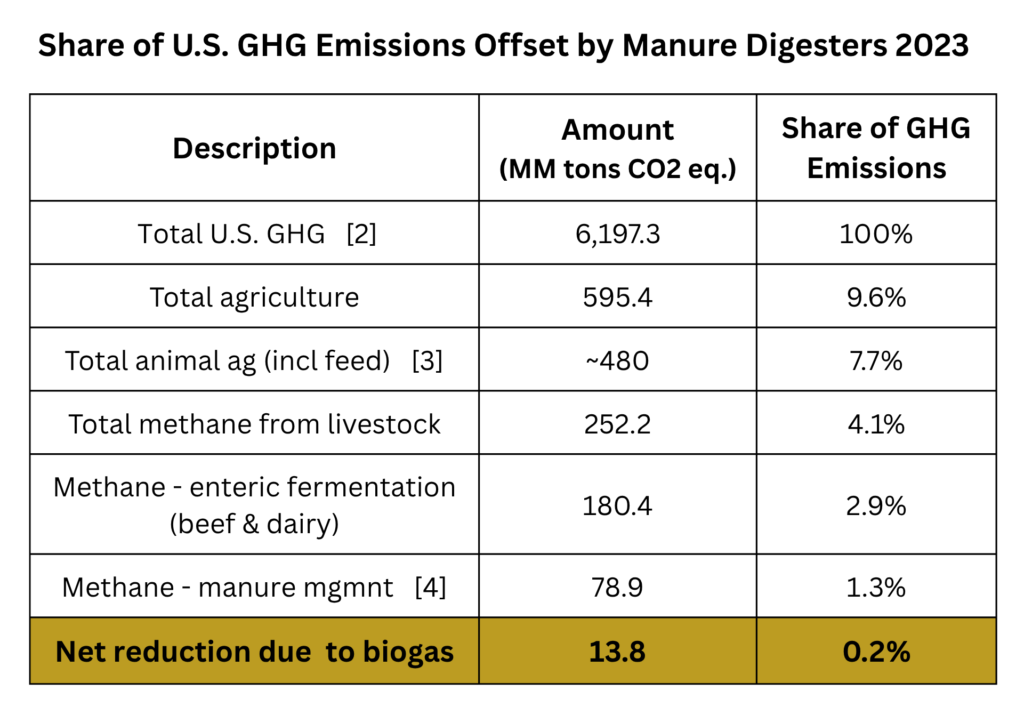
U.S. EPA (updated March 10, 2026). AgSTAR Data and Trends. [“In calendar year 2023, manure-based anaerobic digesters reduced GHG emissions by 14.8 million metric tons of CO2 equivalent (MMTCO2e). 13.8 MMTCO2e direct methane reductions. 0.98 MMTCO2e emissions avoided.”]
U.S. EPA (2025). Inventory of U.S. Greenhouse Gas Emissions and Sinks: 1990-2023, EPA 430-R-25-003. [All figures from Table ES-3 and Section 5 Agriculture, except for our estimate of total animal ag, which includes feed crops, per footnote 3.]
Based on the inclusion of GHG emission from feed crops, see, Animal Ag GHG Emissions
Note: Figure includes the current mitigation amount of 13.8 MMT CO2eq added to methane from manure management of 65.1MMT.
As of June 2024, 400 anaerobic digesters were operating at commercial livestock operations in the U.S.[1] There were 73 additional systems under construction.[2]
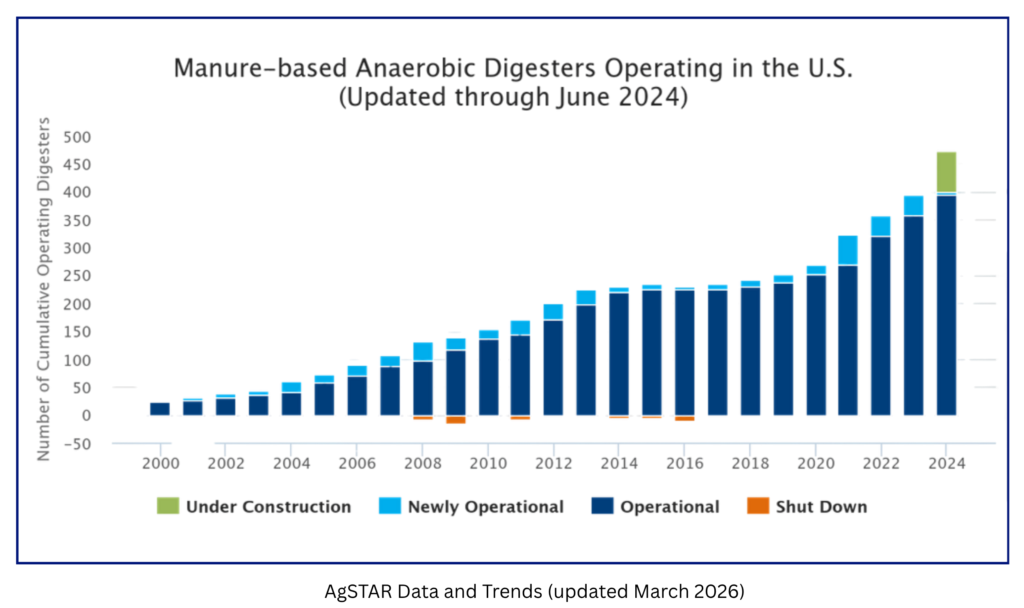
Of the completed operations, 191 are producing renewable natural gas (RNG), with 69 RNG projects under construction.[3]
The EPA estimates that “8,100 U.S. dairy and swine operations could support biogas recovery systems.”[4]
U.S. EPA Livestock Anaerobic Digester Database (updated July 24, 2025). [EPA spreadsheet “based on data available through June 2024.” These figures are based on our assessment of the AgSTAR data.]
Wainer, A., et al., (2025). Deconstructing the Livestock Manure Digester and Biogas Controversy. Current Environmental Health Reports 12:43, Supplemental Material, p. 3. [This report gives a thorough analysis of construction data based on the AgSTAR spreadsheet, giving construction time frames, digesters by animal type, by technology, and by state.]
U.S. EPA (updated February 24, 2026). Renewable Natural Gas from Agricultural-Based AD/Biogas Systems. [“As of June 2024, there are 191 manure-based AD systems producing RNG (includes pipeline injection and compressed natural gas (CNG) projects) in the United States with 69 RNG projects under construction.”]
U.S. EPA (2018). Market Opportunities for Biogas Recovery Systems at U.S. Livestock Facilities. EPA-430-R-18-006, p. 7. [“…biogas recovery systems are potentially profitable for more than 8,100 dairy and swine facilities in the United States.” Table 1 estimates ~5,400 pig farms and ~2,700 dairy farms.]
About 21% of digesters built to date have been shut down.[1,2]
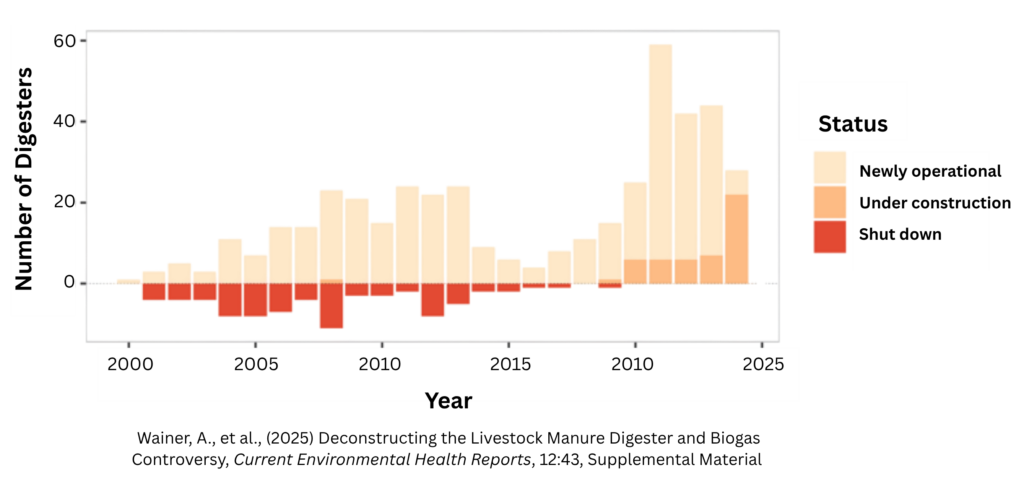
Wainer, A., et al., (2025). Deconstructing the Livestock Manure Digester and Biogas Controversy. Current Environmental Health Reports 12:43, Supplementary Material, Table S1. [“Considering historical performance of digester investments, since 2000, over one in five digesters have shuttered. Approximately half of digesters built before 2005 have been shut down, while the great majority of investments after 2008 remain in operation. Of digesters built to date, 98 (21%) have shut down.”]
Note that the EPA chart in the previous question is misleading, essentially minimizing the closures by showing each year the cumulative total of digesters in operation while showing only the closures in that specific year (rather than also showing the cumulative shut down). The Wainer report above gives a clearer understanding.
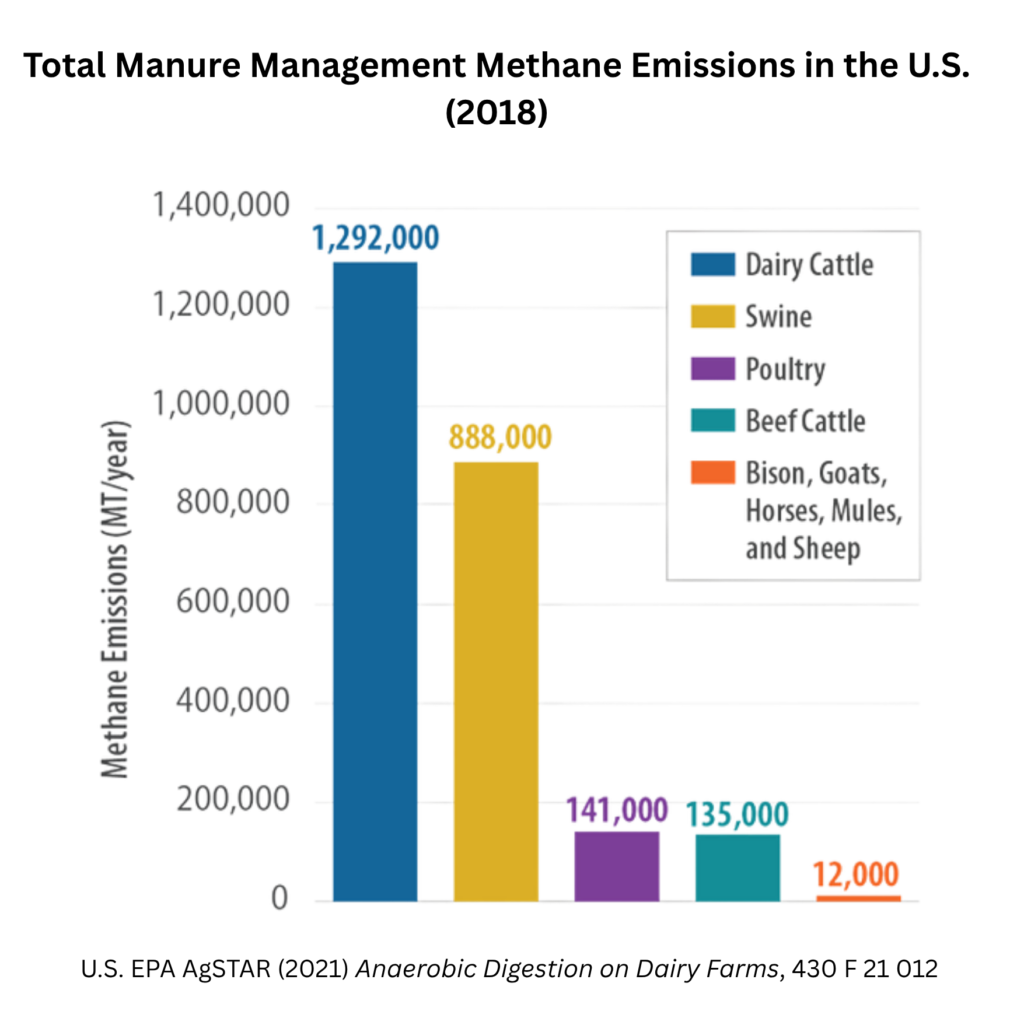
As of 2024, ~84% of operating digesters were at dairy factory farms. About 11% were at pig factory farms.[1,2]
Dairy factory farms create the most methane from their manure management systems.[3]
Pig farms face more barriers to digester construction, due to manure management practices that are less easily adaptable (such as deep-pit), the economic status of contract farmers within a vertically integrated industry, and lower electric prices in states where pig farming is common.[4]
U.S. EPA Livestock Anaerobic Digester Database (updated on July 24, 2025). [The EPA notes that the figures are based on data available through June 2024. Of the 473 digesters either operational or listed as under construction, 398 were at dairy farms and 52 were at pig factory farms. The rest were at poultry or cattle factory farms or combined the manure from different animal types.]
Wainer, A., et al., (2025). Deconstructing the Livestock Manure Digester and Biogas Controversy. Current Environmental Health Reports 12:43, Supplemental Material, p. 3. [This report gives a thorough analysis of construction data based on the AgSTAR spreadsheet, giving construction time frames and digesters by animal type, by technology, and by state.]
Chart from: U.S. EPA AgSTAR (2021). Anaerobic Digestion on Dairy Farms, EPA 430 F 21 012, p. 1.
U.S. EPA AgSTAR (2021). Anaerobic Digestion on Swine Farms, p. 2.
With most digesters at dairy factory farms, it follows that the 2 states with the highest dairy production have the most digesters: California and Wisconsin. There are also many dairy digesters in Pennsylvania and New York [1,2]
California has by far the largest number with 143 units. Programs from the California Department of Food and Agriculture (CDFA) offer the largest subsidies and other incentives.[3]
U.S. EPA Livestock Anaerobic Digester Database (updated July 24, 2025).
USDA (2024). Census of Agriculture 2022, Table 11. [1.69 million milk cows in California in 2022. Wisconsin with 1.26M]
California Department of Food and Agriculture (CDFA) (2025). Dairy Digester Research and Development Program – Report on Funded Projects 2015-2025.
The average costs of dairy digesters can be in the range of ~$2 million to ~$12 million, based on the digesters supported by the California Department of Food and Agriculture (CDFA). The average individual cost of those 143 digesters was ~$5.3 million.[1,2]
We are not aware of data on total building costs for projects supported by federal agencies. According to an analysis of recent USDA data, the average loan guarantee from the Rural Energy for America Program (REAP) for a manure digester was just under $20 million.[3]
California Department of Food and Agriculture (CDFA) (2025). Dairy Digester Research and Development Program – Report on Funded Projects 2015-2025, Table 5, p. 20. [Total cost = $760,437,869 / 143 projects = ~$5.3M]
Aaron Smith (October 14, 2024). How Much Should Dairy Farms Get Paid for Trapping Methane? Energy Institute Blog. [“According to data provided to CARB, it cost $8.6m to construct a typical digester in 2023 on a dairy with 2,500 milking cows.”]
Friends of the Earth et al., (2026). Petition to the USDA, p. 4. https://foe.org/wp-content/uploads/2026/01/2026-01-14-REAP-Digester-Petition_FINAL.pdf [citing to USDA Rural Investments Data Tables. For 2021 through 2025, “For new manure digesters, the average grant was $855,701, and the average loan guarantee was $19,847,098.44.”]
Biodigester covers and liners are typically high-end plastics made from fossil fuels.[1,2]
These plastic covers and liners are multi-acre, impermeable materials that both underlay and cover the various types of lagoons and pits. The covers often weigh tens of thousands of pounds and cost hundreds of thousands of dollars.[3-5]
These are not only a blight on rural landscapes; they are a physical representation of the wastefulness and flawed logic at the core of the manure biogas story.
Washington State Department of Ecology (April 2023). Lagoon and Liner Design Guidelines, Water Quality Program, Publication 98-37, Section T7-5.2 Material Types. [Lagoon liners are typically made from high density polyethylene (HDPE) or other types of plastics.]
Karen Lee (July 29, 2020). Put a lid on it: Cover options for manure storage. Progressive Dairy. [“’Adding a cover converts the full pond to an anaerobic digester,’ says Hartman, who has worked on covering 54 units in the last 13 years, most of which are lined earthen lagoons covered with a high-density polyethylene (HDPE) material for biogas production.”]
EPA AgSTAR Farm Scale Dairy Project, Cottonwood Dairy, Atwater CA. [5,000 cows and a 40 million gallon anaerobic lagoon with a 7.5 acre cover: ~327,000 square feet of material.]
Zulovich, J., et al., (2001). Agronomic and Economic Impacts of Converting Manure Systems. University of Missouri, Table 6-6, p. 6-8. [Analysis of 6 pig farms estimates the size of proposed manure lagoon covers between ~1 and ~7 acres (40,000 to 320,000 sq. feet) at a cost of ~$180,000 to $1.3 million in year 2001.]
Note: A factory farm cover for a 4-acre lagoon at ~175,000 square feet and .3 pounds per square foot would weigh more than 50,000 pounds, or more than 25 tons of plastic, not including the liner. (11,500 sq feet of 60 mil HDPE weighs ~3500 pounds or 3.3 sq. feet per pound.) A cover weighing 50,000 pounds would equal the weight of about 2 million plastic grocery bags. (Calculating at 10 grams per bag.) A 4-acre lagoon cover is about the size of 3 professional football fields including end zones.