
In 2025, about 690 million hatched broiler chickens died or were killed (and were not slaughtered for human meat consumption).[1-3]
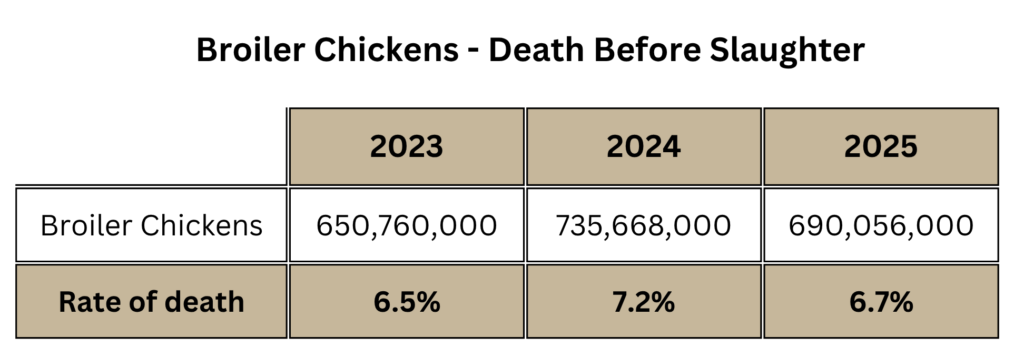
The National Chicken Council (NCC) estimates broiler mortality rates for 2023 at 5.7%, for 2024 at 5.93%, and for 2025 at 5.95%.[4] These figures do not account for chicks that die or are culled at hatcheries prior to placement on factory farms.[5] Nor do they account for birds that die during transport from the facility to the processing plant.[6]
 At the hatchery – Large hatcheries are now mostly automated; machines separate chicks from broken shells, count and weigh them, apply spray vaccines, and sort the chicks into boxes.[7] During this time, an average of about 280 million chicks die annually, or roughly 2-3%.[8] High temperature, inadequate ventilation, and poor egg handling are the most likely causes of chick death upon hatching.[9]
On the factory farm – Because chicks are frail, mortality rates are high during the first week of life. Many factors contribute including genetics and farm conditions, such as temperature, air quality, and overcrowding which keeps chicks from accessing food and water. One source states that “early chick mortality cannot be avoided entirely. 1-5% of mortality is normal in a poultry farm.”[10]
Pre-slaughter stage – The mechanical or manual catching, transport to the slaughterhouse, often under extreme weather conditions, and finally the unloading process at the slaughter plant can cause fatal injuries. Death during this preslaughter phase is referred to as dead-on arrival (DOA) and can account for up to 1% of deaths (out of all hatched chicks) before slaughter.[11]
Calculating the number of broilers hatched less the number of broilers slaughtered. See,
https://docs.google.com/spreadsheets/d/1EValYULCE_iz2U_fgnhGj-fJztpPsbYtxbp6wxja3Cg/edit?gid=0#gid=0 [Note: Our estimates for 2025 may be revised when the USDA’s 2026 numbers for both chicks hatched and broilers slaughtered are released. Very often, the USDA’s summary reports also adjust figures for the prior year.]The USDA collects annual hatchery data for broiler-type chicks “from all known hatcheries which have the capacity to hold at least 1,000 chicken and/or turkey eggs.” “Care is exercised to ensure that all sampled hatcheries are accounted for in the estimate.” [Hatchery Production 2025Summary, p. 39]
Many of the calculations of animals dying before slaughter are broad estimates based on the different types of information available and with an understanding that animal inventory levels change from year to year, and animals born in a certain year do not necessarily die (one way or another) in the same year. Broiler chicks are hatched for different reasons, mostly as “meat” chickens, but also as breeder broiler chickens, and for use in research (see USDA NASS (2026) Hatchery Production 2025 Summary, p. 39). If the animals do not end up in the final slaughter figures they are presumably dying of another cause and therefore are included in these figures. Given the short lives of commercial poultry, these should be reasonable estimates, especially when averaging figures over a 3-year period.
National Chicken Council (March 2026) U.S. Broiler Performance. https://www.nationalchickencouncil.org/statistic/us-broiler-performance/ [NCC does not give backup information for these percentages other than noting that “All data are from USDA or other reliable source.”]
The NCC ties mortality to the “life of the flock” which occurs on the farm where chicks are placed.
See, National Chicken Council (2022) Broiler Welfare Guidelines and Audit Checklist, p. 12 [NCC Welfare Guidelines 2022, p. 12. [“Stocking density is determined at the end of the flock based on target market weight, by adjusting the initial placement numbers with the average mortality (defined as mortality over the life of the flock)…”]Vitek, S. and Jacobs, L. (2026) A Decade of Evidence on Broiler Chicken Dead-on-Arrival Rates and Risk Factors: A Scoping Review. Animals, 16, 805. [Analysis of reports that distinguish between on-farm mortality and death during the preslaughter phase referred to as dead-on-arrival (DOA). at p. 2 & p. 6]
USDA (2013) Poultry Industry Manual, Foreign Animal Disease Preparedness and Response Plan (FAD PReP), p. 18. And see, USDA APHIS/Iowa State Univ. (August 22, 2022) US Poultry Industry Manual – Broilers: brooding. The Poultry Site. [“Most commercial broiler hatcheries are completely automated with little labor needed for separation of chicks from shells, vaccinations, or placement into delivery boxes…. Prepared chicks are placed in ventilated boxes and loaded into an environmentally controlled vehicle, usually a chick bus or enclosed trailer that may transport over 100,000 chicks at a time. “]
Averaging the difference between number of chicks hatched and the number placed from USDA Hatchery Summary Reports 2020 through 2025. Percentage that die is calculated by number of chicks hatched minus number placed / number of chicks hatched.
Fatma Yenilmez (2025) Common Causes of Early Death in Chicks. International Journal of Innovative Approaches in Agricultural Research, Vol. 9 (2), 152-164. pp. 153-155.
Poultry Care (2020). Causes of Early Chick Mortality & 14 Ways to Reduce The Mortality. https://www.poultry.care/blog/causes-of-early-chick-mortality-14-ways-to-reduce-the-mortality
Vitek, S. and Jacobs, L. (2026), p. 2. [This global study found mean DOA rates ranged from 0 to 0.85%, at Abstract]
In 2025, about 338 million day-old male chicks were killed, a little less than half of the total chicks hatched.[1]

The ratio of male-female chicks produced by breeders of laying hens is understood to be one-to-one.[2,3] With that ratio, almost half of all chicks produced by breeders of egg-laying hens are killed each year. This is because “there is currently no economically worthwhile use of the male offspring of layers” who cannot lay eggs.[4]
The predominant method of culling male chicks (and those that are deformed or injured at the hatchery) is by being thrown into a macerator.[5] Although it is commonly accepted that death by maceration is instantaneous, the National Chicken Council’s welfare standards for operating macerators strongly suggest that malfunctions do occur that can leave live chicks in the macerator waste stream, such that continuous monitoring is necessary, as well as documented corrective actions.[6]
A small percentage of male chicks are not killed and are instead used as breeders in the broiler industry with a smaller percentage of males used as breeders in the egg-laying hen industry.[7,8]
In the future, it is possible that new in-ovo sexing technology will be used. The technology can detect male embryos of egg-laying hens before they hatch, which avoids culling the chicks after hatching.[9] As of September 2026, this technology is being used by 40% of the market in Europe. In the U. S., producers managing ~4% of the country’s layer flock have announced they are “transitioning” to in-ovo sexing.[10]
Calculating 50% of egg-type (layer) chicks hatched minus about 7 million male chicks used as breeders. See footnote 5. See, https://docs.google.com/spreadsheets/d/1EValYULCE_iz2U_fgnhGj-fJztpPsbYtxbp6wxja3Cg/edit?gid=0#gid=0
Jeanna Wilson (2013) Incubation temperature does not influence sex ratio in meat-type chickens. College of Agricultural & Environmental Sciences website, Univ of Georgia Research. [“Sex ratio at hatch usually is very close to 1:1 with 50 females hatching for every 50 male chicks.”]
Kaleta, E.F. & Redmann, T. (2008) Approaches to determine the sex prior to and after incubation of chicken eggs and of day-old chicks. World’s Poultry Science Journal. 64(3) 391 [“Domestic chickens produce eggs that contain at almost equal proportions female and male embryos.”]
Krautwald-Junghanns, M. et al., (2018). Current approaches to avoid the culling of day-old male chicks in the layer industry, with special reference to spectroscopic methods. Poultry Science, 97(3), 749–757.
Gurung, S., et al., (2018) Evaluation of Alternative Euthanasia Methods of Neonatal Chickens. Animals, 8, 37, Abstract.
National Chicken Council (2022) Broiler Welfare Guidelines and Audit Checklist, p. 8. [“There should be no live chicks in the hatchery waste stream post-maceration… a live chick in the hatchery waste stream after the completion of the euthanasia process is a major non-conformance. If a major non-conformance is observed by the auditor, it results in an automatic failure of the hatchery operations section of the audit and must result in documented corrective actions.”]
USDA NASS (2026) Chickens and Eggs 2025 Summary, p. 11. [We estimate that ~7 million male chicks were not killed each year. In November 2023 there were ~62.7 million female broiler breeders and 3.7 million female egg-laying hen parents in inventory, ~66.4 million total. These require roosters at ~10 to 1 ratio to generate fertilized eggs for hatchery supply. The U.S. Census of Ag 2022 notes rooster inventory of 7.7 million roosters, reasonably close to 10 to 1. Broiler breeder roosters and hens live a little more than a year.]
USDA (2013) Poultry Industry Manual, Foreign Animal Disease Preparedness and Response Plan (FAD PReP), pp. 12-14. [Implies that both male and female breeding parents are culled at a little over one year old (approx. 65 weeks), and the ratio of roosters to hens is recommended at ~10 to 1.] Confirmation of culling broiler hens at ~65 weeks is noted in: Alabama Cooperative Extension (2022), New Farmer’s Guide to the Commercial Broiler Industry: Poultry Husbandry & Biosecurity Basics, pp. 2-3. [20-22 weeks on pullet farm plus 45 weeks on breeder farm.]
Xie, C., et al., (2023). A review of the recent advances for the in ovo sexing of chicken embryos using optical sensing techniques. Poultry Science, 102(10), 102906–102906.
Elaine Watson (September 9, 2026). In ovo sexing hits 40% penetration in the EU. What will it take to crack the US? AgFunder News. https://agfundernews.com/in-ovo-sexing-hits-40-penetration-in-the-eu-what-will-it-take-to-crack-the-us
In 2025, about 585 million egg-laying type birds died or were killed (and not slaughtered for human meat consumption).[1,2]
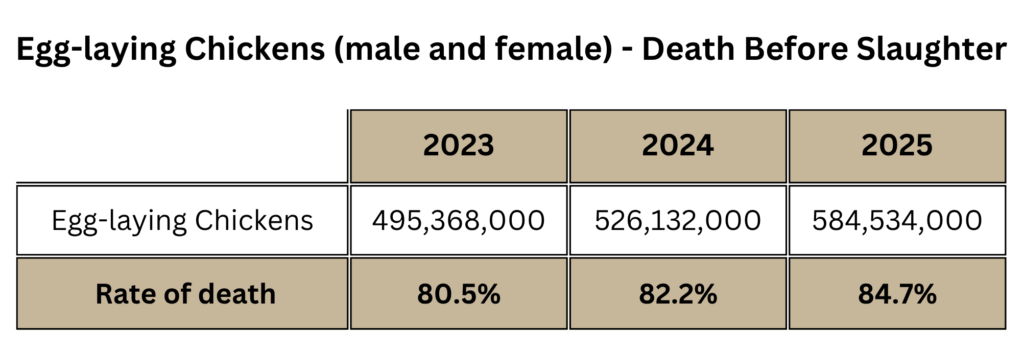
This includes more than 60% of the egg-laying hens (so-called “spent hens”) who are not slaughtered for human meat consumption plus the male chicks slaughtered at birth. Along with table-egg laying hens, the females also include breeders of table-egg layers as well as larger numbers of broiler breeders.
At the hatchery – There is no significant difference in the treatment of female egg-laying chicks who, like broilers, are transported to pullet raising farms shortly after hatching.[3] Thus, there is little reason to believe there is any difference between the 2-3% death rate suffered by broiler chicks at the hatchery except that layers are bred for longevity rather than quick growth and might have better survivability.
On the factory farm – Most “spent hens” are not considered suitable for human consumption when they are no longer valued for egg production. A high percentage of laying hens die or are destroyed and are rendered for animal feed or pet food.[4]] The majority of spent hens that do end up slaughtered for human consumption are broiler chicken breeders, since they are larger birds of a type raised for meat.[5]
Caged or cage-free – One large meta-study found that in recent years, there were no differences in mortality between caged and cage-free systems, “with average figures ranging from 3 to 5% at 60 weeks.”[6]
The significant increase in chicken deaths from 2023 to 2025 is largely due to hens that died or were killed because of avian flu. Egg-laying hens constituted the largest percentage – more than 78% – of birds impacted by the virus.[7,8]
Calculating the number of egg-laying type chickens hatched (including culled male chicks) minus those slaughtered for human meat consumption. See, https://docs.google.com/spreadsheets/d/1EValYULCE_iz2U_fgnhGj-fJztpPsbYtxbp6wxja3Cg/edit?gid=0#gid=0
These are broad estimates based on the understanding that animal inventory levels change from year to year, and animals born in a certain year do not necessarily die (one way or another) in the same year. If the animals do not end up in the final slaughter figures they are presumably dying of another cause and therefore are included in these figures. Given the short lives of commercial poultry, looking at figures over a 2-year period should provide reasonable estimates.
USDA FAD Prep (2013) Poultry Industry Manual, p. 103. [“In a typical production system, companies purchase day-old pullets from hatcheries that are owned and operated by genetics companies with direct sales to egg producers.”
Chris Harris (2019) Finding the value in processing spent laying hens, The Poultry Site. https://www.thepoultrysite.com/articles/finding-the-value-in-processing-spent-laying-hens
USDA NASS (2026) Poultry Slaughter 2025 Summary, p. 5. “Mature Heavy” chickens (82.5 million) versus “Mature Light” (31.3 million) = 72%
Schuk-Paim, et al., (2021). Laying hen mortality in different indoor housing systems: a meta‑analysis of data from commercial farms in 16 countries. Scientific Reports, 11:3052, p. 7. [Although the study used data from more than 6000 commercials flocks from 16 countries, the authors point out that their findings were somewhat limited due to lack of data on different breeds and from top egg-producing countries like China and Mexico.]
More than 200 million birds have been impacted from 2022-February 2026, with an estimate of 75% in commercial facilities for egg-laying hens. Congressional Research Service (April 29, 2025) The Highly Pathogenic Avian Influenza (HPAI) Outbreak in Poultry, 2022-Present, R48518, p. 3-4 & Figure 2. [“…table-egg-laying hens have been the most affected by the ongoing outbreak, accounting for 75% of total domestic poultry loss…”]
The Poultry Site (April 21, 2025) Bird flu wipes out over 30 million US laying hens in 2025, USDA AMS. https://www.thepoultrysite.com/news/2025/04/bird-flu-wipes-out-over-30-million-us-laying-hens-in-2025-usda-ams?utm_source=chatgpt.com
In 2025, about 62 million turkeys, or ~24% of poults hatched, died or were killed (and not sent to slaughter for human meat consumption).[1,2]
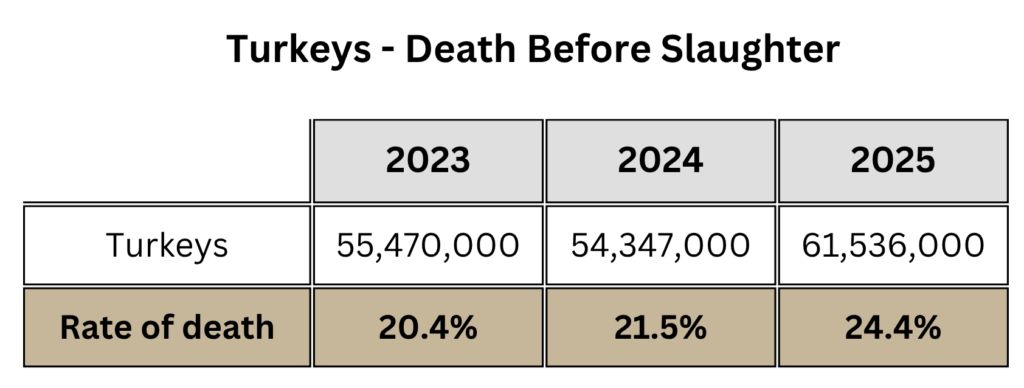
At the hatchery – Newly-hatched turkey poults, like chickens, are transported from hatcheries to factory farms, or “grow out” facilities, within 12 hours of hatch.[3] At the hatchery, an average of about 16 million poults die annually, or roughly between 5 and 7% of hatched chicks (poults).[4] Unwanted or injured poults are put in a macerator. And while death is commonly viewed as instantaneous, the National Turkey Federation’s welfare audit guidelines suggest that malfunctions do occur leaving live birds in the macerator waste, many of whom might not be seen.[5]
On the factory farm – Turkey poults are susceptible to high mortality rates, particularly in the first week of life.[6] A digestive tract disease known as poult enteritis mortality syndrome (PEMS) is a major cause of death in young turkeys.[7] In 2024 and 2025, large numbers were killed due to the spread of HPAI virus.[8] And in 2023-2024, outbreaks of avian metapneumovirus (aMPV), a severe respiratory virus, caused “sizeable economic losses.”[9]
Calculating the number of turkey poults hatched minus the number of turkeys slaughtered. See, https://docs.google.com/spreadsheets/d/1EValYULCE_iz2U_fgnhGj-fJztpPsbYtxbp6wxja3Cg/edit?gid=0#gid=0
These are broad estimates based on the understanding that animal inventory levels change from year to year, and animals born in a certain year do not necessarily die (one way or another) in the same year. Given the relatively short life spans of commercial turkeys, most birds will be born and die in the same calendar year and a 2-year average should provide a reasonably accurate estimate. National Turkey Federation, Raising America’s Turkeys. https://www.eatturkey.org/raising-turkeys/ [“A hen usually takes 14 weeks and weighs 15.5 pounds when processed, but a tom takes roughly 18 weeks to reach a market weight of 38 pounds.”]
Penn State Extension (n.d.) Modern Turkey Industry. https://extension.psu.edu/programs/4-h/opportunities/projects/animal-science/poultry/raising-rearing/viii-other-online-resources/the-chicken/modern-turkey-industry
Averaging the difference between number of poults hatched and the number placed from USDA Hatchery Summary Reports 2021 through 2025. Percentage that die is calculated by number of poults hatched minus number placed / number of poults hatched.
National Turky Federation (2021) Turkey Hatchery Animal Care Audit Checklist, See, section 4 Hatchery BMP, Cell C14. [“Many hatcheries utilize closed vacuum systems to remove waste including poults that have been euthanized making it impossible to visualize the final waste container. Auditor is to verify that the systems and equipment are functioning properly, and that there are no live poults in any waste or trash container.”]
Roehrig, C., & Torrey, S. (2019). Mortality and Early Feeding Behavior of Female Turkey Poults During the First Week of Life. Frontiers in Veterinary Science, 6, 129–129.
Shehata, A.A. et al., (2021) Poult Enteritis and Mortality Syndrome in Turkey Poults: Causes, Diagnosis and Preventive Measures, Animals, 11, 2063.
Congressional Research Service (April 29, 2025) The Highly Pathogenic Avian Influenza (HPAI) Outbreak in Poultry, 2022-Present, R48518, p. 3. [“Turkey flocks compose approximately 11% of HPAI-infected birds affecting turkey production.”]
Alvarez Narvaez, S., et al., (2026). Mapping the genetic diversity of avian metapneumovirus circulating among GA poultry flocks. Avian Diseases, Vol. 69, Issue S1. [USDA ARS authors]
In 2025, about 1.3 billion commercial poultry (i.e., broiler chickens, egg-laying hens, and turkeys) died or were killed prior to slaughter. The rate of death was ~12%.[1]
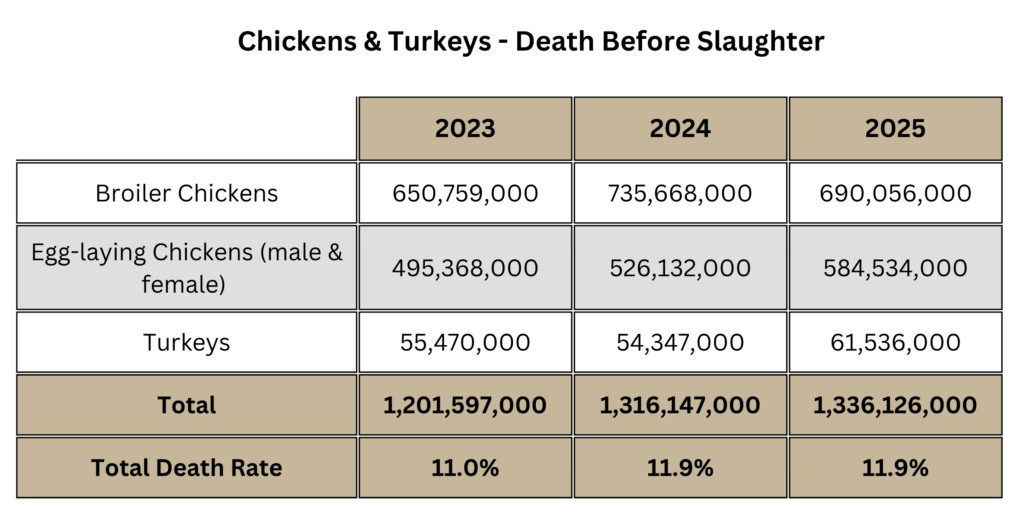
Many birds died slowly – of disease, starvation, thirst, wounds, exhaustion, lameness, cannibalism, the heat, or the cold. They died in fires, on transport trucks, in mass on-farm slaughters, or in macerators on the day they were born. The total figure equals more than three birds for every American, every year.
Calculating the number of turkey poults hatched minus the number slaughtered. See, https://docs.google.com/spreadsheets/d/1EValYULCE_iz2U_fgnhGj-fJztpPsbYtxbp6wxja3Cg/edit?gid=0#gid=0
Yes, there are many other poultry types not included here, including commercially raised ducks. But without data on both the number of other poultry types hatched and an accounting of other poultry types slaughtered, it’s hard to estimate. The USDA publishes in its annual hatchery report only the number of broiler chickens, egg-laying hens, and turkeys hatched.[1,2]
USDA NASS (April 2026) Hatchery Production 2025 Summary, ISSN: 1949-1476.
USDA (2024) 2022 Census of Agriculture, AC-22-A-51, Table 30. [The Census provides an opaque figure of 11.6 billion total poultry hatched, which presumably includes commercial poultry and other types such as pheasants, quail, partridge, and roosters. This figure would indicate that about 450 million poultry other than broiler, egg-type, and turkey chicks hatched in 2022. This seems to be an inexplicably large number given that the other poultry sold in 2022 was well under 100 million (many of these poultry types are raised for game hunting). A reply to our inquiry to the USDA hatchery division did not explain this large discrepancy. Any further info would be welcome.]