
In 2025, more than 42 million pigs were killed or died before being slaughtered for human meat consumption.[1-7
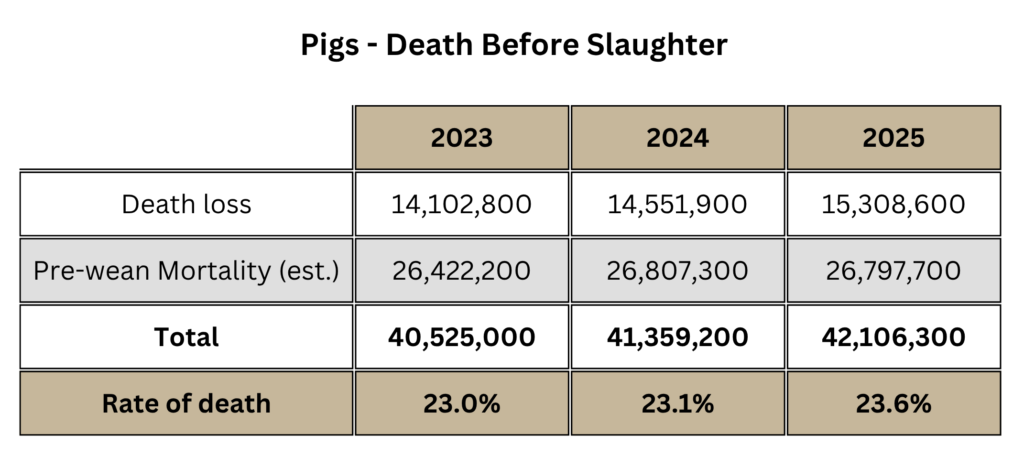
The overall death rate prior to slaughter increased from 2020 through 2023. Although there was a slight drop in deaths of wean-to-finish pigs and breeding sows, pre-wean mortality continues to rise. The most recent industry analysis reports annual 2024 mortality as: [8]
 Pre-wean mortality = 16.4% Wean-to-finish = 6.8% Sow death loss = 12.8% [9]
Calculation, see: https://docs.google.com/spreadsheets/d/12qHNVgadIVdBOuxcVaARHulR94T_Yhie5evOpMQaX-0/edit?gid=0#gid=0
[The death rate was calculated by dividing the death loss by the total of death loss plus pigs slaughtered]Death loss is “an estimate of the number of weaned swine which died for any reason other than being slaughtered for human consumption.” And “Pig Crop” does not include unweaned pigs that die. [USDA NASS (2020) Hogs and Pigs: What is Included in NASS Estimates.
Estimate of 15% of pre-weaned mortality comes from a variety of sources, see footnotes 4-7.
PigCHAMP Knowledge Software, Benchmarking Summaries (USA 2023) https://www.pigchamp.com/benchmarking/benchmarking-summaries [15.15% mean average of 4 quarters]
Stalder, K. J. (2018). 2017 Pork Industry Productivity Analysis. National Pork Board Research Grant Report. [17.3% average pre-wean mortality from 2011 thru 2016. See Table 5.]
Magalhães, E. et al. (2022) Whole-herd risk factors associated with wean-to-finish mortality under the conditions of a Midwestern USA swine production system. Preventive Veterinary Medicine, 198, 105545–105545, table 8. [Pre-wean mortality rates ranging from 10.8% – 18.0% in 1,300 pig cohorts on Midwest farms.]
Holen, J. et al., (2020). Effects of supplementing late-gestation sow diets with zinc on preweaning mortality of pigs under commercial rearing conditions. Translational Animal Science, 4:519-530, p. 520. [“Commercial swine farms commonly experience preweaning mortality rates between 12% to 25%.” “The overall preweaning mortality of pigs in this trial was 13.5%, which is similar to that observed in other commercial facilities…”]
Bradley Eckberg, Meat Farms (June 5, 2024) What and when: Deeper look at wean-to-finish mortality. Farm Progress. https://www.nationalhogfarmer.com/livestock-management/what-and-when-deeper-look-at-wean-to-finish-mortality
For the increase in sow mortality, see Pig Breeding Life
In 2025, about 3.6 million cattle and calves died or were killed (and not sent to slaughter for human meat consumption).[1]
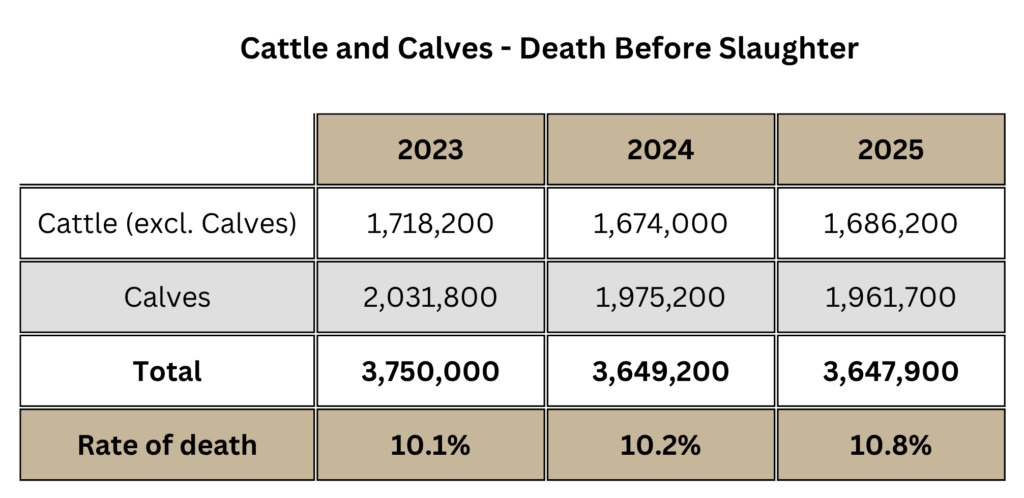
The total death rate prior to slaughter has risen since 2023 although fewer cattle are being slaughtered. One reason is substantial weight gain in the past several years due to genetic breeding, growth-promoting hormones, and longer times on high-energy feeds.[2,3] At a 2025 Symposium on Cattle Health, one veterinary researcher pointed to the increasing death loss caused by heart failure and musculoskeletal issues in feedlot cattle, expressing concern that the animals are being pushed past the capability of their cardiopulmonary systems.[4]
Calculation, see: https://docs.google.com/spreadsheets/d/12qHNVgadIVdBOuxcVaARHulR94T_Yhie5evOpMQaX-0/edit?gid=0#gid=0 [The death rate was calculated by dividing the death loss of cattle & calves by the total of death loss plus cattle & calves slaughtered
Juan Vassallo (February 13, 2026) Cattle Raised for Beef Are Heavier Than Ever, Raising New Concerns in the Industry About Animal Health and Welfare. Investigate Midwest. https://sentientmedia.org/cattle-raised-for-beef-are-heavier-than-ever/
In 2023, the average dressed weight of a steer (after removal of the head, hide, hooves, and organs) was 908 lbs. [USDA (2024) Livestock Slaughter Summary, p. 9] compared to 955 lbs. in 2025 [USDA (2026) Livestock Summary, p. 9]
Dr. Miles Theurer (2025) Impacts of Beef Carcass Size on System Production Efficiency. Research Director at Veterinary Research & Consulting Services, at the 22nd Annual Holt Cat Symposium on Excellence in Ranch Management. https://www.youtube.com/watch?v=uQ-YRAbguZU
In 2025, about 545,000 sheep (including lambs) died or were killed, and not sent to slaughter for human meat consumption.[1]
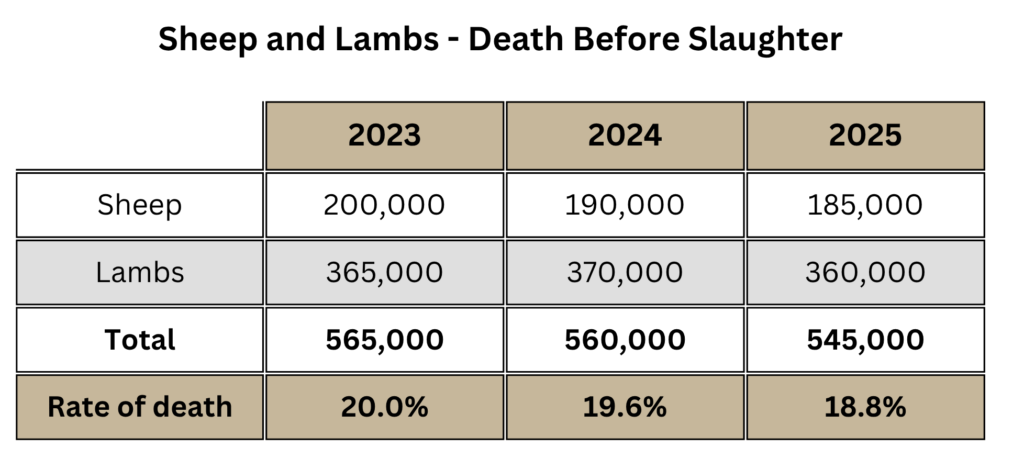
Calculation, see: https://docs.google.com/spreadsheets/d/12qHNVgadIVdBOuxcVaARHulR94T_Yhie5evOpMQaX-0/edit?gid=0#gid=0 [The death rate calculated by dividing the combined sheep and lamb “death loss” by the total of death loss plus sheep and lambs slaughtered.]
In 2025, more than 215 million livestock died or were killed before being sent to slaughter for human meat consumption.[1,2] The cumulative rate of death has risen over the past three years, likely due to increased mortality in pigs and cattle as explored in the questions above.
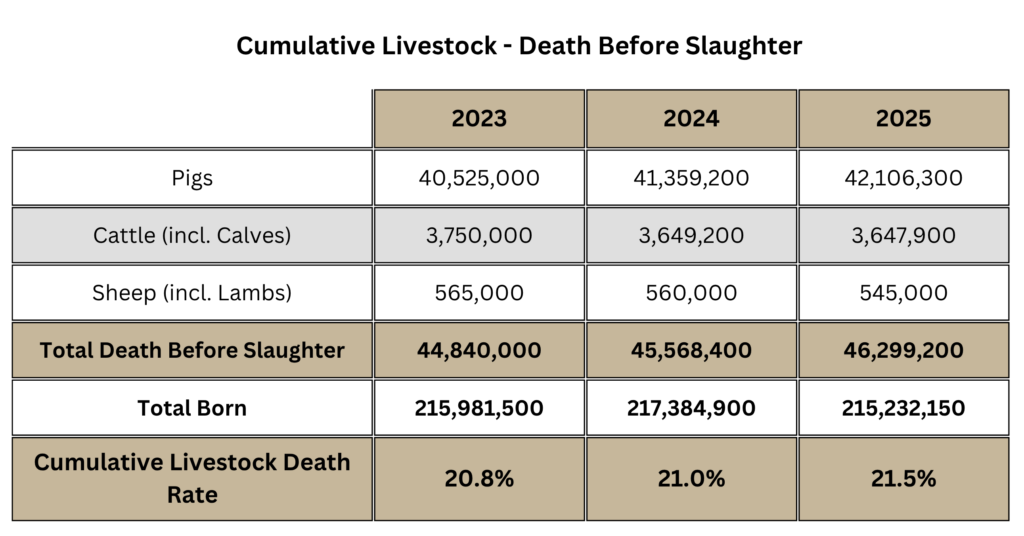
Calculation is based on the total number of deaths before slaughter divided by total livestock born. For pigs, the total number born accounts for pre-wean mortality (see above). For cattle and sheep, the total number born equals deaths before slaughter plus the number slaughtered (see questions above).
Cattle includes dairy cows. The number of livestock slaughtered includes post-mortem condemnations. [USDA NASS (April 2026) Livestock Slaughter 2025 Summary, ISSN: 0499-0544 p. 66.