
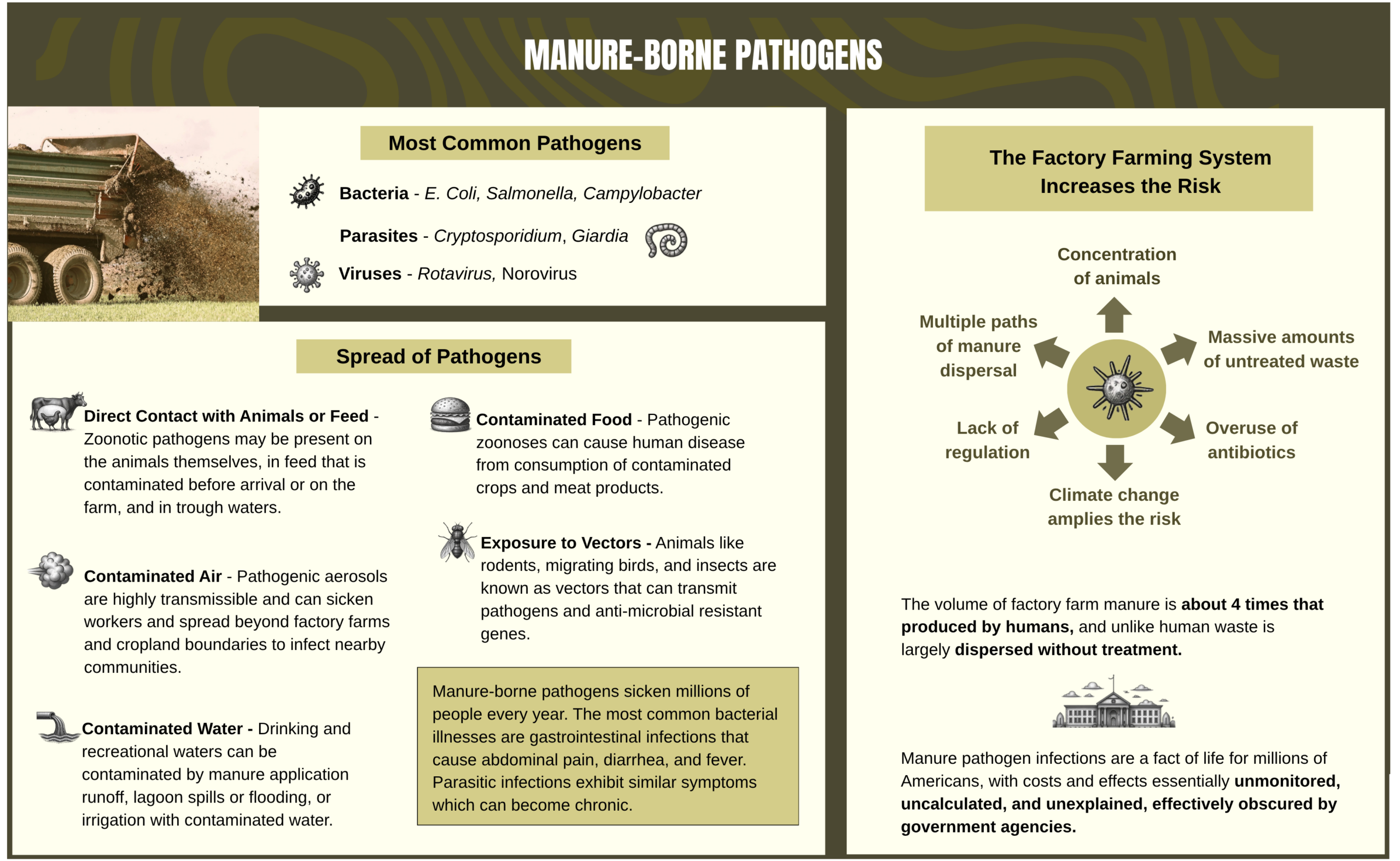
Manure-borne pathogens include bacteria, viruses, and parasites that can sicken people, either through direct contact with manure or indirectly from contaminated water, food, or air. When a person becomes sick from a pathogen that has moved from an animal to human, it is considered a zoonotic transmission, even if the animal was not visibly ill or symptomatic.[1-3]
Some of the more common manure-borne pathogens impacting human health include:
 Bacteria – E. Coli, Salmonella, Campylobacter Parasites – Cryptosporidium, Giardia Viruses – Rotavirus, Norovirus[4-6]
Pathogens are one of many contaminants in factory farm manure, including hormones, heavy metals, antibiotics, other drug residues, and large volumes of potentially polluting nitrogen and phosphorus.[7]
World Health Organization (July 29, 2020) Zoonoses. https://www.who.int/news-room/fact-sheets/detail/zoonoses
U.S. EPA (2013) Literature Review of Contaminants in Livestock and Poultry Manure and Implications for Water Quality, p. 13. [“Pathogens that are of animal origin but that can be transmitted to humans are termed “zoonotic”…”]
See, Zoonoses & Animal Ag
U.S. EPA (2013) Literature Review of Contaminants in Livestock and Poultry Manure and Implications for Water Quality, p. 13-18, Types of Pathogens Found in Livestock. [“The more common zoonotic pathogens in manure include Escherichia coli 0157:H7, Campylobacter, Salmonella, Cryptosporidium parvum, and Giardia lamblia.” And see 3.1.3. Viruses on p. 17]
Waldrip, H. M., et al., (Eds.). (2020). Animal manure: Production, characteristics, environmental concerns, and management. John Wiley & Sons. [In a global analysis, “According to an investigation of over 5000 recorded zoonotic disease outbreaks, Salmonella caused the most outbreaks (855), followed by Escherichia coli which caused 460 outbreaks.” Referring to Smith, K. F., et al., (2014). Global rise in human infectious disease outbreaks. Journal of the Royal Society Interface, 11(101), 20140950.]
Walter, E. J. S., et al., (2025). Foodborne illness acquired in the United States—major pathogens, 2019. Emerging Infectious Diseases, 31(4), 669, p. 672 & Table 1. [For foodborne illnesses specifically: “Of the pathogens included in this assessment, norovirus was estimated to cause most (5.5 million/year) domestically acquired foodborne illnesses, followed by Campylobacter spp. (1.9 million/year), nontyphoidal Salmonella (1.3 million/year)…”]
U.S. EPA (2013) Literature Review of Contaminants in Livestock and Poultry Manure and Implications for Water Quality, Table 1-1, p. 2.
Like other externalities of animal ag, the burden of manure-borne pathogens is a transfer of costs from the many to the few. Though not the most damaging, the toll still makes the long list of factory farming’s externalized costs and suffering. These costs are mostly paid by randomly selected individuals via medical care, lost labor, premature mortality, and environmental degradation, exchanged for corporate profits and cheap meat.[1]
In 2005, the EPA generated a lengthy report that, like many practical and highly researched reports on factory farming during that period, assumed that society would not accept the heightened disease risks of concentrated manure from factory farming. The report concluded, “it is clear that exposure to zoonotic pathogens cause significant human suffering and economic losses in the billions of dollars annually due to lost productivity, treatment of disease, and beach closures. Because of the continuing human disease caused by zoonoses contaminating food and water resources in the U.S., we believe that the current environmental regulations and conventional animal manure management practices are inadequate for protection of human health and the environment.”[2]
As of today, few of the recommendations in that report have been implemented, and little of the suggested research has been done.[3] Despite the massive amounts of factory farm manure, totaling about 4 times the volume of human manure,[4] which unlike human manure is mostly untreated,[5] manure pathogen infections are a fact of life for millions of unsuspecting Americans, with costs and effects essentially unmonitored, uncalculated, and unexplained, effectively obscured by government agencies.
See, Animal Ag Externalities
Dr. Shane Rogers & Dr. John Haines (2005). Detecting and Mitigating the Environmental Impact of Fecal Pathogens Originating from Confined Animal Feeding Operations: Review. U.S. EPA Office of Research and Development, p. 90.
Dr. Shane Rogers & Dr. John Haines (2005), p. 92-98.
See, Total Manure Weight
See, Manure Pollution Overview [question: Is manure from factory farms essentially “untreated”?]
There are many routes by which manure-borne pathogens can infect humans:
Contaminated air – Pathogens can spread via aerosol dispersion. These microbial particles attach themselves to crops, dust, or spread directly from housing and feedlots, potentially affecting agricultural workers. Microbial aerosols are highly transmissible and can spread over large areas. Although concentrations disperse with time and distance, they travel beyond factory farm and cropland boundaries to infect nearby communities.[1-3]
Direct contact with animals, feed, and water troughs – Zoonotic pathogens may be present on the animals themselves, in feed that is contaminated before arrival or on the farm, and in trough waters.[4]
Contaminated water – Drinking and recreational water can be contaminated by manure and fertilizer runoff, lagoon spills or flooding, or irrigation with contaminated water.[5] USGS researchers have found that poultry and livestock manure are a “likely source” of pathogen contamination of surface and groundwater.[6]
Contaminated food – It is well established that pathogenic zoonoses can cause human disease from consumption of contaminated meat products.[7] In a recent study of foodborne illnesses, Salmonella infection was the leading cause of death.[8]
Exposure to vectors – Other animals like rodents, migrating birds, and insects are known as vectors that can transmit bacteria and anti-microbial resistant genes. [9,10]
Borchardt, M. A., & Burch, T. R. (2016). Airborne pathogens from dairy manure aerial irrigation and the human health risk. U.S. Dairy Forage Research Center, USDA Agricultural Research Service, p. 1. [“Using quantitative microbial risk assessment, we estimate the risk for acute gastrointestinal illness for exposure to airborne pathogens 500 feet downwind from dairy manure irrigation is on the order of 1 in 100,000 to 1 in 100 per irrigation event.”]
Leon, I. M., et al., (2025). Comprehensive Analysis of E. coli, Enterococcus spp., Salmonella enterica, and Antimicrobial Resistance Determinants in Fugitive Bioaerosols from Cattle Feedyards. Applied Microbiology, 5(3), 63, p. 24. [“The potential for bacteria to persist in bioaerosols raises potential health concerns, particularly regarding the risk of respiratory transmission to humans working with animals residing in the feedyard environment.”]
Thiel, N., et al., (2020). Airborne bacterial emission fluxes from manure-fertilized agricultural soil. Microbial biotechnology, 13(5), 1631–1647, p. 1641. [“…our measurements indicated 200-fold higher concentrations of enterococci within the dust plume during fertilizer application, suggesting an increased risk for those directly exposed, e.g. agricultural workers.”]
Dr. Shane Rogers & Dr. John Haines (2005). Detecting and Mitigating the Environmental Impact of Fecal Pathogens Originating from Confined Animal Feeding Operations: Review. U.S. EPA Office of Research and Development, p. 27.
U.S. EPA (2013) Literature Review of Contaminants in Livestock and Poultry Manure and Implications for Water Quality, p. 13-18. [“Pathogens and indicator organisms associated with manure can be transported to surface water and ground water through runoff, discharges, infiltration, and atmospheric deposition. Lagoon spills and flooding of constructed treatment wetlands during severe rainstorms or lagoon leaks and equipment failures during dry weather may also release waste and associated pathogens into the environment. Tile drainage may also provide a route for microbes in ground water to reach surface waters.”]
Hubbard, L. E., et al., (2020). Poultry litter as potential source of pathogens and other contaminants in groundwater and surface water proximal to large-scale confined poultry feeding operations. The Science of the Total Environment, 735, Article 139459, p. 13. [“Our results clearly indicate that there are microbial and chemical contaminants linked to agriculture practices, including CAFOs, in the groundwater. … The converging lines of evidence point to the spreading of the poultry litter on land adjacent to the poultry CPFOs as a source of microbial and chemical contaminants to groundwater and surface water.”]
U.S. EPA (2005) Detecting and Mitigating the Environmental Impact of Fecal Pathogens Originating from Confined Animal Feeding Operations: Review, p. 32.
Walter, E. J. S., et al., (2025). Foodborne illness acquired in the United States—major pathogens, 2019. Emerging Infectious Diseases, 31(4), 669, p. 669. [238 deaths in 2019]
Bertelloni, F., et al., (2023). House flies (Musca domestica) from swine and poultry farms carrying antimicrobial resistant Enterobacteriaceae and Salmonella. Veterinary Sciences, 10(2), 118, p. 2. [“Houseflies can acquire and share different enteric bacterial pathogens, such as Salmonella and Campylobacter. In particular, houseflies can easily acquire Salmonella from food, feed, manure, and waste; furthermore, adult insects can transmit this bacterium to each other, and vertical transmission is demonstrated too.”]
U.S. EPA (2013) Literature Review of Contaminants in Livestock and Poultry Manure and Implications for Water Quality, p. 50. [“For example, resistance (antimicrobial-resistant bacteria) can spread between herds of animals, particularly when in close confinement, or via vectors such as insects and rodents.”]
The most common illnesses from manure-borne pathogens are gastrointestinal infections that cause abdominal pain, diarrhea, and fever. Bacterial infections like E. coli and Salmonella are gastrointestinal infections. Parasitic infections such as cryptosporidiosis also exhibit similar gastrointestinal symptoms, though they can become recurrent or chronic.[1,2]
Fecal pathogens may cause only minor sickness in some, but can cause serious conditions or death in others, especially in children, the elderly, or those with weakened immune systems.[3]
Alegbeley, O. O. & Sant’Ana, A. S., (2020). Manure-borne pathogens as an important source of water contamination: An update on the dynamics of pathogen survival/transport as well as practical risk mitigation strategies. International Journal of Hygiene and Environmental Health, 227, 11324, p. 3. [See Table 2: “Human infectious dose and diseases caused by common Manure-associated-pathogens.”]
U.S. EPA (2013) Literature Review of Contaminants in Livestock and Poultry Manure and Implications for Water Quality, p. 14. [“Information on the prevalence, illnesses (primarily gastrointestinal), and infectious doses (numbers of organisms required to cause infection) associated with some of the bacterial and protozoan agents are provided in Table 3-1.)”]
USGS (2018) Bacteria and E. Coli in Water. [“Consumption of or contact with water contaminated with feces of warm-blooded animals can cause a variety of illnesses. Minor gastrointestinal discomfort is probably the most common symptom; however, pathogens that may cause only minor sickness in some people may cause serious conditions or death in others, especially in the very young, old, or those with weakened immunological systems.”] https://www.usgs.gov/special-topics/water-science-school/science/bacteria-and-e-coli-water
There is no public health tracking that isolates pathogens from manure as a cause of illness.[1] It is likely that the number of annual cases of disease originating from manure-borne pathogens number in the low millions, perhaps 2 to 5 million. The CDC estimates foodborne and waterborne diseases from major pathogens, many of which come from manure, total about 15 to 20 million.
For foodborne illnesses, the agency cites to a report by a group of researchers who estimated that in 2019 there were ~9.9 million illnesses and more than 900 deaths, most of which are related to pathogens that are commonly found in manure.[2,3]
For waterborne illnesses, the CDC estimated that in 2021 there were ~7.2 million cases, with pathogens that are often found in manure associated with a significant share of cases.[4]
Not surprisingly, several reports indicate that water sources near farmlands or livestock are more at risk of pathogenic contamination, particularly when transport is accelerated by rainfall or irrigation.[5,6] In addition, “the larger the herd size, the greater the potential for the dissemination of infectious agents.”[7]
U.S. EPA (2013) Literature Review of Contaminants in Livestock and Poultry Manure and Implications for Water Quality, p. 62. [“Although many, if not most, outbreaks are believed to be associated with human fecal contamination, livestock and poultry manure contains pathogens that may contaminate water. The number of waterborne disease outbreaks that may be associated with zoonotic pathogens from livestock and poultry manure is not understood. This is in part because confirming the source of an outbreak is challenging, and many outbreaks may not even be recognized.” Naturally attribution for air-borne pathogens is even more challenging.]
Walter, E. J. S., et al., (2025). Foodborne illness acquired in the United States—Major pathogens, 2019. Emerging Infectious Diseases, 31(4), 675–685, Tables 1 & 2. [The pathogens studied were Campylobacter, Clostridium perfringens, Listeria, Norovirus, Salmonella, and E. Coli, although the researchers did not identify the pathogens as being from manure.]
Interagency Food Safety Analytics Collaboration. (2022). Interagency food safety analytics collaboration. Foodborne illness source attribution estimates for 2020 for Salmonella, Escherichia coli O157, and Listeria monocytogenes using multi-year outbreak surveillance data, United States. Interag. Food Saf. Anal. Collab., 157. [See Figures 2 through 5 for sources for E Coli, Salmonella, and other pathogens broken down by animal-sourced foods and plant-based foods. Naturally, plant-based sources are often originally due to animal-based sources such as irrigation water or land-applied manure.]
https://www.cdc.gov/ifsac/php/data-research/annual-report-2022.htmlCollier, S. A., et al., (2021). Estimate of burden and direct healthcare cost of infectious waterborne disease in the United States. Emerging infectious diseases, 27(1), 140. [Including: Giardiasis = 415,000. Cryptosporidiosis = 322,000. Campylobacteriosis = 171,000. Salmonellosis = 77,000]
Alegbeley, O. O. & Sant’Ana, A. S., (2020). Manure-borne pathogens as an important source of water contamination: An update on the dynamics of pathogen survival/transport as well as practical risk mitigation strategies. International Journal of Hygiene and Environmental Health, 227, 11324.
Poulsen, M. N., et al., (2018). Residential proximity to high-density poultry operations associated with campylobacteriosis and infectious diarrhea. Int J Hyg Environ Health, 221(2): 323–333, p. 9. [“In this study evaluating patients’ residential proximity to high-density poultry operations and diarrheal illnesses we found that patients who lived closer to a greater number or larger operations had a higher odds of diagnosis with campylobacteriosis and infectious diarrhea.”]
Alegbeley, O. O. & Sant’Ana, A. S., (2020), p. 9.
This answer remains uncertain and is relatively unexplored by federal agencies. In 2005, the EPA stated “the true incidence of illness that may be caused by zoonotic pathogens remains largely unknown.”[1] In 2011, an FDA report estimated that for 82% of infections, no specific pathogen was identified.[2]
The EPA has acknowledged that “The number of waterborne disease outbreaks that may be associated with zoonotic pathogens from livestock and poultry manure is not understood. This is in part because confirming the source of an outbreak is challenging, and many outbreaks may not even be recognized. Not all persons will seek medical attention, some outbreaks may be too small to be noticed, and reporting to the Waterborne Disease & Outbreak Surveillance System is voluntary. Furthermore, among recognized outbreaks of acute gastrointestinal illness, the causative agent remains unidentified for a substantial portion.”[3] Since that report, little has been done by federal agencies to answer this question.[4]
Some pathogens are understood to mostly originate in manure. For instance, the CDC reports that Campylobacter bacteria is a cause of diarrheal illness and that infection is most common by eating raw or undercooked poultry or eating other contaminated food, drinking untreated water, and touching animals that carry Campylobacter.[5] The source of E. coli (STEC) infections is often manure, even when the consumed food is plant-based.[6]
Though it is challenging to confirm that a source is agricultural as opposed to human[7], many independent studies show that pathogenic contamination is far more likely in areas where there are numerous CAFOs.[8-11] USGS researchers have found that poultry and livestock manure is a “likely source” of pathogen contamination of surface and groundwater.[12]
Dr. Shane Rogers & Dr. John Haines (2005). Detecting and Mitigating the Environmental Impact of Fecal Pathogens Originating from Confined Animal Feeding Operations: Review. U.S. EPA Office of Research and Development, Table 5 & p. 22.
D. W. K. Acheson (2011) Food and Waterborne Illnesses. FDA Center for Food Safety & Applied Nutrition, p. 367.
U.S. EPA (2013) Literature Review of Contaminants in Livestock and Poultry Manure and Implications for Water Quality, p. 62.
Beshearse, E., et al., (2021). Attribution of illnesses transmitted by food and water to comprehensive transmission pathways using structured expert judgment, United States. Emerging infectious diseases, 27(1), 182. [This CDC report categorizes pathways, but still doesn’t shed much light on the origins of the pathogens.]
CDC (2026) About Campylobacter infection. https://www.cdc.gov/campylobacter/about/index.html
Marshall, K. E., et al., (2020). Lessons learned from a decade of investigations of Shiga toxin–producing Escherichia coli outbreaks linked to leafy greens, United States and Canada. Emerging infectious diseases, 26(10), 2319. [“Many animals can be STEC hosts, but ruminants, primarily cattle, are considered the major reservoir (7–10). STEC shed from cattle and wild animals can directly contaminate leafy greens or indirectly contaminate them through irrigation water, runoff, or dust containing feces (8,11–13).”]
U.S. EPA (2013) Literature Review of Contaminants in Livestock and Poultry Manure and Implications for Water Quality, p. 63. [“It is not generally possible to confirm unequivocally that the source is agricultural as opposed to human…”]
Casey, J. A., et al., (2015) Industrial Food Animal Production and Community Health. Curr Environ Health Rep, 2(3):259-71, Abstract. [“Industrial food animal production (IFAP) is a source of environmental microbial and chemical hazards. A growing body of literature suggests that populations living near these operations and manure-applied crop fields are at elevated risk for several health outcomes.”]
Poulsen, M. N., et al., (2018). Residential proximity to high-density poultry operations associated with campylobacteriosis and infectious diarrhea. Int J Hyg Environ Health, 221(2): 323–333, p. 9. [“In this study evaluating patients’ residential proximity to high-density poultry operations and diarrheal illnesses we found that patients who lived closer to a greater number or larger operations had a higher odds of diagnosis with campylobacteriosis and infectious diarrhea.”]
Burkholder, J., et al., (2007). Impacts of Waste from Concentrated Animal Feeding Operations on Water Quality. Environmental Health Perspectives, 115(2), 308–312, p. 309. [“The presence of many contaminants from livestock waste has been documented in both surface water and groundwater supplies in agricultural areas within the United States.”]
Mallin, M. A., et al., (2015). Industrial Swine and Poultry Production Causes Chronic Nutrient and Fecal Microbial Stream Pollution. Water, Air, and Soil Pollution, 226(12), Article 407, Abstract. [“Geometric mean fecal coliform counts were in the thousands at five of seven sites, especially in locations near swine waste sprayfields.”]
Hubbard, L. E., et al., (2020). Poultry litter as potential source of pathogens and other contaminants in groundwater and surface water proximal to large-scale confined poultry feeding operations. The Science of the Total Environment, 735, Article 139459, p. 13. [“Our results clearly indicate that there are microbial and chemical contaminants linked to agriculture practices, including CAFOs, in the groundwater. … The converging lines of evidence point to the spreading of the poultry litter on land adjacent to the poultry CPFOs as a source of microbial and chemical contaminants to groundwater and surface water.” All authors were with the USGS]
Massive amounts of concentrated manure – The amount of factory farm manure produced in the U.S. is about 4 times that produced by humans.[1] Manure can contain pathogens at millions to billions per gram of feces and, under certain conditions, pathogens can survive in the environment for days to more than a year [2]
Concentration of animals – High-density livestock and poultry operations are optimal environments for incubating, amplifying, and transmitting zoonotic diseases.[3]
Overuse of antibiotics – U.S. animal agriculture uses about two-thirds of all medically important antibiotics.[4] This creates conditions for bacteria to acquire new traits that help enhance survival, increasing the danger to human health.[5,6]
Untreated waste – Unlike human feces which is generally treated in waste management plants to remove harmful pathogens, manure is largely dispersed without treatment.[7]
Many paths of manure dispersal – Manure pathogens can be spread multiple ways through application on crops and soil; aerial contamination through bioaerosols and dust; water contamination due to manure runoff from old or poorly designed manure storage sites and from storms; direct contact from farm workers; and animal and insect vectors like birds and flies.[8]
Lack of regulation – Because of the many thousands of factory farm and cropland “nonpoint sources,” pollutants from animal ag are not effectively regulated by the Clean Water Act.[9] And there are no National Ambient Air Quality Standards (NAAQS) or Clean Air Act rules that set limits on airborne pathogens emitted from animal feeding operations.[10]
Climate change amplifies risk – Climate change is expected to bring more intense rainfall and flood risks, particularly in the Midwest and Southeast where most factory farms and feed crops are located.[11] The flooding of manure storage sites brings additional health risks to local communities.[12]
See, Total Manure Weight [question: “Animals raised for food produce how much waste annually?]
Dr. Shane Rogers & Dr. John Haines (2005). Detecting and Mitigating the Environmental Impact of Fecal Pathogens Originating from Confined Animal Feeding Operations: Review. U.S. EPA Office of Research and Development, p. 4 & p. 19, Table 4.
National Assoc. of Local Boards of Health (2010). Understanding Concentrated Animal Feeding Operations and Their Impact on Communities, p. 9. [“The potential for transfer of pathogens among animals is higher in confinement, as there are more animals in a smaller amount of space.”] Also see, Animal Ag Drivers of Zoonoses [question: How does animal ag directly increase the spread of zoonotic diseases?]
See, Animal Ag Antibiotic Usage
Univ. of Oxford (July 28, 2026) Study finds that industrial chicken farms are accelerating the spread of a major foodborne disease. [citing to Kyne, O. J., et al., (2026) Accelerating Campylobacter zoonosis in the Anthropocene. PNAS, 123: 32, p. 1. [“Using large-scale genomic data, we reveal that dense, rapidly growing livestock populations can promote cross-species transmission, sustain high pathogen diversity, and accelerate adaptive evolution, including traits linked to persistence and antimicrobial resistance.”]
Farm Forward (August 2026) Salmonella Risk in the U.S. Poultry Industry: When Infections Become More Severe and Harder to Treat. https://www.farmforward.com/publications/salmonella-risk-in-the-u-s-poultry-industry-when-infections-become-more-severe-and-harder-to-treat/ [“In our new analysis of FSIS salmonella serotype and antibiotic resistance testing data, we found that, over the last decade, contamination with high-virulence and multidrug-resistant strains linked to invasive infection, hospitalization, and death has risen sharply and shows no indication of slowing or reversing. In other words, while the percentage of positive salmonella tests is lower overall, a growing share of the salmonella that exists is among the most dangerous to human health.”]
Glibert, P. M. (2020). From hogs to HABs: impacts of industrial farming in the US on nitrogen and phosphorus and greenhouse gas pollution. Biogeochemistry, 150(2), 139-180, p. 143. [“There is no wastewater treatment for these animal wastes—other than holding it for periods of time.”] Also see, Manure Pollution Overview [question: Is manure from factory farms essentially “untreated”?]
See prior question.
See, Clean Water Act Animal Ag Regulations [question: “Are animal ag water pollutants effectively regulated under the Clean Water Act?”]
See, Lack of Air Regulations
Climate Central (March 26, 2025) Heavier Rainfall Rates in U.S. Cities. [“According to the Fifth National Climate Assessment, as the climate has warmed over the last six decades, the heaviest rainfall events have become wetter in all major regions of the continental U.S., led by: the Northeast, Midwest, and Southeast.”]
Quist, A. J. L., et al., (2025). Hurricanes, industrial animal operations, and acute gastrointestinal illness in North Carolina, USA. Environmental Research, Health, 3(1), 15005, p. 8. [“In this paper, we found that areas with heavy hurricane precipitation and many hog CAFOs experienced an increased AGI ED (acute gastrointestinal illness at emergency departments) visit rate during the three-week period after Hurricane Florence, compared to their expected AGI ED rates.”]
Yes, although the degree of risk is somewhat controversial.[1,2] About 75% of the antibiotics given to livestock is excreted in manure.[3] Antibiotics enter the environment through varying routes into air, water, and soil.[4]
Most reports confirm associations between high levels of antibiotic usage in farmed animals and overall health risks to humans.[5,6] There is also clear evidence of risks to agricultural workers and local communities.[7,8]
Murray, C. J., et al., (2022). Global burden of bacterial antimicrobial resistance in 2019: a systematic analysis. The Lancet, 399(10325), 629-655, p. 649. [“Increased use of antibiotics in farming has been identified as a potential contributor to AMR in humans although the direct causal link remains controversial.”]
Chang, Q., et al., (2015). Antibiotics in agriculture and the risk to human health: how worried should we be? Evolutionary applications, 8(3), 240-247, p. 244. [“The topic of agricultural antibiotic use is complex… As we noted at the start, many believe that agricultural antibiotics have become a critical threat to human health. While the concern is not unwarranted, the extent of the problem may be exaggerated.”]
Casey, J. A., et al., (2013). High-density livestock operations, crop field application of manure, and risk of community-associated methicillin-resistant Staphylococcus aureus infection in Pennsylvania. JAMA internal medicine, 173(21). [“About 75% of administered antibiotics are not absorbed by the animal and end up in manure.”]
Chee‐Sanford, J. C., et al., (2009). Fate and transport of antibiotic residues and antibiotic resistance genes following land application of manure waste. Journal of environmental quality, 38(3), 1086-1108, p. 1089. [“The excretion of waste products by grazing animals, atmospheric dispersal of feed and manure dust containing antibiotics, and the incidental release of products from spills or discharges are also potential pathways of antibiotic residue entry into the environment. … The practice of land application of livestock manure provides large area scale for introduction of antibiotics into the environment.”]
Tang, K. L., et al., (2017). Restricting the use of antibiotics in food-producing animals and its associations with antibiotic resistance in food-producing animals and human beings: a systematic review and meta-analysis. The Lancet Planetary Health, 1(8), e316-e327, p. e324. [“The evidence of effect on human beings was more limited and less robust, though meta-analysis of 13 studies showed similar results, with a 24% absolute reduction in the prevalence of antibiotic-resistant bacteria in humans with interventions that reduce antibiotic use in animals.”]
For further info on factory farms, antibiotic resistance, and human health risk, see, Antibiotic Resistance & Animal Ag
Casey, J. A., et al., (2013), p. 7. [“There was evidence that both a crop field manure application model that incorporated distance, swine manure volume, season of application, and field area, as well as a livestock operation model that incorporated distance and swine count, were each associated with increased risk of infection.”]
Tang, K. L., et al., (2017), p. e324. [“Similarly, in the human studies, the pooled prevalence of antibiotic resistance reported was 24% lower in the intervention groups compared with control groups, with a stronger association seen for humans with direct contact with food-producing animals.”]