
The main reasons are:
 More than a hundred agricultural herbicides in use in the U.S. Multiple applications as standard practice on most crops. Human health risks, both documented and still unknown. Lack of comprehensive research, monitoring, and effective regulation. Scientific controversies and public confusion regarding impacts. Damages to biodiversity either directly or via changes in ecosystems. Ubiquity of residues in waterways and throughout the environment. Unstudied effects of the myriad combinations of pesticides. Unstudied effects of inert ingredients which are protected corporate info. Increasing reliance due to vast tracts of monoculture GE production. Growing weed resistance causing constant changes in compounds, combinations, and number of applications. Growing public interest demands accountability and will eventually impact how the public eats, votes, and pressures policymakers.
These issues are explored throughout these pages.[1] We focus on glyphosate and atrazine because they are the most widely used and studied herbicides.
Also see, Herbicide Harm to Biodiversity
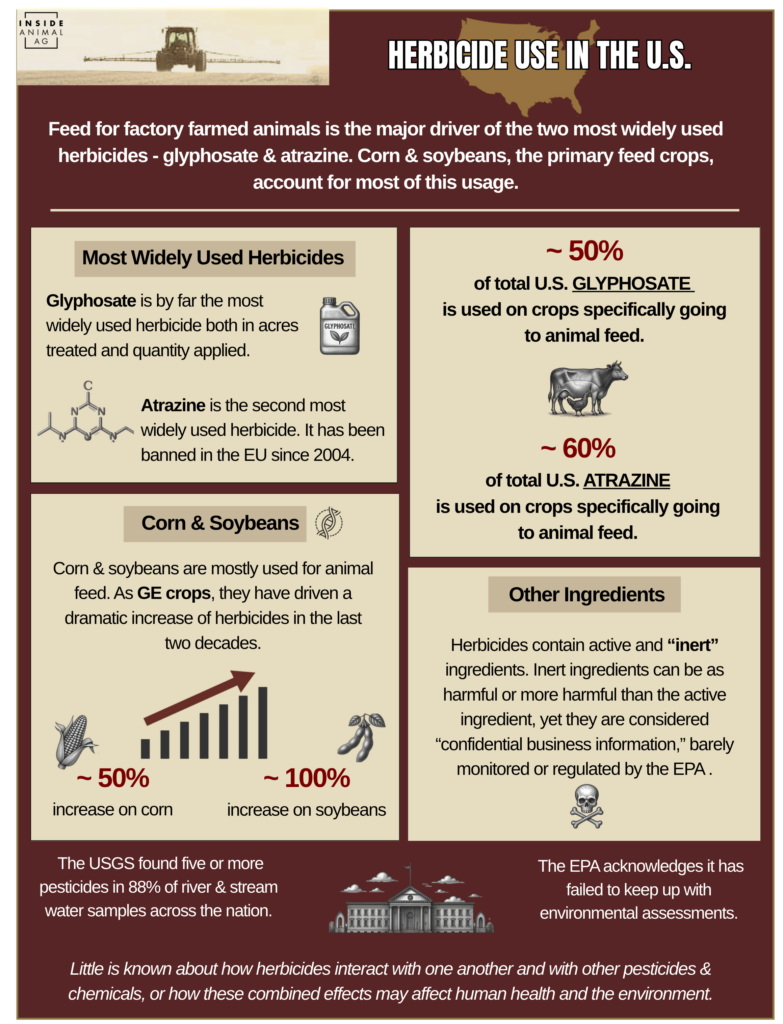
Glyphosate is the most widely used herbicide both in terms of area treated and quantity applied (weight of active ingredients).[1,2]
Atrazine is the second most widely used.[3,4]
Other commonly used herbicides include acetochlor, 2,4-D, and dicamba.[5] There are likely more than a hundred agricultural herbicides in use.[6-9]
U.S. EPA (2019) Memorandum: Glyphosate: Response to Comments, Usage, and Benefits. p. 2 and p. 27. [“Glyphosate is the most commonly used herbicide in the United States, in terms of area treated. … Glyphosate is a broad-spectrum herbicide that is applied on an average to 298 million acres of crop land annually, making it the most commonly used herbicide on agricultural sites in the United States.”]
U.S. EPA (2016) Pesticides Industry Sales and Usage: 2008-2012, Table 3.4 & p. 13. [“Glyphosate was the most used active ingredient in 2012 (270 million to 290 million pounds used), as it has been since 2001.” Was more than triple the pound volume of atrazine.]
U.S. EPA (2016) Pesticides Industry Sales and Usage: 2008-2012, Table 3.4. [Atrazine at 64M to 74M pounds.]
Beaulieu, M., et al., (2020). Predicting atrazine concentrations in waterbodies across the contiguous United States: The importance of land use, hydrology, and water physicochemistry. Limnology and Oceanography, 65(12), 2966-2983. [“Atrazine, an herbicide, is the second most used pesticide in the United States…”]
USGS Pesticide National Synthesis Project, Estimated Annual Agricultural Pesticide Use (through 2019). https://water.usgs.gov/nawqa/pnsp/usage/maps/ [Rough estimates of pounds applied are based on visual charts given for each herbicide. Glyphosate (275M lbs.), atrazine (76M lbs.), acetochlor (55M lbs.), 2,4-D (46M lbs.), dicamba (32M lbs.)]
Covert, S. A., et al., (2020). Pesticide mixtures show potential toxicity to aquatic life in US streams, water years 2013–2017. Science of the total environment, 745, 141285, p. 2. [“In the United States, over half a billion pounds (over 226,700,000 kg) of pesticides were used annually from water years (WY) 2013–2017, including the use of more than 400 different pesticides during any given year to maintain and improve crop production by controlling weeds, insects, and other pests.” Studies suggest that between a quarter and a half of agricultural pesticides are herbicides.]
Donley, N. (2019). The USA lags behind other agricultural nations in banning harmful pesticides. Environmental Health, 18(1), 44. pp. 4-5. [“Of the 508 pesticide active ingredients that have been used in agriculture in the USA since 1970, 134 have been cancelled.”]
U.S. EPA (2022) Balancing Wildlife Protection and Responsible Pesticide Use: How EPA’s Pesticide Program Will Meet its Endangered Species Act Obligations, p. 10. [“Generally, there are more than 17,000 registered pesticide products containing more than 1,200 active ingredients…” This includes all pesticide products, not just agricultural.]
Patel, O., et al., (2018). Pesticide use, allergic rhinitis, and asthma among US farm operators. Journal of Agromedicine, 23(4), 327-335. [“A total of 161 specific pesticides were identified. Of these, herbicides accounted for the largest class of pesticides (42.9%), followed by insecticides (28.6%) and fungicides (18.0%).”]
More than 50% of total U.S. glyphosate is used on crops specifically going to animal feed.[1]
About 60% of total U.S. atrazine is used on crops specifically going to animal feed.[2]
See, Herbicide Use on Feed Crops [question: What share of total glyphosate is applied to crops used specifically for animal feed?
See, Herbicide Use on Feed Crops [question: What share of total atrazine is applied to crops used specifically for animal feed?
Immense production – Corn and soybeans are the nation’s largest crops and the largest users of glyphosate and atrazine.[1] Corn and soybean production goes mostly to animal feed.[2] These two crops take up ~55% of U.S. cropland – an area the size of Texas.[3]
Monoculture crops – Monoculture agriculture eliminates much of the biodiversity (predators, competing plants, and alternative hosts) that would otherwise keep weeds in check.[4,5] Large amounts of herbicides applied with advanced technology are now the norm to keep yields high and labor costs down. Corn and soybeans are mostly grown on huge tracts of monoculture cropland – continuous areas of a single plant species. About 63% of corn and ~65% of soybeans are grown on monoculture tracts exceeding 500 acres.[6]
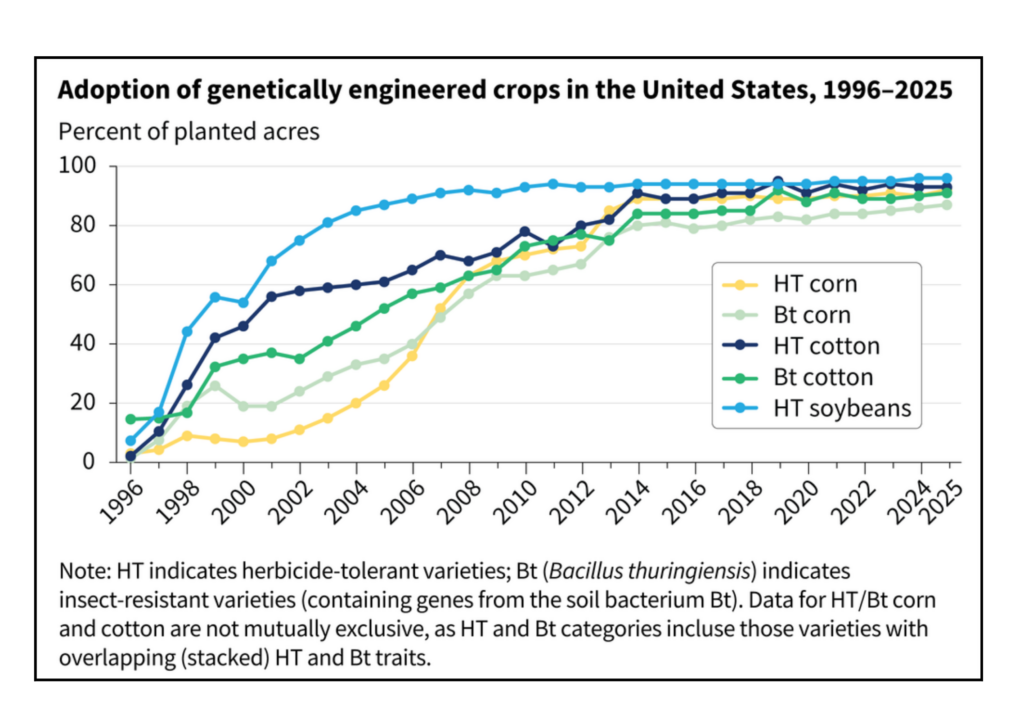
Genetically Engineered (GE) Crops – Corn and soybeans are now almost entirely grown from genetically modified seeds that are herbicide tolerant (primarily glyphosate). This allows farmers to use herbicides freely and more often.[7,8] The adoption of GE corn and soybeans has increased dramatically in the last 30 years.[9] The pervasive and long-term use of herbicides, particularly in GE corn and soybeans, has led to the evolution of herbicide resistant weeds, which in turn has driven increasing herbicide usage along with multiple applications including both older and newer herbicides.[10,11]
See, Herbicide Use on Feed Crops
See, Share of Corn Crop for Feed and Share of Soybean Crop for Feed
USDA NASS (2026) Acreage, p. 32. [In 2025, corn and soybeans planted on 180 million acres. (Corn = 98.8M. Soybeans = 81.2M.) Total acres planted = ~322M, including 311.5M in “principal crops” (p. 5) + ~10M acres for vegetables and fruits (See USDA Census of Ag 2022 Tables 35-37). 180 / 322 = ~56%]
Amina Khatri (2025) Monoculture’s Peril: Environmental, Economic, and Food Security Risks. Journal of Environmental Hazards, 09:03, p. 1. [“The absence of natural predators and competitors in such simplified environments can also lead to the unchecked proliferation of pest species, thereby creating a self-perpetuating cycle of dependency on chemical interventions.”]
Allison Balogh (2021) The rise and fall of monoculture farming. Horizon, The EU Research & Innovation Magazine. [“Raising a single crop has drawbacks as it increases the risk of disease and pest outbreaks because monocultures lack other plant and animal species that limit the spread of disease and control pests through predation. This means larger amounts of pesticides and herbicides, which can pollute rivers and streams, are needed compared to more diverse farming systems.”]
USDA 2022 Census of Agriculture. [See pages 25-27. Corn = 18,211,453 + 32,192,409 / 80,597,963 = ~63%. Soybeans = 19,150,664 + 35,952,510 / 84,599,236 = ~65%. Tallies in the Census of Ag are for harvested cropland. The corn figures are for corn for grain only.]
Mortensen, D. A., et al., (2024). Another step on the transgene-facilitated herbicide treadmill. Pest Manag Sci 80: 4145–4149, p. 4146. [“Interestingly, glyphosate use rates continued at 1.4 kg ha−1 despite the ever-worsening problem of glyphosate resistance. Hence, the large increase in total herbicide use over that period was driven primarily by applications of other pre- and post-emergence herbicides intended to control glyphosate-resistant weeds. Dramatic increases in the use of dicamba following the introduction of dicamba-resistant soybean further added to the total.”]
USDA (2022) 2021 Agricultural Chemical Use Survey – Corn [See Table 2. Considering only the top 5 herbicides applied to corn, the average use is 2.14 herbicide types per acre.]
USDA ERS (2025) Adoption of Genetically Engineered Crops in the United States – Recent Trends in GE Adoption. https://www.ers.usda.gov/data-products/adoption-of-genetically-engineered-crops-in-the-united-states/recent-trends-in-ge-adoption
Bonny, S. (2016). Genetically modified herbicide-tolerant crops, weeds, and herbicides: overview and impact. Environmental management, 57(1), 31-48, Abstract. [“However, the repetition of glyphosate-tolerant crops and of glyphosate only applications in the same fields without sufficient alternation and herbicide diversity has contributed to the appearance of glyphosate-resistant weeds. These weeds have resulted in a rise in the use of glyphosate and other herbicides.”]
Myers, J. P., et al., (2016). Concerns over use of glyphosate-based herbicides and risks associated with exposures: a consensus statement. Environmental Health, 15(1), 19. [“The emergence and spread of glyphosate-resistant weeds requires farmers to spray additional herbicides, including older herbicides posing documented environmental and public health risks and/or newer, more costly herbicides to avoid crop yield losses and slow the spread of these weeds. This is particularly problematic in grain and row-crop fields planted for several years with Roundup Ready GE crops.”]
It is generally accepted that glyphosate has wide-ranging negative effects on non-target plants, micro-organisms, and animals.[1]
The EPA has determined that glyphosate is “likely to adversely affect” 93% of the nation’s endangered species (1,676 species) and 96% of critical habitats.[2] Many scientific journals have documented the negative effects of glyphosate and its formulations on animals.[3,4]
Glyphosate has been found to distort microbial communities in soil, plants, and animals, which increases risk of disease.[5] Reports have documented the damage of glyphosate to amphibians;[6] honeybees;[7] and earthworms.[8]
The species that may have seen the steepest decline in the U.S. are monarch butterflies, which have declined by 85% or more due to widespread and increased use of glyphosate and the adoption of herbicide resistant crops that have decimated milkweed – the host plants for egg-laying female monarchs.[9]
Adding to, and in many cases exceeding, the toxicity of glyphosate as an active ingredient, are the chemicals added to glyphosate formulations. These additives have been found to make glyphosate formulations more toxic than the active ingredient by itself, particularly for aquatic animals.[10,11]
Klátyik, S., et al., (2023). Terrestrial ecotoxicity of glyphosate, its formulations, and co-formulants: evidence from 2010–2023. Environmental Sciences Europe, 35(1), 51–29. [“Both GLY (glyphosate) alone and GBHs (glyphosate-based herbicides) have unintended side-effects on many terrestrial organisms, including non-target plants, microorganisms, insects, spiders, or earthworms, as well as vertebrates such as amphibians, reptiles, or mammals.”]
U.S. EPA (2021) Final National Level Listed Species Biological Evaluation for Glyphosate, Chapter 4: Appendix 4-1, Species Effects Determinations, Summary Tables.
Evalen, P. S., et al., (2024). Toxicity of glyphosate to animals: A meta-analytical approach. Environmental Pollution, 347, 123669, p. 5. [“Nonetheless, we conservatively demonstrate that GLY/GBH can be sub-lethally toxic for animals, particularly for animals in aquatic or marine habitats.”]
van Bruggen, A. H. C., et al., (2018). Environmental and health effects of the herbicide glyphosate. The Science of the Total Environment, 616–617, 255–268, p. 14. [“Chronic low dose effects on animals and humans have been documented recently.”]
van Bruggen, A. H. C., et al., (2018), p. 14. [“Thus, the presence of glyphosate in soil could change the community compositions of bacteria and fungi, in turn altering soil ecosystem functions and plant and animal health.”]
Mann, R. M., et al., (2009). Amphibians and agricultural chemicals: Review of the risks in a complex environment. Environmental Pollution (1987), 157(11), 2903–2927.
Balbuena, M.S., et al., (2015) Effects of sublethal doses of glyphosate on honeybee navigation. The Journal of Experimental Biology, 218, 2799.
Gaupp-Berghausen, M., et al., (2015). Glyphosate-based herbicides reduce the activity and reproduction of earthworms and lead to increased soil nutrient concentrations. Scientific Reports, 5(1), 12886-.
Wepprich, T., et al., (2019). Butterfly abundance declines over 20 years of systematic monitoring in Ohio, USA. PloS One, 14(7), e0216270, p. 2.
Klátyik, S., et al., (2023), p. 2. [“Recently, numerous studies have confirmed the high individual toxicity of co-formulants…”]
van Bruggen, A. H. C., et al., (2018), p. 260. [“ Glyphosate formulations with POEA are generally more toxic than those without this surfactant. Aquatic animals seem to be more sensitive to POEA than terrestrial animals.”]
The EPA has determined that atrazine is likely to adversely affect 56% of endangered or threatened species and 41% of critical habitats.[1] The agency’s lengthy analysis of the many confirmed damages to species, especially aquatic species, seems wholly incompatible with its continued use and agency approval.[2]
A recent report summarizes the data regarding atrazine’s position as “the most widespread pesticide water contaminant in the United States.”[3] USGS researchers confirm that atrazine is by far the most pervasive and toxic herbicide in the nation’s rivers and “a persistent threat to aquatic life.”[4]
Studies have shown that atrazine causes testicular disfunction in certain fish, amphibians, and reptiles resulting in partial or complete feminization of males.[5,6] These findings have not been consistent across all studies. However, a meta-analysis of these reports found that “seven of the 10 studies including results on males and females reported strong trends or statistically significant alterations (6 studies) in at least one aspect of general gonadal morphology associated with atrazine exposure.”[7] A more recent review concludes generally that “atrazine is known to be an endocrine-disrupting chemical.”[8]
Atrazine was effectively banned by the EU in 2004 and is currently banned in more than 30 other countries.[9-11]
U.S. EPA (2021) Final National Level Listed Species Biological Evaluation for Atrazine, Chapter 4: Appendix 4-1, Species Effects Determinations, Summary Tables (Table 4-1, 4-2).
Farruggia, F. T., et al., (2016). Refined ecological risk assessment for atrazine. US Environmental Protection Agency, Office of Pesticide Programs: Washington, DC, USA, Abstract. [“Based on the results from hundreds of toxicity studies on the effects of atrazine on plants and animals, over 20 years of surface water monitoring data, and higher tier aquatic exposure models, this risk assessment concludes that aquatic plant communities are impacted in many areas where atrazine use is heaviest, and there is potential chronic risk to fish, amphibians, and aquatic invertebrates in these same locations.” “EPA levels of concern for chronic risk are exceeded by as much as 22, 198, and 62 times for birds, mammals, and fish, respectively.”]
Donley, N., & Bradley, C. M. (2026). Evaluating the effectiveness of EPA’s proposed runoff mitigation plan on atrazine surface water concentrations in the United States, Vol. 55, No. 5, p. e70274. [See Introduction, p. 2]
Shoda, M. E., et al., (2026). Riverine Pesticide Trends in the United States: Assessing a Decade of National-Scale Monitoring. ACS ES&T Water, 6(6), 3510-3521, p. 3517. [“Notably, the percentage of sites and percentage of samples with atrazine acute aquatic life benchmark exceedances were typically an order of magnitude higher than for other pesticides. …indicating atrazine’s and consistent historical use.”]
Hayes, T. B., et al., (2011). Demasculinization and feminization of male gonads by atrazine: consistent effects across vertebrate classes. The Journal of steroid biochemistry and molecular biology, 127(1-2), 64-73.2.
Hayes, T. B., et al., (2002). Hermaphroditic, Demasculinized Frogs after Exposure to the Herbicide Atrazine at Low Ecologically Relevant Doses. PNAS 99(8), 5476-5480.
Rohr, J. R., & McCoy, K. A. (2010). A Qualitative Meta-Analysis Reveals Consistent Effects of Atrazine on Freshwater Fish and Amphibians. Environmental Health Perspectives, 118(1), 20–32, p. 26.
Stradtman, S. C., & Freeman, J. L. (2021). Mechanisms of Neurotoxicity Associated with Exposure to the Herbicide Atrazine. Toxics (Basel), 9(9), 207, p. 5. See also, Mikaela Conley (May 4, 2024) Atrazine, an endocrine-disrupting herbicide banned in Europe, is widely used in the U.S., U.S. Right to Know. https://usrtk.org/pesticides/atrazine/ [Listing studies of health impacts on both humans and animals]
Legislation.gov.uk (2004) Commission Decision concerning the non-inclusion of atrazine, 2004/248/EC. [“Measures should be taken to ensure that existing authorisations for plant protection products containing atrazine are withdrawn within a prescribed period and are not renewed and that no new authorisations for such products are granted.”]
Bethsass, J., & Colangelo, A. (2006). European Union bans atrazine, while the United States negotiates continued use. International journal of occupational and environmental health, 12(3), 260-267.
Pesticide Action Network International (2024) PAN International Consolidated List of Banned Pesticides. https://pan-international.org/pan-international-consolidated-list-of-banned-pesticides/
Most studies of herbicide impacts on human health and the environment analyze the effects of active ingredients, i.e. glyphosate or atrazine, in isolation, thereby ignoring or downplaying the impacts of added inert ingredients, degradates, and the effects of applying multiple pesticides simultaneously or in succession.[1,2]
Inert ingredients (co-formulants) – Herbicides are formulations that include substances added to aid the active ingredient’s performance, storage, and usability. These are called inert ingredients, which the EPA cautions “does not mean non-toxic.”[3] The law does not require manufacturers to identify inert ingredients on product labels.[4] Astonishingly, the identity of inert ingredients – spread throughout the environment in the hundreds of millions of pounds – is considered “confidential business information.”[5,6] And a number of these additives have been found to be as toxic or more toxic than the active ingredient alone, particularly for aquatic animals.[7]
Degradates – After an herbicide is applied, the original chemical (the parent compound) can be transformed into subsequent compounds termed degradates by chemical reactions with soil, water, sunlight, or other environmental factors, and they can also be significantly more harmful that the original pesticide.[8,9] A degradate of glyphosate is called AMPA (aminomethylphosphonic acid). Studies are inconclusive as to the toxicity of AMPA alone, but some indicate that the “toxicity risk of AMPA, in view of its longer persistence in the environment, is higher when compared with glyphosate.”[10]
Nagy, K., et al., (2020). Systematic review of comparative studies assessing the toxicity of pesticide active ingredients and their product formulations. Environmental Research, 181, 108926, Abstract. [“…the approval of pesticide products is still mostly limited to determining the toxicity of the individual ingredients ignoring the possible combined effects in mixtures. … Ignoring the possible risks deriving from the interaction between the active and other ingredients of various commercial pesticide product formulations might result in the misinterpretation of its toxicological profile.]
Klátyik, S., et al., (2025). Toxicological concerns regarding glyphosate, its formulations, and co-formulants as environmental pollutants: a review of published studies from 2010 to 2025. Archives of Toxicology, 99(8), 3169-3203, p. 3170. [“Unfortunately, most regulatory assessments and published studies do not assess the significant impacts of co-formulants on product chemistry, environmental fate, absorption, distribution, metabolism, and excretion (ADME), and adverse impacts and outcomes.”]
U.S. EPA (November 2025) Basic Information about Pesticide Ingredients. https://www.epa.gov/ingredients-used-pesticide-products/basic-information-about-pesticide-ingredients
40 CFR Part 156 – Public Availability of Identities of Inert Ingredients in Pesticides – A Proposed Rule by the Environmental Protection Agency on 12/23/2009. [“Active ingredients must be identified by name and percentage on the pesticide’s ingredient statement, which is a necessary component of the pesticide product label under FIFRA section 2(q)(2)(A). By contrast, only the total percentage of all inert ingredients in the pesticide must be contained on the ingredient statement. FIFRA section 2(n)(1). There is no statutory requirement that the names of all inert ingredients be contained on the ingredient statement.”]
U.S. EPA (November 2025) Basic Information about Pesticide Ingredients. [“Under federal law, the identity of inert ingredients is confidential business information.”]
Cox, C., & Surgan, M. (2006). Unidentified inert ingredients in pesticides: implications for human and environmental health. Environmental health perspectives, 114(12), p. 1803. [In a review of over 100 agricultural products, Northwest Coalition for Alternatives to Pesticides (NCAP) found that they contained an average of > 50% inert ingredients.” Annual U.S. herbicide weight is ~800M pounds.]
See question below.
USGS (March 11, 2021) Did You Know That Pesticides Can Be Transformed Into Other Chemicals? Water Resources Mission Area. [“The most frequently detected transformation products were degradates of nine herbicides, one insecticide, and two fungicides; the summed concentrations of these transformation products frequently exceeded the concentration of the parent pesticide. … A toxicity analysis using the assumption that transformation products have the same toxicity as their parent pesticide indicates that potential aquatic effects of pesticide-related compounds could be underestimated by an order of magnitude or more.”]
Bacmaga, M., et al., (2024) Environmental Implication of Herbicide Use. Molecules 29, 5965, p. 7. [“These chemicals degrade in the environment under the influence of microbial activity and various physicochemical factors, i.e., sunlight, temperature, humidity, and oxygen content. During these processes, they are transformed into metabolites that may be non-toxic or more harmful than the starting compound itself.”]
Meftaul, I., et al., (2020) Controversies over human health and ecological impacts of glyphosate: Is it to be banned in modern agriculture? Environmental Pollution 263, 114372, p. 3.
Myers, J. P., et al., (2016) Concerns over use of glyphosate-based herbicides and risks associated with exposures: a consensus statement. Environmental Health 15:19, p. 4.
Covert, S. A., et al., (2020). Pesticide mixtures show potential toxicity to aquatic life in US streams, water years 2013–2017. Science of the total environment, 745, 141285.
Nowell, L. H., et al., (2018). Complex mixtures of dissolved pesticides show potential aquatic toxicity in a synoptic study of Midwestern US streams. Science of the Total Environment, 613, 1469-1488. [“Mixtures of 2 or more pesticide compounds were observed in all but 1 of the 1,197 water samples (99.9%).”]
Yes, it is widely understood that so-called inert ingredients can be toxic wholly apart from the active ingredient and/or increase the toxicity of the active ingredient.[1,2]
In glyphosate-based herbicides, most formulations include surfactants which increase penetration of the leaf surfaces of weeds. They generally account for 5-15% of the product’s weight.[3]The most common surfactant is known as POEA (polyethoxylated tallow amines), and studies have found that it is significantly more harmful than the active ingredient.[4-7] Experienced researchers claim that the cytotoxicity (toxic effect on cells) can vary up to 100 times depending on formulation.[8] POEA surfactants in glyphosate-based herbicides are banned in Europe.[9]
Klatyik, S., et al., (2023). Terrestrial ecotoxicity of glyphosate, its formulations, and co-formulants: evidence from 2010–2023, Environmental Sciences Europe 35:51, p. 2. [“Recently, numerous studies have confirmed the high individual toxicity of co-formulants and the increased combined toxicity of active ingredients and co-formulants.”]
U.S. EPA (November 2025) Basic Information about Pesticide Ingredients. [“The name “inert” does not mean non-toxic.”]
Mesnage, R., et al., (2019). Insight into the confusion over surfactant co-formulants in glyphosate-based herbicides. Food and Chemical Toxicology, 128, 137-145, p. 139.
Defarge, N., et al., (2018). Toxicity of formulants and heavy metals in glyphosate-based herbicides and other pesticides. Toxicology reports, 5, 156-163, Abstract. [“In the short term, the strong herbicidal and toxic properties of its formulations were exerted by the POEA formulant family alone. The toxic effects and endocrine disrupting properties of the formulations were mostly due to the formulants and not to glyphosate.”]
Zsanett Miko & Attila Hettyey (2023) Toxicity of POEA-containing glyphosate-based herbicides to amphibians is mainly due to the surfactant, not to the active ingredient. Ecotoxicology 32, 15-150, p. 153. [“Our results clearly show that from the two main components of the most widely used glyphosate-based herbicides, it is the surfactant (POEA) that is primarily responsible for the harmful effects, while the active ingredient (glyphosate) has much weaker toxicity.” “Previous studies suggested that for aquatic organisms POEA is the more harmful component.” at p. 151]
Klátyik, S., et al., (2024). Aquatic ecotoxicity of glyphosate, its formulations, and co-formulants: evidence from 2010 to 2023. Environmental Sciences Europe, 36(1), 22. p. 49. [“This increased combined toxicity of the components present in commercial pesticide formulations has been demonstrated for POEA and many other co-formulants in glyphosate-based herbicides.”]
Meftaul, I. M., (2020). Controversies over human health and ecological impacts of glyphosate: Is it to be banned in modern agriculture?. Environmental Pollution, 263, 114372. [“Moreover, several investigations confirmed that the surfactant, polyethoxylated tallow amine (POEA), contained in the formulations of glyphosate like Roundup, is responsible for the established adverse impacts on human and ecological health.”]
Mesnage, R., et al., (2019), p. 138. [“Cytotoxicity of Roundup formulations can vary by up to 100-fold, even if commercial products contain the same form and concentration of glyphosate, but different co-formulants.”]
Official Journal of the European Union – Commission Implementing Regulation (EU) 2016/1313 of 1 August 2016 amending Implementation Regulation (EU) No 540/2011 as regards the conditions of approval of the active substance glyphosate. [“In the light of current scientific and technical knowledge it is appropriate to amend the conditions of use of the active substance in particular by excluding the co-formulant POE-tallowamine from the use in plant protection products containing glyphosate. Implementing Regulation (EU) No 540/2011 should be amended accordingly.”]
There are many reports that claim that “the alternatives” to glyphosate are worse than glyphosate.[1-4] These claims are questionable, especially considering the toxicity of glyphosate’s inert ingredients, the immense unknowns of its interactions with other pesticides, and the unstudied long-term impacts on the environment, especially biodiversity.
More critically, the arguments rest on the assumption that vast amounts of chemical herbicides must be used on crops; it’s simply a matter of which have been proven to be more toxic. There are (and always have been) more ecological ways to control weeds, but they require more effort and less yield in the short term.[5] The real question is whether we accept using immense amounts of chemical herbicides on cropland to grow animal feed and submit to both the known and unknown health and environmental damages from all herbicides or do we choose another path?
The economic damages from corn production are likely orders of magnitude greater than the profits from that production. Damages due to glyphosate-based herbicides add to that long list of externalized costs. Should we consider the alternative of not using two-thirds of the nation’s cropland to grow cheap feed crops for factory farmed animals?
Duke, S. O. (2018). The history and current status of glyphosate. Pest management science, 74(5), 1027-1034. [“As mentioned above, most analyses of the environmental impact of glyphosate-resistant crops found an improvement over the multiple herbicides and tillage that they replaced.”]
Kniss, A. R. (2017). Long-term trends in the intensity and relative toxicity of herbicide use. Nature communications, 8(1), 14865, p. 6. [“So although the chronic hazard quotient increased in 2 of 3 glyphosate-resistant crops, if glyphosate were not used the chronic hazard quotient would almost certainly be even greater since other herbicides with greater chronic toxicity would have been used instead.”]
Metcalfe, H., (2024). Trade-offs constrain the success of glyphosate-free farming. Scientific Reports, 14(1), 8001. Abstract. [“Removing glyphosate was projected to increase weed abundance, herbicide risk to the environment, and arable plant diversity and decrease food production.”]
Meftaul, I. M., et al., (2020). Controversies over human health and ecological impacts of glyphosate: Is it to be banned in modern agriculture?. Environmental Pollution, 263, 114372, p. 13. [“Based on the state-of-the-art situation, it appears that glyphosate is a lesser toxic herbicide compared to several other weed killers if proper guidelines are followed during its application at judicious concentrations.”]
MacLaren, C., et al., (2020). An ecological future for weed science to sustain crop production and the environment. A review. Agronomy for Sustainable Development, 40(4), 24.
Atrazine was effectively banned by the EU in 2004 and is currently banned in more than 30 other countries.[1-3] In 2025, it was classified as “probably carcinogenic to humans” by the WHO’s International Agency for Research on Cancer (IARC) which also found there was “sufficient” evidence that it caused cancer in animals.[4]
Legislation.gov.uk (2004) Commission Decision concerning the non-inclusion of atrazine, 2004/248/EC. [“Measures should be taken to ensure that existing authorisations for plant protection products containing atrazine are withdrawn within a prescribed period and are not renewed and that no new authorisations for such products are granted.”]
Bethsass, J., & Colangelo, A. (2006). European Union bans atrazine, while the United States negotiates continued use. International journal of occupational and environmental health, 12(3), 260-267.
Pesticide Action Network International (2024) PAN International Consolidated List of Banned Pesticides.
Cattley, R.C., et al., (2026). Carcinogenicity of atrazine, alachlor, and vinclozolin. Lancet Oncol. Vol 27, Issue 1.
According to the EPA, there are more than 17,000 registered pesticide products containing more than 1,200 active ingredients.[1] The EPA does not have the time, manpower, or expertise to analyze even a small portion of these.[2,3] EPA pesticide approvals rely on industry-supplied data that claim the pesticides are safe for use.[4,5]
The damaging impacts of so-called inert ingredients are almost entirely beyond the scope of testing and regulation.[6,7] Their usage and compositions are withheld from public understanding.[8-10] The myriad combinations of chemicals and degradates and their impacts on the environment are beyond comprehension.[11,12]
We are all involved in a high-stakes experiment regarding the impacts of these chemicals set free on land and water, especially those on biodiversity.[13,14]
U.S. EPA (2022) Balancing Wildlife Protection and Responsible Pesticide Use: How EPA’s Pesticide Program Will Meet its Endangered Species Act Obligations, p. 10. [Of these, about 400 are agricultural pesticides. See, Covert, S. A., et al., (2020). Pesticide mixtures show potential toxicity to aquatic life in US streams, water years 2013–2017. Science of the total environment, 745, 141285. p. 2. [“…including the use of more than 400 different pesticides during any given year to maintain and improve crop production…” Studies suggest that between a quarter and a half of agricultural pesticides are herbicides.]
U.S. EPA (2022) Balancing Wildlife Protection and Responsible Pesticide Use, p.10. [In past decades, the Agency has met those obligations for less than 5% of the thousands of pesticide actions it completes annually under the Federal Insecticide, Fungicide, and Rodenticide Act (FIFRA). … EPA’s Pesticide Program has been unable to keep pace with its ESA workload…”]
David Shepardson & Nichola Groom (July 28, 2025) US EPA cutting workforce by 23%, closing research division. Reuters. [“In January, the EPA had 16,155 employees, and after layoffs and employees taking financial incentives to leave or retire, it will have a workforce of 12,448, the agency said.”]
Boone, M. D., et al., (2014). Pesticide regulation amid the influence of industry. BioScience, 64(10), 917-922, p. 917. [“A major weakness of the USEPA’s pesticide risk assessment is the use of industry-supplied data, which has inherent conflicts of interest.”]
Benbrook, C., et al., (2021). Commentary: novel strategies and new tools to curtail the health effects of pesticides. Environmental Health, 20(1), 87, Abstract. [Proposal to: “End near-sole reliance in regulatory decision-making on industry-supported studies by supporting and relying more heavily on independent science, especially for core toxicology studies.”]
Donley, N., et al., (2024). Forever pesticides: a growing source of PFAS contamination in the environment. Environmental Health Perspectives, 132(7), 075003, p. 1. [“Unlike active ingredients, “inerts” are not required to be publicly disclosed on the pesticide label and toxicity testing is limited.”]
Benbrook, C., et al., (2021), p. 4. [“The core toxicology tests required by the EPA, EU, and most other regulatory authorities focus almost exclusively on pure active ingredients.”]
U.S. EPA (November 2025) Basic Information about Pesticide Ingredients. [“Under federal law, the identity of inert ingredients is confidential business information.”]
Mesnage, R., et al., (2019). Insight into the confusion over surfactant co-formulants in glyphosate-based herbicides. Food and Chemical Toxicology 128, 137-145, p. 138. [“ The identity and concentration of the co-formulants in end-use pesticide products is proffered as confidential business information by industry and accepted as such by regulators, and hence is rarely disclosed on product labels or via any publicly accessible source.”]
USDA NASS (2026) Chemical Surveys/Agricultural Chemical Use Program. See methodology pages for all. [“ All pesticide-use estimates in report are published per active ingredient (rather than per product); one or more active ingredients are present in known amounts in the pesticide products reported in survey.”]
Covert, S. A., et al., (2020). Pesticide mixtures show potential toxicity to aquatic life in US streams, water years 2013–2017. Science of the total environment, 745, 141285. [USGS researchers found five or more pesticides in almost 90% of river water samples from across the nation.]
Wan, N.F., et al., (2025). Pesticides have negative effects on non-target organisms. Nature Communications, 16(1), 1360–16, p. 7. [“While we identified responses for individual compounds, it is likely that these effects may be exacerbated through additive or potentially synergistic effects where compounds are applied in combination or to areas with existing residues present.”]
Battaglin, W. A., et al., (2014). Glyphosate and Its Degradation Product AMPA Occur Frequently and Widely in U.S. Soils, Surface Water, Groundwater, and Precipitation. Journal of the American Water Resources Association, 50(2), 275–290, p. 285. [USGS researchers explain that “…the ecosystem effects of chronic low-level exposures to pesticide mixtures are uncertain.”]
Wan, N.F., et al., (2025), Abstract. [“Pesticides affect a diverse range of non-target species and may be linked to global biodiversity loss. The magnitude of this hazard remains only partially understood. … Our results question the sustainability of current pesticide use and support the need for enhanced risk assessments to reduce risks to biodiversity and ecosystems.”]