
According to the USDA grazing is “Feeding on standing vegetation, as by livestock or wild animals.”[1]
Grazing allows farmed animals to be outdoors and directly consume forage: grasses, legumes, and forbs, on rangeland or pasture.[2]
USDA NALT Glossary (National Agricultural Library Thesaurus)
USDA NRCS (June 2022) National Range and Pasture Handbook. No. 645, pp. A5-A8.
Farmed animals that are ruminants generally spend at least some portion of their lives grazing. A ruminant “characteristically has a stomach divided into four compartments and chews a cud that consists of plant food that is regurgitated when partially digested.”[1]
The vast majority of farmed animals that graze are cattle raised for beef or dairy products, with sheep and goats also grazing.[2]
“ruminant” American Heritage Dictionary, n.d.
USDA (2024) 2022 Census of Agriculture, United States, Vol 1, Part 51, Tables 12, 27 & 28.
The purpose of grazing cattle in the U.S. is to raise animals to an age and size at which they can enter factory farm feedlots.[1] Their health must be good enough to survive the difficult transition, including social losses, multiple transports, periods of limited food and water, tight confinement, mutilations, various drugs, hormones, and growth promotants, and especially the unnatural corn based-diets.[2,3]
Unlike chickens and pigs, cattle cannot survive to suitable slaughter weights solely on high-grain diets. Even a few months on corn/soy feedlot diets makes many cattle sick.[4-7] Therefore, the length of time on feedlots must be limited.
Cattle are grazed on rangeland or pasture with their mothers for 5 to 7 months until they reach a weight of about 500 pounds. Some are then transported to other grazing lands, some are partially grazed, and others go directly to feedlots.[8,9] Almost all end up on feedlots prior to slaughter, with an average stay of about 5 months.[10,11]
Drouillard, J. S. (2018). Current situation and future trends for beef production in the United States of America—A review. Asian-Australasian journal of animal sciences, 31(7), 1007. See p. 1009-1010 and Figure 2 for possible paths from grazing lands to feedlots. [“The primary product of cow-calf operations is weaned calves, which are sold to stocker operators, backgrounding lots, or feedlots.”]
Crawford, et al., (2022). Feeding a high-energy finishing diet upon arrival to high-risk feedlot calves: Effects on health, performance, ruminal pH, rumination, serum metabolites, and carcass traits. Journal of Animal Science, 100(9), skac194. p. 1. [“During the marketing process, these cattle are usually weaned and immediately transported to auction barns where they are comingled and have limited access to feed and water. Upon feedlot arrival, cattle experience additional stress such as handling, administration of implants, vaccines, and other animal health products, castration, and provision of unfamiliar feedstuffs…”]
Francis Fluharty (2017) How to transition calves to grain-based diets. Farm Progress. [“Many animals are seeing an automatic waterer and learning to eat from a feed bunk for the first time. Further, take into account the fact that newly weaned animals in confinement are developing a new social hierarchy, are being exposed to several potentially harmful pathogens that must be managed through vaccinations and may develop respiratory problems if they are further stressed with rapid diet changes.”]
Nagaraja, T. G., & Chengappa, M. M. (1998). Liver abscesses in feedlot cattle: a review. Journal of animal science, 76(1), 287-298, Abstract. [“Liver abscesses in slaughtered beef cattle result from aggressive grain-feeding programs.”]
Eastwood, L. C., et al., (2017). National Beef Quality Audit-2016: Transportation, mobility, and harvest-floor assessments of targeted characteristics that affect quality and value of cattle, carcasses, and by-products. Translational Animal Science, 1(2), 229-238. [About 18% of cattle in feedlots have liver abscesses.]
USDA APHIS (2013) Feedlot 2011 Part IV: Health and Health Management on U.S. Feedlots with a Capacity of 1,000 or More Head, p.ii. [“The most common illness of cattle placed in feedlots was respiratory disease; 16.2 percent of cattle were affected with respiratory disease.”]
Steven C. Loerch (January 2000) Metabolic Diseases of Feedlot Cattle, Department of Animal Sciences, The Ohio State University.[“There are four main metabolic diseases feedlot operators need to be aware of: polio, acidosis, rumenitis and bloat. Unlike respiratory diseases, these are not infectious diseases and therefore are not contagious. They do have one thing in common, they occur primarily in cattle fed high grain finishing rations.”]
Gillespie, J., et al., (July 2023) Structure, Management Practices, and Production Costs of U.S. Beef Cow-Calf Farms, USDA ERS, Report No. 321. [“On cow-calf operations, cows (i.e., female bovine animals that have given birth) give birth to calves, which are generally raised to weights of 400–600 pounds before being weaned. Once weaned, calves may be sold and shipped to feedlots, where they are fed until reaching slaughter weight, or to stocker producers, where they gain additional weight on pasture prior to moving to the feedlot. Alternatively, calves may be retained as backgrounders or stockers, or finished to slaughter weight on the farm. Cow-calf production mostly occurs on pasture with forage grazing as the primary feed source, supplemented with hay and sometimes other feeds.”]
USDA APHIS (May 2021). Beef 2017 – Beef Cow-calf Health and Management Practices in the United States, 2017, p. 6. [“Weaning normally occurs when calves are 4 to 8 months old.”]
Drouillard, J. S. (2018), Abstract. [“Young steers and heifers are grain-based diets fed for an average of 5 months.”]
Food Animal Production Manual (2015). Western Institute for Food Safety and Security at the University of California, Davis and the Food and Drug Administration, p. 23. [“Cattle (heifers or steers in feedlots) typically remain on a feedlot from 90 to 180 days before being sent to a processing facility at 18 to 22 months of age.”
Ruminants have evolved to digest and metabolize cellulose which is the essential part of the solid framework of plants – highly fibrous and indigestible to most animals.[1] The grains and oilseeds fed to factory farmed pigs and poultry are not easily digested by ruminants and often create digestive and other health problems, which are then treated prophylactically with antibiotics.[2-4]
The economics of a cheaper food source also plays a role. About 35% of the contiguous U.S. is considered grazing land.[5] The topography, soil characteristics, and water availability in these areas usually limit agricultural uses. It has become accepted that cattle, sheep, and goats grazing on these lands “render productive vast portions of otherwise unusable land.”[6] This, of course, presumes that land is not productive if it cannot grow food for humans, even if it does support natural ecosystems, biodiversity, and sequestration of carbon.[7-9]
Lee Rinehart (2008) Ruminant Nutrition for Graziers, USDA NRCS, Publication of National Sustainable Agriculture Information Service, pp. 2 and 4.
Francis Fluharty (2017) How to transition calves to grain-based diets, Farm Progress. https://www.farmprogress.com/livestock/how-to-transition-calves-to-grain-based-diets
USDA (2011) FAD PReP Beef Feedlot Industry Manual, Animal and Plant Health Inspection Service, pp. 9, 16, 17. [Cattle sent to feedlots are slowly transitioned to a diet with corn and soy products, are often given antibiotics prophylactically, and must be kept relatively healthy for an average of 5 to 6 months prior to slaughter.]
PewTrust.org (2021) FDA Must End Unnecessary Long-Term Antibiotic Use on Farms and Feedlots. https://www.pewtrusts.org/en/research-and-analysis/articles/2021/06/01/fda-must-end-unnecessary-long-term-antibiotic-use-on-farms-and-feedlots [Antibiotics are regularly given to cattle on feedyards to prevent liver abscesses, a condition associated with the highly enriched grain-based diets that cattle growers use to rapidly increase animal weight before slaughter.]
Winters-Michaud, C. et al., (2024) Major Uses of Land in the United States, 2017, USDA ERS Bulletin No. 275, Table 1, p. 5. [We do not include 132M acres of “forest-use land” categorized by Winters-Michaud as grazing land since it is not the “primary use.”]
Lee Rinehart (2008) Ruminant Nutrition for Graziers, p. 3.
Asner, G. P., et al., (2004). Grazing systems, ecosystem responses, and global change. Annu. Rev. Environ. Resour., 29, 261-299.
Hovick, T.J., et al., (2021) Rangeland Biodiversity, Rangeland Wildlife Ecology and Conservation, McNew et al. (eds.) Ch. 8, p. 217. [“Given the large amount of land that is used for livestock production, it is not surprising that livestock herbivory has profound impacts on rangeland biodiversity.”]
USDA Forest Service (2021) Do you Know Where Your Rangeland Carbon Is? https://www.fs.usda.gov/rm/pubs_journals/rmrs/sycu/2021/sycu5_2021_11_rangeland_carbon.pdf
Grazing lands are generally divided into rangeland and pastureland.
 Rangelands – are made up of mostly native plants that are uncultivated.[1,2] Pasturelands – are made up of mostly introduced forage plants that are cultivated.[3,4]
Pellant, M., et al., (2020) Interpreting Indicators of Rangeland Health, Version 5. Tech Ref 1734-6, Bureau of Land Management, Table 1, p. 5. [Rangelands are “lands on which the indigenous vegetation (climax or natural potential) is predominantly grasses, grass-like plants, forbs, or shrubs and is managed as a natural ecosystem. If plants are introduced, they are managed similarly.”]
USDA NALT Glossary [Rangelands defined as “Land on which the historic climax plant community is predominantly grasses, grasslike plants, forbs, or shrubs. Includes lands revegetated naturally or artificially when routine management of that vegetation is accomplished mainly through manipulation of grazing. Rangelands include natural grasslands, savannas, shrublands, most deserts, tundra, alpine communities, coastal marshes.”]
USDA NRCS Pasture Resources. [“Pasture is a land use type having vegetation cover comprised primarily of introduced or enhanced native forage species that is used for livestock grazing. Pasture receives periodic renovation and cultural treatments such as tillage, fertilization, mowing, weed control, and may be irrigated.”]
Bundy, L. R., et al., (2025). United States pasture and rangeland conditions: 1995–2022. Agronomy Journal, 117(1), e21736, p. 1. [“Pastures are defined as land used for herbaceous forage crops that are highly managed and cultivated, while rangelands are an area of shrub and/or natural grass ecosystems primarily used for extensive livestock production.”]
Out of total contiguous U.S. land area (~1.9 billion acres in 48 states), grazing land accounted for about 671 million acres in 2017, or ~35% of contiguous U.S. land area.[1] This is land on which grazing is the primary use.[2]

Winters-Michaud, C. et al., (2024) Major Uses of Land in the United States, 2017, USDA ERS Bulletin No. 275, Table 1, p. 5. [total continental U.S. land area = 1,891 million acres. Total grazing land = 671 million acres. 671 /1891 == 35.49%]
Note: Winters-Michaud et al., categorizes an additional ~132 million “forest-use” acres as grazing land. But we do not include those acres since grazing is not the “primary use” on that land. land = 803 million acres. 803 /1891 == 42.5%]
About 670 million acres are used for grazing as their “primary use.” This is ~35% of the contiguous U.S.[1] The categories are broadly estimated as follows:
Rangelands (~540 million acres) About 400 million acres are privately-owned rangelands.[2] About 140 million acres are federally owned rangelands.[3]
Pastureland (~130 million acres) About 120 million acres are privately-owned pastureland.[4] About 10 million acres are privately owned croplands used for pasture.[5]
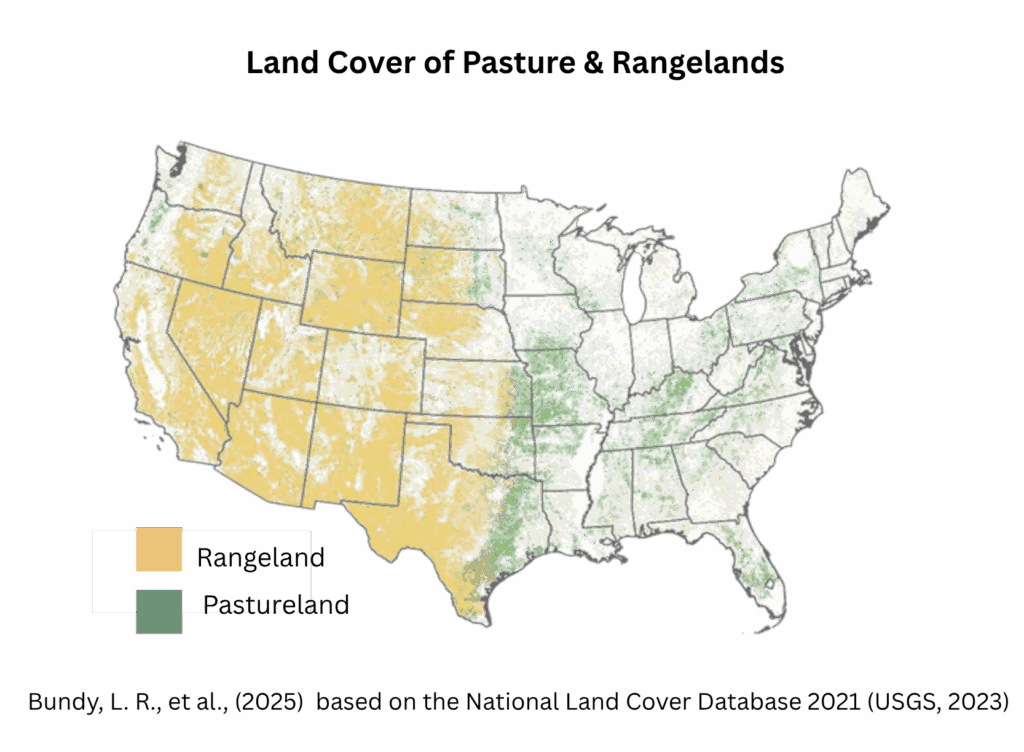
Rangelands make up the bulk of grazing lands, ~540 million acres. They are mostly in Western states.[6]
Winters-Michaud, C., et al., (2024) Major Uses of Land in the United States, 2017. USDA ERS Bulletin No. 275, Table 1, p. 5. [Total land area contiguous U.S. = 1,891.1M acres; Grazing land = 671M acres. We do not include 132M acres of “forest-use land” categorized by Winters-Michaud as grazing land since it is not the “primary use.” Of these acres, broadly estimated, ~70M acres are federally owned (see, USDA Forest Service (2021) Grazing Statistical Summary Fiscal Year 2021, p. 5.) and ~60M acres are privately owned forest lands (estimated from Winters-Michaud, Figure 11, p. 36.)
USDA (2020) Summary Report: 2017 National Resources Inventory, NRCS and Center for Survey Statistics and Methodology, Iowa State University, p. 2-1. [Non-federal rangeland = 403.9M acres. Note: chart includes Hawaii and Caribbean islands at ~1M acres]
Note: Between the BLM and the Forest Service, about 213M acres were actively grazed in 2017. See, Grazing on Federal Lands [question “How many federal acres are actively grazed?”] We are not aware, however, of the BLM or US Forest Service breaking down their active grazing acreage into rangelands and grazed forests. Therefore, we use the “total grazed forest-use” figure from Winters Michaud (Table 9, p. 32.) and subtract the estimate of “private forest land grazed” (estimated from Winters-Michaud, Figure 11, p. 36.) to arrive at ~70M acres for federal grazed forest (which coincides with Forest Service use of 74M acres). That puts grazed federal rangelands at ~140 million acres (213M – 70M = ~140M) which seems reasonable.
USDA (2020) Summary Report: 2017 National Resources Inventory, p. 2-1. [Non-federal pastureland = 121.6M acres. Note: chart includes Hawaii and Caribbean islands at ~.5M acres]
Winters-Michaud, C., et al., (2024), Table 1, p. 5. [Cropland used for pasture = 13M acres]
Grazing map: Bundy, L. R., et al., (2025). United States pasture and rangeland conditions: 1995–2022. Agronomy Journal, 117(1), e21736, Figure 1, p. 3.
Rangelands make up the bulk of grazing lands, ~540 million acres. They are mostly in Western states.[1]
Grazing map: Bundy, L. R., et al., (2025). United States pasture and rangeland conditions: 1995–2022. Agronomy Journal, 117(1), e21736, Figure 1, p. 3.