
About 58% of all U.S. crops harvested goes specifically to animal feed.
Of this share we estimate that: About 56% comes from quantifiable shares of the top 10 U.S. crops.(See next question) About 2% or more comes from other, less easily quantifiable uses. (See 3rd question)
In 2025, counting only the animal feed share of the top 10 harvested crops, animal feed is the ultimate usage for ~56% of all crops harvested.[1-4] This percentage has grown slightly every year since 2022.[5]
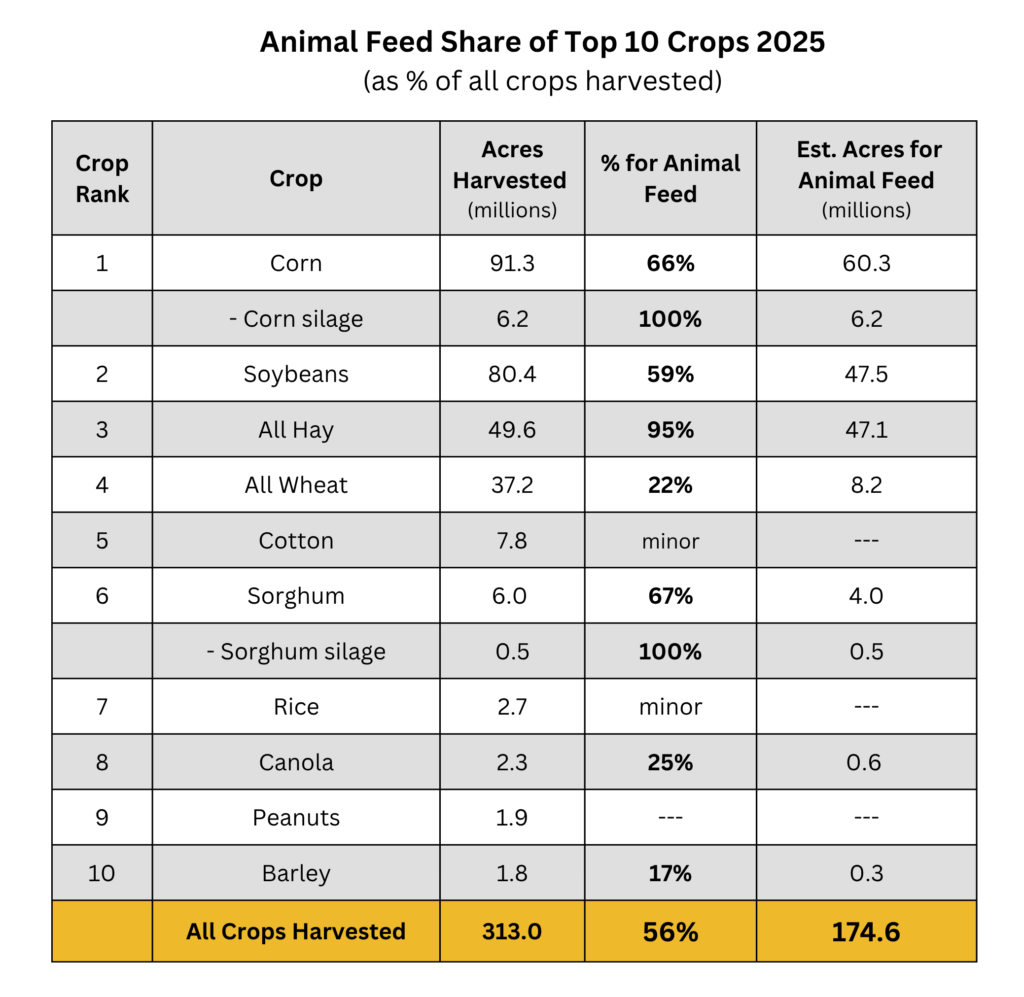
An analysis of animal feed usage for crops outside of the top 10 would of course increase this percentage, since some of those usages are significant. Additionally, there are many types of animal feed usage within the top 10 crops that are not included due to lack of firm data. (See question 3)
Top 10 Crops Harvested: USDA NASS (2026) Acreage, ISSN: 1949-1522, Crop Area Planted and Harvested, Yield and Production in Domestic Units, 2025, p. 32. [Total animal feed usage of 174.6 million acres / total crops harvested of 313 million acres = ~55.78%.] [Note: As a base, we use the USDA’s estimate of 313 million acres in “Total crops harvested” (column B in Summary table 3 of Major Land Uses) which accounts for all land for harvested crops, including double-cropped acres. Crop rank is based on acres planted]
All Crops Harvested: [USDA Economic Research Service, Major Land Uses (2026) Summary Table 3, Total crops harvested.
Note: Our assumption throughout this page is that crop usage for animal feed directly translates into crop acreage. In other words, if a crop is produced on 10 million acres and 50% of usage goes to animal feed, then we estimate 5 million acres are used for animal feed. In many cases, especially corn and soy, much of the production goes to processing plants that then produce animal feed, among other products. Therefore, it is not a direct crop-to-animal-feed connection. Still, it is a reasonable way, and perhaps the best way, to assess overall feed crop usage through the metrics of acreage.
The references for all the percentages for specific crops on this page can be found throughout the other pages in this category.
Using the same analysis, the share was 52.5% in 2022, 53.6% in 2023, and 55% in 2024.
There are multiple animal feed uses that are not included in the calculations above.[1] We estimate that they add at least 2% to the totals (and probably much more) due to the following factors:
Crops used directly for forage – especially corn, hay, and sorghum. We have no specific data on how prevalent these practices are, though they are common. For example, livestock eat hay or sorghum directly or consume them as swath forage (i.e., grazing crops cut and left out in windrows).[2-4] These uses are not considered harvests, so these acres are not included in USDA estimates.
Harvested crops for silage – Also not considered in USDA data is the practice of harvesting a crop for a secondary usage, i.e., harvesting wheat or rye not as grain but as “hay” or “silage” for animal feed.[5,6]
Secondary uses for crops – Three of the major crops by acreage (cotton, rice and sugar beets) are commonly used for feed as processed meal or the byproduct of milling, though they are not included because of a lack of firm data on amounts.[7]
Processed oils for animal feed – Another potentially significant factor is processed oil used as animal feed. The use of corn oil and soy oil as feed additives is common and could possibly increase the total by a percentage point or two since they are both major outputs from vast amounts of cropland.[8-10]
Other crops – Also not included in our tally are animal feed shares for additional crops. Of these, barley is often used, particularly for pigs.[11] And rye and oats stand out as crops used directly for forage or for cover cropping that is ultimately grazed.[12,13]
More analysis and research in this area would be valuable. A deeper understanding of the degree to which animal feed dominates U.S. agriculture would potentially inform ag policy, heighten pollution mitigation efforts, and shift consumer choices.
Decision Innovation Solutions (February 2025) Animal Feed Consumption. Report prepared for IFEEDER and American Feed Industry Assoc., Table 6.1, pp. 78-79.
South Dakota State University Extension (2023) Swath Grazing. https://extension.sdstate.edu/swath-grazing
McCartney & Baron, “Extending the Grazing Season: Swath Grazing by Beef Cows,” Cool Forages: Advanced management of temperate forages. https://farmwest.com/wp-content/uploads/2020/08/45-AFM-2013-45-McCartney.pdf
Dahlke, G. R. (2022) Swath Grazing Forage Sorghum and Pearl Millet Observations Regarding Quality and Utilization as Winter Feed, Iowa State University Animal Industry Report 2021, 17(1):15553.
Beef Magazine (2023) Winter wheat may be more valuable for grazing, hay crop this spring. https://www.beefmagazine.com/grazing-systems/winter-wheat-may-be-more-valuable-for-grazing-hay-crop-this-spring [“For some producers, the option to graze out wheat or harvest it as hay may net more value per acre than harvesting it for grain, especially if grazing would keep them from purchasing additional feed at current market prices.”]
Univ. of Nebraska-Lincoln, Cropwatch (2023) Pasture and Forage Minute: Wheat Grazing vs. Grain Value, Choosing Summer Forage, https://cropwatch.unl.edu/2023/pasture-and-forage-minute-wheat-grazing-vs-grain-value-choosing-summer-forage [“Cereal grains like wheat are grown for dual purpose (forage and grain) production in the Central Plains and Southern Plains states.”]
Decision Innovation Solutions (February 2025) Animal Feed Consumption. Report prepared for IFEEDER and American Feed Industry Assoc., Table 6.1, pp. 78-79.
USDA Feed Grains Yearbook Tables, table 29. [Cotton, peanut, and sunflower meals also go to animal feed, as do millfeeds from rice. Taken together, these volumes of feed equal more than 3% of the volume of soybean meal, the second largest component in animal feed]
USDA APHIS (July 16, 2024) Swine 2021 Part II: Reference of Management Practices on Large-Enterprise Swine Operations in the United States, Tables C.6.a, D.6.a, E.6.a, F.6.a. https://www.aphis.usda.gov/swine-2021-part-ii-reference-management-practices-large-enterprise-swine-operations-united-states [Notes the share of farm operations that use corn oil (6%) and soy oil (19%) in pig nursery diets.]
U.S. Grains Council, DDGS User Handbook, 4th ed., Chemical Composition and Energy Value of Distillers Corn Oil for Swine and Poultry, p. 15. [“Distillers Corn Oil is used as a high quality energy source primarily in poultry and swine diets because of its high metabolizable energy (ME) content and relatively low price compared with other feed fats and oils.”]
Decision Innovation Solutions (February 2025) Animal Feed Consumption. Table 6.1, pp. 78-79.
Farm Progress (2014) Is ryegrass haylage right for your operation? https://www.farmprogress.com/livestock/is-ryegrass-haylage-right-for-your-operation- [“Ryegrass is one of the highest quality forages that can be produced in the Southeast.”
Kubesch, J., et al., (n.d.) Planting Oats for Forage. Univ. of Arkansas, Division of Agriculture. https://www.uaex.uada.edu/publications/pdf/FSA3151.pdf [“Oats are fast-growing small grains that have long been used for grazing, hay and silage. Oats can be used to fill forage gaps in either spring or fall. They are popular for grazing in fall or as a hay crop in spring.”]
At least 60% of total harvested crops grown for food went to animal feed in 2024. Counting only the quantifiable animal feed uses of the top 10 crops bring this total to ~59%. Adding all the other uses that are less easily quantifiable (as noted in the question above) brings this share well above 60%.[1]
This calculation is an estimate of the share of animal feed as a portion of all animal and human food production. The crops generating non-food products are cotton and that portion of corn processed for ethanol.
The share of whole, unprocessed foods for humans from these top 10 crops is extraordinarily low – perhaps 1-2% at most.
This calculation is made by subtracting 7.8 million acres for cotton and 21.8 million acres of corn used for ethanol from the acreage of all crops harvested (311 million acres). (The ethanol figure is derived from the share of corn used to make ethanol (35.9%) x the portion that goes to ethanol only (73.3% with the remainder to DDGs for animal feed and corn oil uses) = 26.3% of 82.9 million acres (harvested corn without added silage acres) = 21.8 million acres. Animal feed acres of 167.2 million / 281.4 million acres (311 – 7.8 – 21.8 = 281.4) == 59.42%