
Feed crops are those crops which are primarily grown to feed farmed animals. Most feed crops, especially the enormous use of corn and soybeans for feed, are a creation of factory farming. Instead of animals foraging for natural foods or given foods that humans consider waste products, feed crops are cultivated, processed, transported, and fed to confined animals who have no alternative food sources.[1]
Almost all chickens and pigs are raised on processed feed. Beef cattle and dairy cows are sometimes on pasture or range or consume forage on CAFOs. For ruminants, long periods of processed high-grain diets cause disease.
Current U.S. agricultural production practices are a primary source of environmental damage. They use an immense amount of scarce resources, as noted throughout this site. It is important to know the extent to which those damages and resource usages are in the service of industrialized animal agriculture.[1]
The U.S. has some of the most fertile land and best crop growing conditions in the world.[2,3] We having been using most of that fertile land to grow food for farmed animals and are seeing steadily degrading soils, especially in monoculture croplands for corn and soybeans.[4] More land and resources are used for feed crops than is commonly understood. The long list of negative externalities stemming from that usage is key to understanding the full impacts of industrial animal ag.
See for example, Inside Corn – How much really goes to animal feed and why it matters
Thaler, E.A., et al., (2021). The extent of soil loss across the US Corn Belt. PNAS, 118(8), p. 2. [“The fertile soils and temperate climate make the Corn Belt one of the world’s most agriculturally productive regions.”]
National Aeronautics and Space Administration (NASA) (2014) Satellite Shows High Productivity from U.S. Corn Belt, News Release 14-016. [“Data from satellite sensors show that during the Northern Hemisphere’s growing season, the Midwest region of the United States boasts more photosynthetic activity than any other spot on Earth, according to NASA and university scientists.”]
Thaler, E. A., et al., (2021), p. 7. [“We find that historical soil erosion has completely removed A-horizon soil from approximately one-third of the Corn Belt …75% of the corn and 60% of the soybeans produced in the United States are grown in the Corn Belt.”]
The 3 largest crops in the U.S. are all primarily feed crops – corn, soybeans, and hay/alfalfa, together accounting for ~73% of all harvested crops.[1,2]
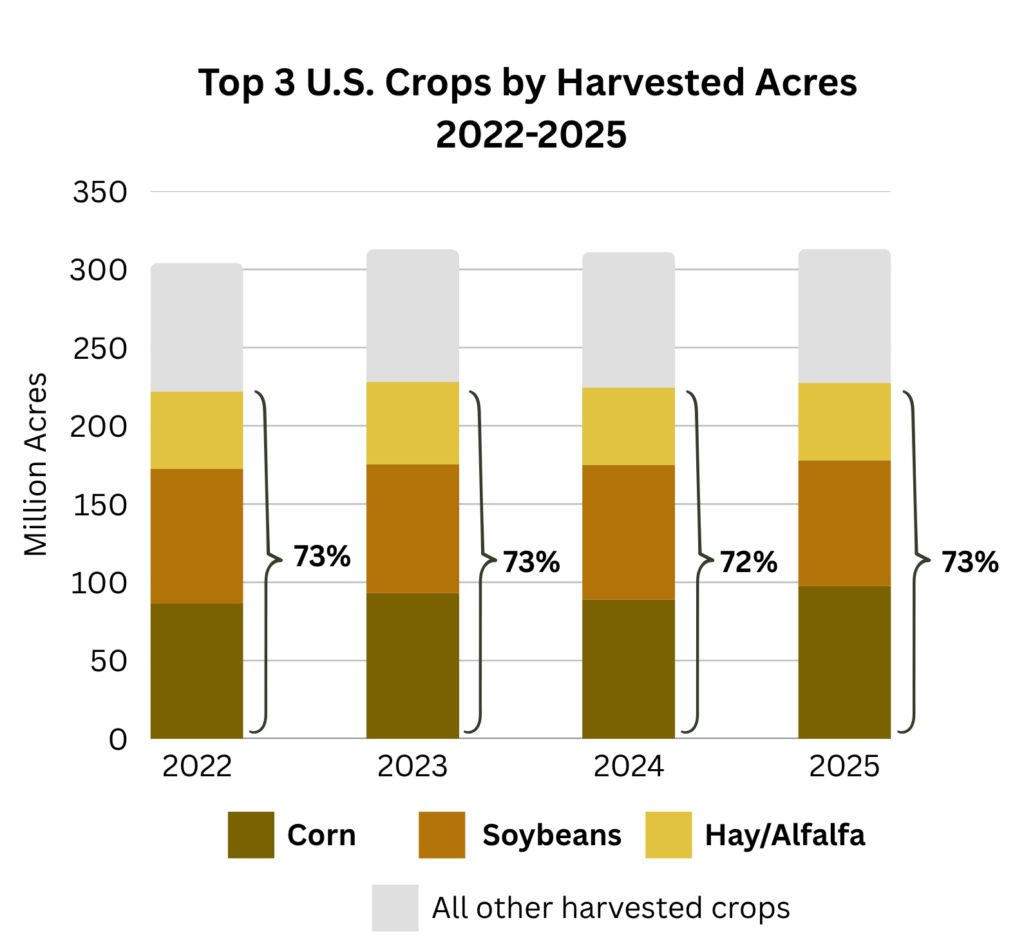
USDA NASS Acreage Reports, ISSN: 1949-1522, 2022-2025. Note: As a base, we use the USDA’s estimate of “Total crops harvested” (column B in Summary table 3 of Major Land Uses) which accounts for all land for harvested crops, including double-cropped acres. Note: Harvested corn includes harvested corn silage.
Some percentage of acres of alfalfa and hay are grazed directly, though not included in the amount of land devoted to feed crops.
In 2024, the total production weight of corn and soybeans – the 2 largest feed crops – was over 1 trillion pounds.[1,2] That is ~10 times the weight of vegetable production (including potatoes).[3,4]
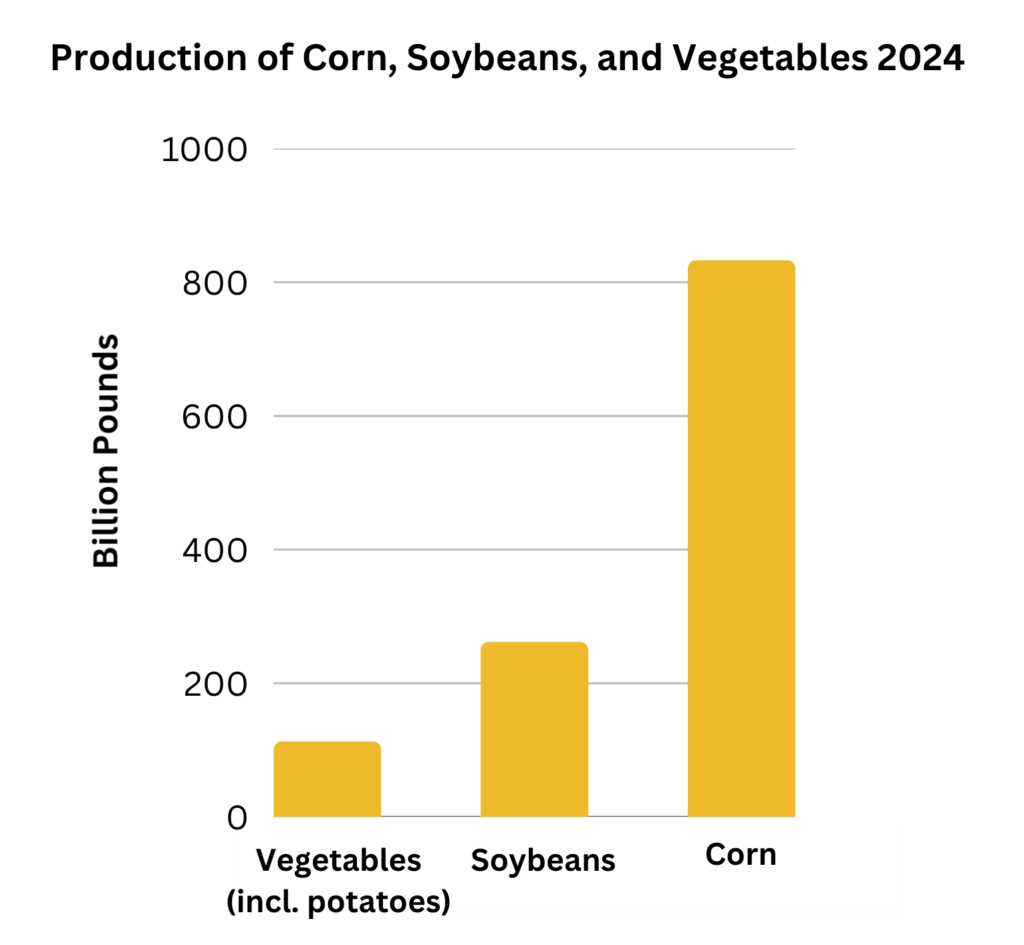
The total weight of vegetable production (including potatoes) was ~113 billion pounds. The total production weight of soybeans was ~262 billion pounds. The total production weight of corn was ~833 billion pounds.
USDA NASS (January 2025) Crop Production, ISSN: 1936-3737, p. 51 [Soybean production = 4,366,492,000 bushels x 60 lbs. per bushel = 261,989,520,000 lbs.]
USDA NASS (January 2025) Crop Production, p. 10 [Corn production = 14,866,744,000 bushels x 56 lbs. per bushel = 832,537,664,000 lbs.]
USDA Economic Research Service (2024) Vegetables and Pulses Outlook: July 2024, VGS-373, Table 1. [2023 Vegetables fresh = 310 million cwt (hundredweight), vegetables processing = 380, potatoes = 441 = total of 1,131 million cwt = 113,100,000,000 pounds.]
Calculation: 859 billion lbs. of corn + 250 billion lbs. of soybeans = 1,109 billion lbs. 113 billion lbs. of vegetables + potatoes. 1,109 / 113 = 9.8 times.
Corn production as calculated by the USDA includes only “field corn,” which is the type of corn that is fed to animals and used for ethanol production. The USDA refers to “field corn” as “corn” and refers to corn humans typically eat as “sweet corn.” Sweet corn production is less than 1% of the volume of “field corn” and is tallied by the USDA as a vegetable instead of a feed grain.
Acreage harvested for hay production, corn, and soybeans is ~50 times the size of acreage harvested for vegetables (including potatoes and melons).[1-3]

USDA Census of Agriculture 2022 (2024) [Note: Vegetable production acreage seems to vary significantly in different USDA reports, so we base these figures on the 2022 Census of Ag harvested acres. Vegetables (including potatoes and melons) = 4.3 million acres. Soybeans = 84.6M. Corn = 80.6M. Hay (including alfalfa) = 47.2M. Calculation: 212.4 / 4.3 = 49.4 times.
Corn production as calculated by the USDA includes only “field corn,” which is the type of corn that is fed to animals and used for ethanol production. The USDA refers to “field corn” as “corn” and refers to corn humans typically eat as “sweet corn.” Sweet corn production is less than 1% of the volume of “field corn” and is tallied by the USDA as a vegetable instead of a feed grain.
In 2025, approximately 750 pounds of soybeans and 2,794 pounds of corn were produced for every American.[1-3]
USDA NASS (January 2026) Crop Production, ISSN: 1936-3737, p. 51 [Soybean production = 4,261,858,000 bushels x 60 lbs. per bushel = 256 billion lbs. /341,145,500 == 750 lbs. per person.
USDA NASS (January 2026) Crop Production, p. 10 [Corn production = 17,020,549,000 bushels x 56 lbs. per bushel = 953 billion lbs. / 341,145,500 == 2,794 lbs. per person.
US Census Bureau, U.S. and World Population Clock. [Resident American population of 341,145,500 on January 1, 2025]
Major row crops like corn, soybeans, and wheat have multiple uses as feed, human food, and industrial products. The grains (like corn) or oilseeds (like soybeans) go through a variety of channels and processing for both domestic use and exports.
Corn, for example, is: Fed directly to domestic farmed animals. Exported and then fed directly to animals in other countries. Processed for ethanol which generates an important coproduct (DDGs) which is then fed to farmed animals domestically or exported and fed to animals overseas. Harvested along with the plants (corn silage) and then fed to farmed animals.
When the USDA reports that feed use “typically accounts for about 40 percent of total domestic corn use,” the agency counts only the first use and not the other three.[1,2]
Soybeans are slightly more complex, because both processing and exports make up larger shares.
USDA Economic Research Service (4/17/25) Feed Grains Sector at a Glance. https://www.ers.usda.gov/topics/crops/corn-and-other-feed-grains/feed-grains-sector-at-a-glance/ [Feed use “typically accounts for about 40 percent of total domestic corn use.”]
For percentages of corn and soybeans to animal feed, see Share of Corn Crop for Feed and Share of Soybean Crop for Feed.
Along with the inherent complexity of the varying channels (as noted above), there are several other factors that tend to obscure analysis:
It is not in the interest of the U.S. agriculture industry to highlight that most cropland is used to grow feed for animals. Farming that directly feeds people is more highly valued than farming that feeds pigs and chickens.
Highlighting that exported crops are mostly used for animal feed does not bolster the “feeding the world” narrative.[1]
Because the USDA considers corn a grain, soybeans an oilseed, and hay a forage crop, they are often analyzed separately which limits an understanding of their combined contributions to animal feed production.
There are a multitude of crop products that go into animal feeds, including grains, oilseeds, meals, fats, and processed co-products, all sent to more than 5,000 feed mills across the U.S.[2] And while usage of these products is independently tracked by weight for the feed industry, neither the share of crops nor the acreage used for production is analyzed.[3]
The USDA, despite its diligent tracking of every aspect of U.S. agriculture, does not attempt to total the respective proportions of exports, byproducts (both domestic and exported), and silage used for animal feed.
A statistic such as the amount of U.S. soybeans used for feed is hard to uncover, even though feed is by far the major use of soybeans. Researchers trying to confirm this stat regularly point to a single sentence in a short, outdated USDA “factsheet” about soybean production practices that states “just over 70 percent of soybeans grown in the United States are used for animal feed…” The report provides no source or back-up for this data point.[4]
USDA (2022) Strategic Plan Fiscal Years 2022–2026, p. 3. https://www.usda.gov/sites/default/files/documents/usda-fy-2022-2026-strategic-plan.pdf [“Vision: An equitable and climate-smart food and agriculture economy that protects and improves the health, nutrition, and quality of life of all Americans; yields healthy land, forests, and clean water; helps rural America thrive; and feeds the world.”]
Decision Innovation Solutions (February 2025) Animal Feed Consumption, See, 2024 Feed Mill Distribution in the United States, pp. 3 and 12. [Report prepared for IFeeder and the American Feed Industry Assoc. “Compared to the 2020 report (2019 diets), 23 feed ingredients were added into 2023 feed consumption study.”]
Decision Innovation Solutions (February 2025) Animal Feed Consumption, See, Ingredient Circularity Aggregation, Table 6-1, p. 78.
USDA (2015) Coexistence Fact Sheets Soybeans, Office of Communications. https://www.usda.gov/sites/default/files/documents/coexistence-soybeans-factsheet.pdf
In 2025, the U.S. was the largest producer of corn.[1] The U.S. was the second largest producer of soybeans, behind Brazil.[2]
USDA Foreign Agricultural Service, Production – Corn – Top Producing Countries – 2025/2026 Corn.
https://www.fas.usda.gov/data/production/commodity/0440000 [U.S. ranks #1 for corn production with 33% of world production.]USDA Foreign Agricultural Service, Production – Soybeans – Top Producing Countries – 2025/2026 [U.S. ranks #2 for soy production with 27% of world production.]