
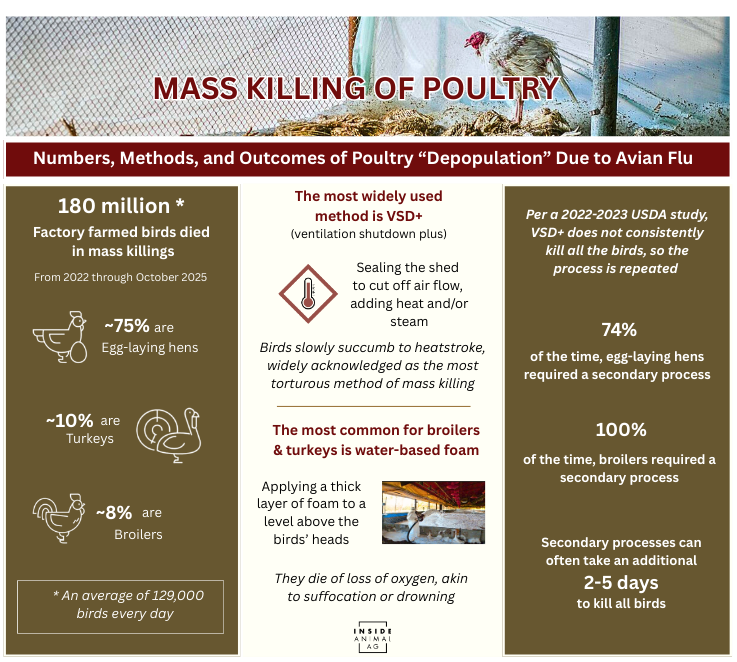
Banner photo: Glass Walls/We Animals
To download chart click here
Euthanasia is “transitioning an animal to death as painlessly and stress-free as possible.”
Depopulation (what we refer to as mass killing) is “when large numbers of animals must be destroyed in response to an animal health emergency.”[1]
The USDA has authority to choose and implement mass killing procedures during animal health emergencies, including avian flu.[2-4]
USDA (2016) Highly Pathogenic Avian Influenza (HPAI): Depopulation and Disposal. p. 1. https://www.aphis.usda.gov/sites/default/files/hpai-depopulation-disposal.pdf
USDA APHIS Veterinary Services (May 2017) Highly Pathogenic Avian Influenza Response Plan: The Red Book, FAD Prep, p. 2-5. [“The Animal Health Protection Act (AHPA), 7 U.S. Code 8301 et seq., authorizes the Secretary of Agriculture to restrict the importation, entry, or further movement in the United States or order the destruction or removal of animals and related conveyances and facilities to prevent the introduction or dissemination of livestock pests or diseases.”]
USDA (2016) Highly Pathogenic Avian Influenza (HPAI): Depopulation and Disposal. [“Federal law gives the U.S. Department of Agriculture (USDA) authority to depopulate animals in these situations to stop disease spread.”]
For information about the USDA’s authority over mass killings and their choices of methods of killing, see, Poultry Welfare Regulations
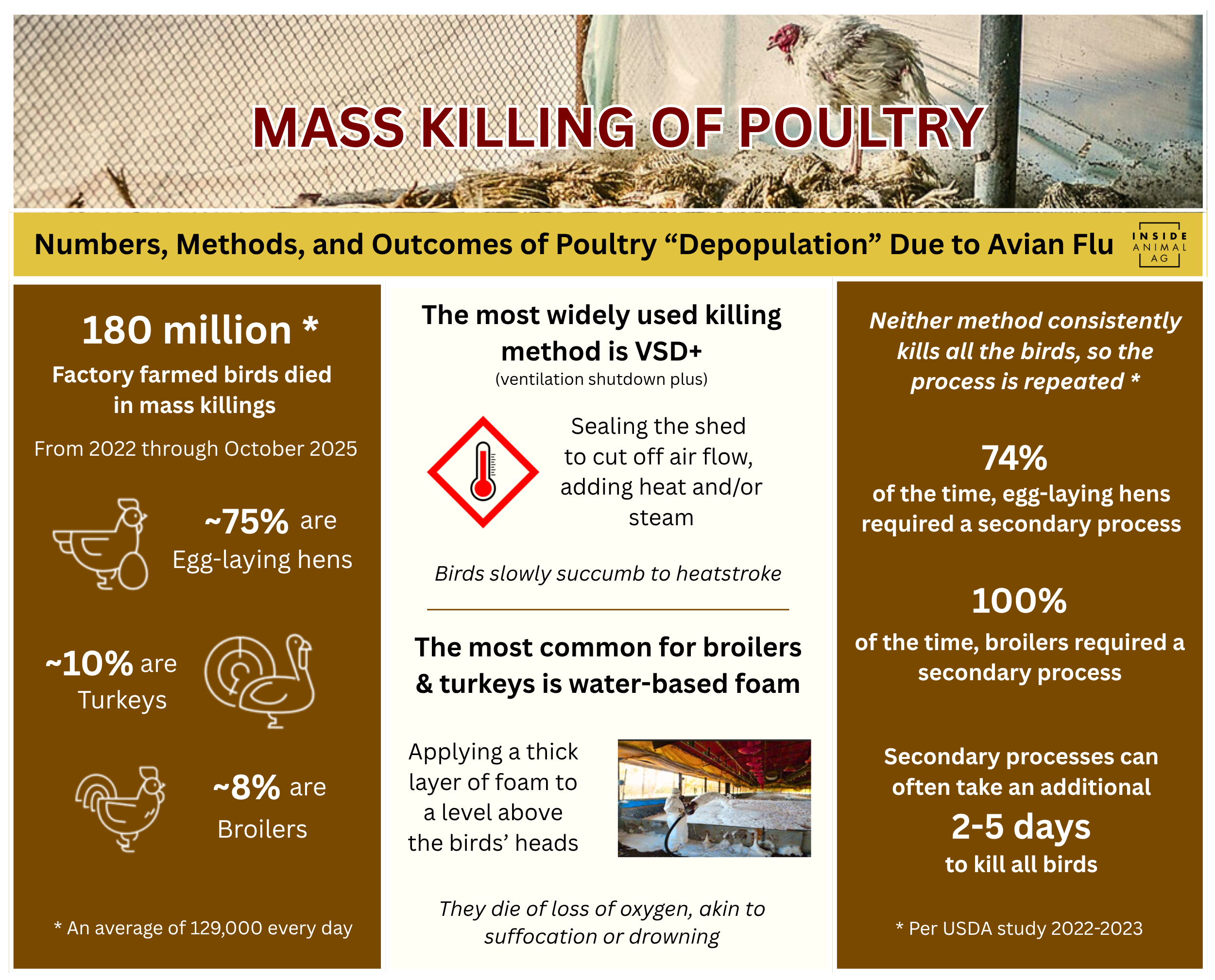
From 2022 through October 2025, more than 180 million poultry animals have died in mass killings due to avian flu.[1-3]
As of October 2025, more than 41 million egg-laying hens have been killed year-to-date.[4]
The first major avian flu events were from 2014-2015 when approximately 50 million birds were killed.[5,6]
USDA APHIS Confirmations of Highly Pathogenic Avian Influenza in Commercial and Backyard Flocks. https://www.aphis.usda.gov/livestock-poultry-disease/avian/avian-influenza/hpai-detections/commercial-backyard-flocks (Accessed 11/6/25) [This site provides numbers of birds affected by date, but it does not tally annual losses.]
Emily Anthes & Apoorva Mandavilli (October 22, 2025) Bird Flu Is Back. New York Times. [“Since early 2022, the virus has affected more than 180 million farmed birds and killed countless wild ones.”]
Kenny Torella (October 30, 2025) We may never get bird flu — or egg prices — under control. Vox. [“So far, poultry farms have killed more than 180 million birds since the start of the outbreak in early 2022.”]
USDA (October 24, 2025) Egg Markets Overview, A weekly publication of the USDA AMS Livestock and Poultry Program, Livestock, Poultry, and Grain Market News Division. [As of October 24th, “In 2025 to date, based on the latest data from APHIS, HPAI in commercial table egg layer flocks have resulted in the depopulation of 41.4 million birds.”]
USDA APHIS Veterinary Services (May 2017) Highly Pathogenic Avian Influenza Response Plan: The Red Book, FAD Prep, p. 1-3. [“…the 2014–2015 outbreak resulted in the loss (death or depopulation) of approximately 50 million birds.”]
Congressional Research Service (April 29, 2025) The Highly Pathogenic Avian Influenza (HPAI) Outbreak in Poultry, 2022-Present, R48518, p. 1. [“An HPAI outbreak occurred in the United States in 2014-2015… More than 50 million birds, primarily egg-laying hens and turkeys, died directly from the disease or were euthanized to help control the spread of the disease (“depopulated”), resulting in direct economic losses reaching $1.6 billion.”]
From 2022 through April, 2025, about 75% of the birds killed have been egg-laying hens. About 11% have been turkeys, and about 8% have been broilers.[1,2]
Congressional Research Service (April 29, 2025) The Highly Pathogenic Avian Influenza (HPAI) Outbreak in Poultry, 2022-Present, R48518, p. 3-4 & Figure 2. [“…table-egg-laying hens have been the most affected by the ongoing outbreak, accounting for 75% of total domestic poultry loss…”]
Clifford, J., et al., (April 1, 2025) Proposed U.S. Poultry And Egg Industry Vaccination Plan For Highly Pathogenic Avian Influenza (HPAI), Submitted by the HPAI Vaccination Working Group Convened by U.S. Egg Producers, p. 1. [“As of April 1st, 2025, over 131 million egg laying hens from over 130 farms have been depopulated due to infection with HPAI.” According to CRS report above, as of April 25, 2025, total of 168.6M killed. 131M / 168.6M = ~78%]
Animal welfare is understood to be a low priority for the USDA in dealing with avian flu outbreaks on factory farms. The agency states that its primary goals are a) to maximize speed, b) protect public health and the environment, and c) stabilize animal ag operations and the “continuity of business.”[1,2]
While pursuing these primary objectives, animal welfare is prioritized “as much as possible.”[3] In practice, it appears to be an incidental consideration. It is widely accepted that poultry suffer for prolonged periods under current practices.[4] (See following questions)
USDA APHIS (January 2022) HPAI Response: Response Goals & Depopulation Policy, p. 1. [“APHIS goals for a highly pathogenic avian influenza (HPAI) response are to (1) detect, control, and contain HPAI in poultry as quickly as possible; (2) eradicate HPAI virus using strategies to protect public health and the environment, and stabilize animal agriculture, the food supply, and the economy; and (3) provide science- and risk-based approaches and systems to facilitate continuity of business for non-infected animals and non-contaminated animal products.”]
AVMA Guidelines for the Depopulation of Animals: 2019 Edition, p. 51. [“The priority in FAD (foreign animal disease) emergencies is the ability to stop the spread of the pathogen.”]
USDA APHIS, 2022-2023 Highly Pathogenic Avian Influenza Outbreak, Section F. Animal Welfare. [“Given the extenuating circumstances during an emergency response, the welfare of animals is prioritized as much as possible…”]
Reyes-Illg, G., et al., (2023) The Rise of Heatstroke as a Method of Depopulating Pigs and Poultry: Implications for the US Veterinary Profession. Animals, 13, 140, Abstract. [“While no research using validated measures of animal welfare assessment has been performed on these methods, their pathophysiology suggests that animals are likely to experience pain, anxiety, nausea, and heat distress prior to loss of consciousness. Heatstroke-based methods may result in prolonged suffering and often do not achieve 100% mortality.”]
Ventilation shutdown plus (VSD+) – is by far the most widely used mass killing method.[1] It is the most common method used on egg-laying hens, who make up about three-quarters of the animals killed since the 2022 outbreak began.[2] VSD+ involves the sealing of poultry houses to cut off airflow, followed by turning on heaters, steam, and/or gas to hasten the death of the birds through a combination of suffocation and heatstroke.[3,4]
Carbon dioxide (CO2) – is used for most of the egg-laying hens that are not killed with VSD+, especially those in cages.[5] Similar to VSD+, this method involves closing off the building and pumping in vaporized CO2. The building needs to be “sealed to ensure gas will be higher than the head height of the tallest birds, since CO2 is heavier than air.”[6]
Water-based foam – is the most common method for broilers and turkeys who are generally raised on the ground (floor-reared) where foam application is more efficient.[7,8] Birds are forced into a portion of the poultry house, then equipment is used to spray a thick layer of foam that should rise one foot above the head height of all birds. The process causes “rapid airway occlusion, resulting in hypoxia, leading to unconsciousness, terminal convulsions, brain death, and altered terminal cardiac activity.”[9]
VSD+ was not used in the 2014-2015 avian flu outbreaks.[10] The most common methods were water-based foam and CO2 gas. Almost 75% of commercial operations used water-based foam and almost 25% used CO2 gas during the earlier outbreak.[11]
AWI (2025) Depopulation (Mass Killing) of Farmed Animals. [“Through Freedom of Information Act requests, AWI received records from the USDA for depopulation events involving over 171 million birds impacted by the current outbreak. According to these records, approximately 123 million birds—or 72% of the birds for which data was provided—were killed in depopulations in which VSD+ was used for the entire flock or for birds in at least one barn on the premises.” From February 2022 through June 2025]
USDA APHIS, 2022-2023 Highly Pathogenic Avian Influenza Outbreak, p. 1. [“During the 2022–2023 outbreak, VSD+ was used alone, or in combination with other methods, on 49 percent of commercial turkey, 85 percent of commercial table egg, 44 percent of commercial broiler, and 29 percent of commercial duck premises.”]
American Assoc. of Avian Pathologists (2021) Poultry Depopulation Guide & Decision Tree, pp. 15-16. https://aaap.memberclicks.net/assets/Positions/2020_Poultry_Depopulation%20Guide%20FINAL%20%202-11-21.pdf
Veterinarians Against Ventilation Shutdown. What is Ventilation Shutdown (VSD/VSD+)? A Poultry Veterinarian’s Definition. https://www.vavsd.org/about [“The pig or chicken barn is closed, all air inlets and ventilation sealed, and fans turned off. Heaters, steam, and/or gas are turned on. Body heat from the animals, combined with any added heat, raises the temperature in the house until the pigs or chickens die from hyperthermia (overheating) or suffocation from built-up gases. This typically takes hours, according to all published research.”]
USDA APHIS, 2022-2023 Highly Pathogenic Avian Influenza Outbreak, p. 4 & Table 1, p. 5. [“For commercial table egg premises, VSD+ was used on 85 percent while CO2 was used on 33 percent of premises.”]
American Assoc. of Avian Pathologists (2021) Poultry Depopulation Guide & Decision Tree, p. 13.
American Assoc. of Avian Pathologists (2021) Poultry Depopulation Guide & Decision Tree, pp. 10-11.
USDA APHIS, 2022-2023 Highly Pathogenic Avian Influenza Outbreak, p. 4 & Table 1, p. 5. [“Foam was used to some extent” on 80 percent of commercial turkey premises and 67 percent of commercial broiler premises.]
Benson , E. R., et al., (2012) Mass Emergency Water-Based Foam Depopulation of Poultry. Avian Diseases, Vol. 56., No. 4, p. 892. [“…specialized equipment is used to create a mixture of water, commercial foam concentrate, and gas (ambient air, C02, or other gases). The foam mixture is applied to a depth that rises 15 to 30 cm above the heads of the birds. In a typical implementation, the process is started at one side or end of the poultry house and foam is applied around the birds as the foam generation equipment is moved toward the opposite end of the house.”]
Animal Welfare Institute (June 15, 2023) Petition For Rulemaking to United States Department Of Agriculture Animal And Plant Health Inspection Service. Petition To Amend Regulations Pertaining to Highly Pathogenic Avian Influenza, p. 9. [“This method was used to depopulate birds impacted by HPAI for the first time in January 2016 on four commercial turkey operations in Dubois County, Indiana, during a brief resurgence of the virus in that state.”]
Animal Welfare Institute (June 15, 2023) Petition For Rulemaking to United States Department Of Agriculture Animal And Plant Health Inspection Service, p. 8. [During the 2014-2015 outbreak, “Nearly 73 percent of commercial operations utilized waterbased foaming for depopulation, while 24 percent utilized CO2 gassing.”]
Yes, without question. VSD+ is widely understood to be the most torturous method of mass killing, as well as the most common current method.
 Reyes-Illg, G., et al., (2023): Notes that very little research has been performed to assess animal welfare during these processes. However, “Non-lethal heat stress is widely acknowledged to be detrimental to animal welfare and temperature-humidity conditions that are high enough to cause death also are accepted as causing severe suffering.”[1]
Veterinarians Against Ventilation Shutdown: “Ventilation shutdown is a brutal, painful method of animal depopulation.”[2]
AVMA (American Veterinary Medical Association): The AVMA’s recommendation that ventilation plus be “permitted in constrained circumstances” has improbably and controversially become the lever used by the USDA to make VSD+ the default option for mass killings, especially of egg-laying hens.[3] Water-based foam and whole house gassing (CO2) are clearly listed as “preferred methods.”[4]
USDA historical documents: In prior outbreaks (especially 2014-2015) VSD+ was considered a method of last resort.
2015 – “However, VSD should be used only after a full consideration of the epidemiologic threat posed concludes that no other method can achieve a sufficiently timely measure of assurance that the virus will not spread.”[5]
2017 – “In almost all cases, water-based foam or carbon dioxide are the depopulation methods available to rapidly stamp-out the HPAI virus in poultry.”[6]
USDA current assessments: VSD+ requires a “secondary depopulation” much more often than other methods because some birds are still alive after the first process. Broiler houses required a secondary process 100% of the time, and egg-laying hen houses 74% of the time in a wide ranging USDA assessment.[7] These secondary processes often take from 2 to 5 additional days to complete.[8]
AWI (Animal Welfare Institute): “Ventilation shutdown plus is a method of depopulation that involves trapping animals inside a building, closing off airflow, and ratcheting up the temperature (the “plus” refers to the addition of heat and sometimes steam) until the animals die from hyperthermia/heatstroke over several agonizing hours. This method likely causes extreme, prolonged suffering and does not always result in 100% mortality.”[9]
EFSA (The Panel on Animal Health and Welfare of the European Food Safety Authority): Ventilation shutdown techniques are not accepted as a killing method.[10]
World Animal Health Organization (OIE): Does not recognize ventilation shutdown as an acceptable method of killing.[11,12]
Reyes-Illg, G., et al., (2023) The Rise of Heatstroke as a Method of Depopulating Pigs and Poultry: Implications for the US Veterinary Profession. Animals, 13, 140, p. 6. [“While no research using validated measures of animal welfare assessment has been performed on these methods, their pathophysiology suggests that animals are likely to experience pain, anxiety, nausea, and heat distress prior to loss of consciousness. Heatstroke-based methods may result in prolonged suffering and often do not achieve 100% mortality.”]
Veterinarians Against Ventilation Shutdown. https://www.vavsd.org/
AVMA Guidelines for the Depopulation of Animals: 2019 Edition, pp. 53-54 & Appendix A, p. 86. [“A1.2 Permitted in constrained circumstances: These methods are permitted only when the circumstances of the emergency are deemed to constrain the ability to reasonably implement a preferred method.”]
AVMA Guidelines for the Depopulation of Animals: 2019 Edition, pp. 53-54.
USDA (September 15, 2015). HPAI Outbreak 2014-2015: Ventilation Shutdown Evidence & Policy, p. 2.
USDA APHIS Veterinary Services (May 2017) Highly Pathogenic Avian Influenza Response Plan: The Red Book, FAD Prep, p. 5-44.
USDA APHIS, 2022-2023 Highly Pathogenic Avian Influenza Outbreak, Table 5 & Section F. Animal Welfare. [“Across production species, a secondary depopulation method was required more frequently when VSD+ was the primary depopulation method…”]
USDA APHIS, 2022-2023 Highly Pathogenic Avian Influenza Outbreak, Figure 12 & Section F. Animal Welfare. [Of 200 houses, more than 20 took an additional 2 to 5 days to complete the secondary process.]
Animal Welfare Institute (2025) Depopulation (Mass Killing) of Farmed Animals. [“Ventilation shutdown plus is a method of depopulation that involves trapping animals inside a building, closing off airflow, and ratcheting up the temperature (the “plus” refers to the addition of heat and sometimes steam) until the animals die from hyperthermia/heatstroke over several agonizing hours.”]
Nielsen, S. S., et al., (2019). Killing for purposes other than slaughter: poultry. EFSA Journal, 17(11), e05850, EFSA Panel on Animal Health and Welfare (AHAW), p. 25. [“Ventilation shutdown should not be used as a killing method and prolonged periods of ventilation shutdown before injection of gas can lead to heat stress.”]
World Animal Health Organization (OIE) (2022). Terrestrial Animal Health Code, Chapter 7.6 – Killing of Animals for Disease Control Purposes. [Not listed in killing methods on pages 4-6]
Animal Welfare Institute (June 15, 2023) Petition For Rulemaking to United States Department Of Agriculture Animal And Plant Health Inspection Service. Petition To Amend Regulations Pertaining to Highly Pathogenic Avian Influenza, p. 11. [“It is worth noting that VSD+, or any other depopulation methods that rely on heatstroke as the cause of death, are not recognized under the World Organisation for Animal Health’s (WOAH) Terrestrial Animal Health Code.”]
VSD+ involves shutting down barn ventilation systems thereby closing off airflows, and adding heat and sometimes humidity, ultimately leading to the deaths of the animals from heatstroke.[1,2]
Death may take hours, with associated symptoms such as dizziness, disorientation, thirst, and exhaustion. Early in the process, emotional and behavioral reactions (e.g., heat distress or aggression) may pose further risks to the animals, while delirium and disorientation can develop as heatstroke progresses, prior to the onset of stupor and eventual loss of consciousness. Respiratory distress occurs in the terminal phase of heatstroke.[3]
Veterinary researchers have also found that symptoms of heatstroke across many species include shock, gastrointestinal bleeding, muscle degeneration, acute respiratory distress syndrome, and brain injury. However, they also point out the lack of “research using validated measures of animal welfare assessment.”[4]
In addition, VSD+ does not consistently kill all the birds, so the process must often be repeated. In fact, VSD+ has unusually high occurrences of so-called secondary depopulation processes. This means that some birds suffer for hours and days before the secondary process is completed. In USDA assessments of hundreds of factory farm houses, egg-laying hens required a secondary VSD+ process 74% of the time. For broiler houses it was 100% of the time.[5] These secondary processes often take 2 to 5 additional days to kill all the birds.[6]
USDA APHIS, 2022-2023 Highly Pathogenic Avian Influenza Outbreak, p. 2. [“As implied, VSD+ involves shutting down barn ventilation systems, adding heat, and allowing heat, humidity, and CO2 to accumulate, ultimately leading to the deaths of the animals.”]
Animal Welfare Institute (2025) Depopulation (Mass Killing) of Farmed Animals. [“Ventilation shutdown plus is a method of depopulation that involves trapping animals inside a building, closing off airflow, and ratcheting up the temperature (the “plus” refers to the addition of heat and sometimes steam) until the animals die from hyperthermia/heatstroke over several agonizing hours. This method likely causes extreme, prolonged suffering and does not always result in 100% mortality. For these reasons, VSD+, or any other method that relies on heatstroke as the cause of death, is not recognized as an acceptable method of killing by the World Organisation for Animal Health—the leading international authority on the health and welfare of animals.”]
Animal Welfare Institute (June 15, 2023) Petition For Rulemaking to United States Department Of Agriculture Animal And Plant Health Inspection Service. Petition To Amend Regulations Pertaining to Highly Pathogenic Avian Influenza, p. 11.
Reyes-Illg, G., et al., (2023) The Rise of Heatstroke as a Method of Depopulating Pigs and Poultry: Implications for the US Veterinary Profession. Animals, 13, 140, p. 6.
USDA APHIS, 2022-2023 Highly Pathogenic Avian Influenza Outbreak, Table 5. [“Across production species, a secondary depopulation method was required more frequently when VSD+ was the primary depopulation method; however, it is possible that the need for a secondary method of depopulation was under reported when CO2 was the primary method because secondary depopulation (i.e., cervical dislocation) was conducted immediately when birds were removed from the cart.]
USDA APHIS, 2022-2023 Highly Pathogenic Avian Influenza Outbreak, Section F, Figure 12. [Of 200 houses, more than 20 took an additional 2 to 5 days to complete the secondary process. “The time from the completion of primary depopulation to completion of secondary depopulation may reflect a period of increased stress for the birds that did not succumb to the primary depopulation method.”]
The USDA’s journey from denying the use of VSD+ to making it the default option despite the obvious animal welfare horrors is a particularly depressing chapter in the history of factory farming’s abuses. Reports from the Animal Welfare Institute (AWI) offer a credible and detailed analysis of the history and ramifications of the USDA’s policy change.[1]
As AWI explains in a 2023 petition to the USDA, “Despite years of working toward development of WHG (whole house CO2 gassing) in commercial settings, the availability of other, more humane methods and having a strict VSD+ policy in place meant to limit the use of the method—an action that itself suggests the agency clearly recognizes an inherent problem with its use—VSD+ seems to have served as the default depopulation method, especially on large-scale operations and in the first several months of the outbreak.”[2]
This statement, however, does not help explain why the USDA has accepted the most torturous procedure as the default option. A hint was provided in a 2015 USDA report analyzing the alternative process generally considered to be the most humane, i.e., “whole-house CO2 gassing.” The USDA states, “When tested in typical U.S. poultry management systems, it is excessively expensive, and euthanasia goals are not readily achieved.”[3]
The AVMA’s 2019 Guidelines for Depopulation, which have served as a critical rationale and cover for this policy (despite its almost complete lack of endorsement), are expected to be revised soon after a period receiving comments, including from AWI.[4,5] AWI has continued its advocacy, including with detailed compilations of alternative practices viewed as less torturous.[6]
Animal Welfare Institute (June 15, 2023) Petition For Rulemaking to United States Department Of Agriculture Animal And Plant Health Inspection Service. Petition To Amend Regulations Pertaining to Highly Pathogenic Avian Influenza, pp. 5-12.
Animal Welfare Institute (June 15, 2023) Petition For Rulemaking to United States Department Of Agriculture Animal And Plant Health Inspection Service, p. 12.
USDA APHIS Veterinary Services (2015) NAHEMS Guidelines: Mass Depopulation & Euthanasia, FAD PReP, p. 41.
American Veterinary Medical Association, Guidelines for the Depopulation of Animals: 2019 Edition, pp. 53-54.
Animal Welfare Institute (January 30, 2025) Re: AWI Comments on AVMA Draft Guidelines for the Depopulation of Animals.
Animal Welfare Institute (2025) Fact Sheet: Higher-Welfare Farmed Animal Depopulation Methods: Information and Sources.
https://awionline.org/sites/default/files/uploads/documents/awi-higher-welfare-farmed-animal-depopulation-methods.pdf