
Until recently, the most credible estimate was that almost two-thirds of all antibiotics deemed medically important were used by the U.S. factory farming system.[1-3]
This is now an underestimate, given the reported 16% increase in animal usage from 2023 to 2024.[4] Human use has remained relatively steady.[5]
David Wallinga (2022). U.S. Livestock Industries Persist in High-intensity Antibiotic Use, Issue Brief, IB: 22-II-A, NRDC. [“The most recent data suggest around 66% of all medically important antimicrobials sold in the USA of all medically important antimicrobials sold in the USA are intended for use in food animal production, primarily in swine and cattle.”]
Patel, S. J., et al., (2020). Antibiotic stewardship in food-producing animals: challenges, progress, and opportunities. Clinical therapeutics, 42(9), 1649-1658. [“Approximately two thirds of the tonnage of antibiotics considered medically important to humans is sold for use in food-animal production.” Refers to research by Wallinga]
U.S. FDA (2022). 2021 Summary Report On Antimicrobials Sold or Distributed for Use in Food-Producing Animals, p. 3, fn 1. [Medically important antimicrobials, “are those antimicrobials that have been determined to be medically important to human medicine.”]
U.S. FDA (2025). Releases Annual Summary of Sales and Distribution of Antimicrobials in 2024 for Use in Food-Producing Animals. https://www.fda.gov/animal-veterinary/cvm-updates/fda-releases-annual-summary-sales-and-distribution-antimicrobials-2024-use-food-producing-animals [“The 2024 data indicate that U.S. sales and distribution of medically important antimicrobial drugs approved for use in food-producing animals increased by 16 percent between 2023 and 2024.” The FDA does not calculate usage but rather “sales and distribution,” which remains a reasonable proxy for usage.]
U.S. CDC (2019). Outpatient Antibiotic Prescriptions, United States, 2019. [Total prescriptions = 251.1M] and CDC (2024) Outpatient Antibiotic Prescriptions, United States, 2024. [Total prescriptions = 255.9M, up 2% from 2019. We compare 2019 to 2024, since these are pre-Covid compared to post-Covid. Human antibiotic use dipped during Covid but otherwise has been relatively stable. About 90% of human usage is from outpatient prescriptions.]
It was estimated that in 2019 almost two-thirds of all medically important antibiotics were used for animal food production.[1-6]
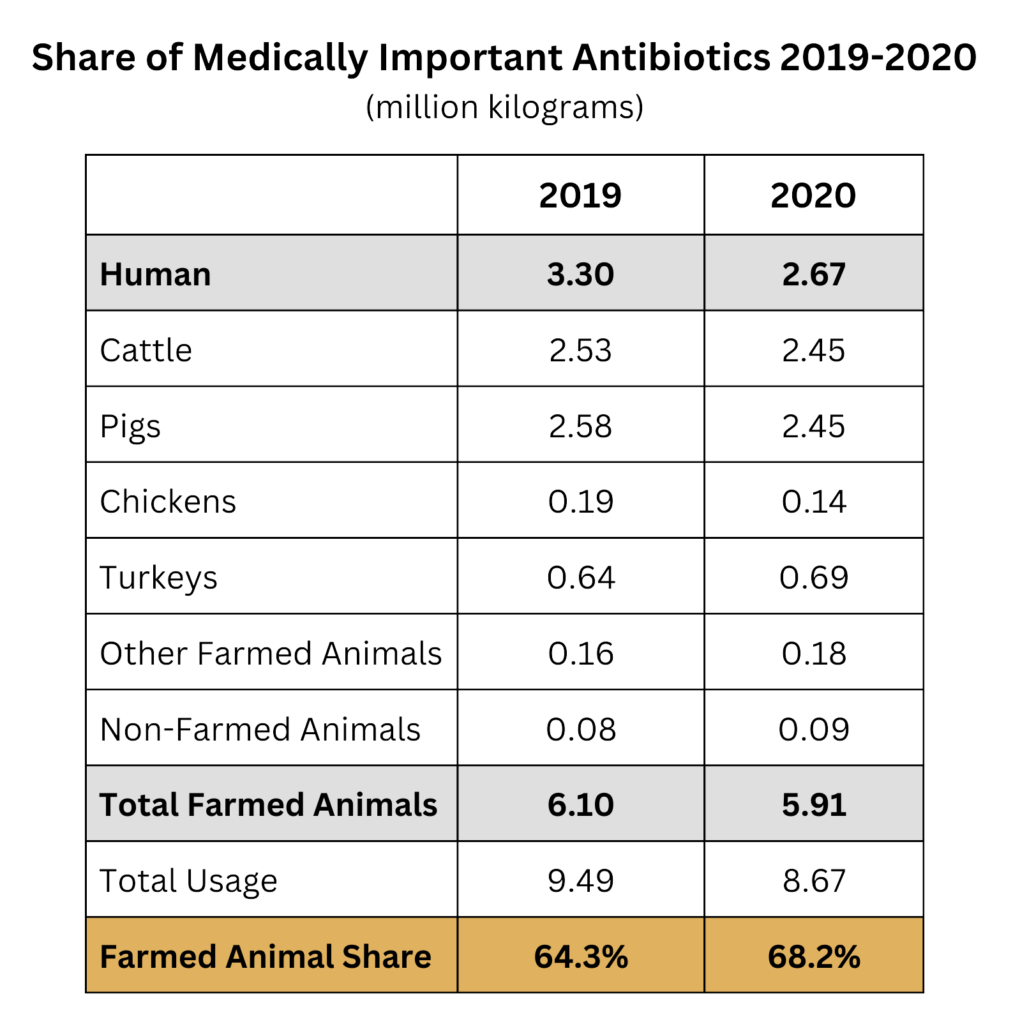
Since the FDA does not calculate total human use by weight, these estimates rely on credible but unverifiable sources.[7]
This estimate of “almost two-thirds” is now an underestimate, given the reported 16% increase in animal usage from 2023 to 2024.[8] Human use has remained relatively steady.[9,10]
U.S. FDA (2025). 2024 Summary Report On Antimicrobials Sold or Distributed for Use in Food-Producing Animals, Table 4b. [Provides farmed animal totals from 2015 through 2024. However, we are not aware of human use total estimates after 2020.]
David Wallinga (2022). U.S. Livestock Industries Persist in High-intensity Antibiotic Use, Issue Brief, IB: 22-II-A, NRDC. [“The most recent data suggest around 66% of all medically important antimicrobials sold in the USA of all medically important antimicrobials sold in the USA are intended for use in food animal production, primarily in swine and cattle.” Note: This report estimates human use totals through 2019 as well as providing an excellent overview with key resources. We are not aware of other credible sources for human use figures. Dr. Wallinga is a researcher and recognized expert; NRDC has been at the forefront of research and advocacy in this area.]
David Wallinga (September 2023). Antibiotic Use Remains Far Too Intensive in U.S. Livestock, NRDC. https://www.nrdc.org/bio/david-wallinga-md/antibiotic-use-remains-far-too-intensive-us-livestock [Provides human use totals through 2020]
Note: Based on the FDA’s detailed explanations of “other animals,” we broadly estimate that about two-thirds are animals farmed for food. A quick estimate of biomass of animals slaughtered for food other than cattle, pigs, chickens and turkeys (e.g., ducks, sheep, goats, and bison) and their approximate total biomass, suggests they equal ~2% of total farmed biomass. Therefore, an estimate of ~2% of antibiotic use appears reasonable. The other portion (~1%) is assumed to be from the other named categories, i.e., domestic animals (dogs, horses), uses in aquaculture, and “unknown uses.” Also note that the FDA uses the term “sold for use” instead of “used” since they cannot confirm actual usage; to simplify language we say “used.” We also assume that human estimates do not confirm actual ingestion.
Note: The dip in human use in 2020 is likely due to Covid-19. See, CDC, COVID-19 Impacts on Antibiotic Use. [In outpatient settings (the primary usage), antibiotic use significantly dropped in 2020 compared to 2019. Therefore, 2019 is a better reflection of long-term trends.]
U.S. FDA (2022). 2021 Summary Report On Antimicrobials Sold or Distributed for Use in Food-Producing Animals, p. 3, fn.1. [Medically important antimicrobials “are those antimicrobials that have been determined to be medically important to human medicine.”]
The FDA does not offer estimates of the total antibiotic usage for humans for reasons that appear vague or not relevant. Their reasons include: the comparatively large population of animals, their larger weights, the varying durations and dosages of treatment, and some unknowns regarding companion animal usage. Given that this is probably the single most sought-after figure, as well as a key indicator of progress in terms of ongoing reductions, it seems surprising that the FDA cannot provide an estimate. For details on their rationale, see, 2021 Summary Report On Antimicrobials Sold or Distributed for Use in Food-Producing Animals, pp. 6-7.
U.S. FDA (2025). FDA Releases Annual Summary of Sales and Distribution of Antimicrobials in 2024 for Use in Food-Producing Animals. [“The 2024 data indicate that U.S. sales and distribution of medically important antimicrobial drugs approved for use in food-producing animals increased by 16 percent between 2023 and 2024.”] Also, see question below [What is the recent trend for animal ag antibiotic usage?]
CDC (2019). Outpatient Antibiotic Prescriptions, United States, 2019. [Total prescriptions = 251.1M] CDC (2024). Outpatient Antibiotic Prescriptions, United States, 2024. [Total prescriptions = 255.9M]
CDC (September 15, 2025). Antibiotic Use in the United States. https://www.cdc.gov/antibiotic-use/hcp/data-research/antibiotic-prescribing.html [“Most human antibiotic use (85-95%) occurs in outpatient settings.”]
According to the recent estimate for 2019:

U.S. FDA (2025). 2024 Summary Report On Antimicrobials Sold or Distributed for Use in Food-Producing Animals, Table 4b. [Provides farmed animal totals from 2015 through 2024. However, we are not aware of human use total estimates after 2020.]
David Wallinga (September 2023). Antibiotic Use Remains Far too Intensive in U.S. Livestock, NRDC. [Provides human use totals by weight through 2020. We are not aware of a more recent estimate of total human use by weight or share of total. This information is not provided by the FDA or the CDC.]
According to the FDA:
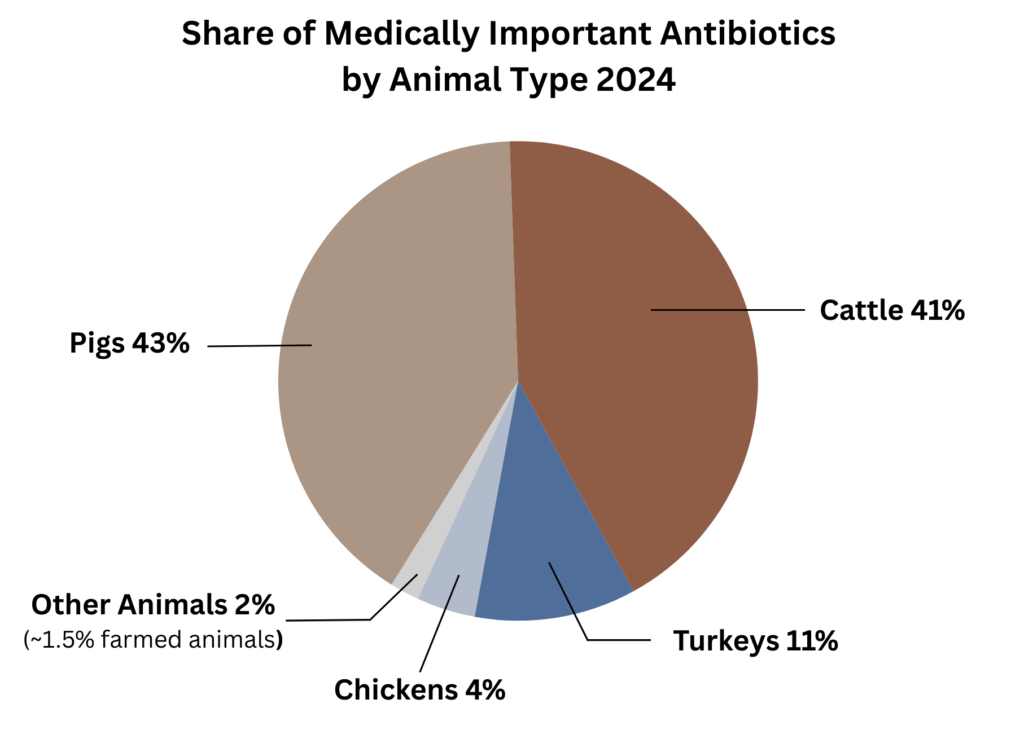
U.S. FDA (2025). 2024 Summary Report On Antimicrobials Sold or Distributed for Use in Food-Producing Animals, Tables 4a & 4b.
There have been 2 major developments over the last decade:
 In 2017, the FDA completed a process begun in 2013 that transitioned medically important antibiotics from over-the-counter to requiring veterinary oversight; the agency also disallowed their use for the purposes of growth promotion.[1,2] This action caused the dip in overall usage from 2015 through 2017.[3]
For 2024, the FDA data shows a 15.8% increase from 2023 for farmed animal usage, a sharp increase to the upward trend since 2017.[4] To date, there is no clear explanation for the increase.[5]

U.S. FDA (2018). 2017 Summary Report On Antimicrobials Sold or Distributed for Use in Food-Producing Animals, p. 3. [Note: This report finalized industry guidelines set out in Rule 213, see fn 2]
U.S. FDA (2013). Guidance for Industry #213, p. 4. [“(1) Limit medically important antimicrobial drugs to uses in animals that are considered necessary for assuring animal health, and (2) Limit medically important antimicrobial drugs to uses in animals that include veterinary oversight or consultation.”]
Karin Hoelzer & Daniel Feingold (December 21, 2018). Animal Antibiotic Sales Fall for 2nd Year, Pew.
https://www.pew.org/en/research-and-analysis/articles/2018/12/21/animal-antibiotic-sales-fall-for-2nd-yearU.S. FDA (2025). 2024 Summary Report On Antimicrobials Sold or Distributed for Use in Food-Producing Animals, Tables 4a & 4b.
Lisa Held (January 20, 2026) Sales of Antibiotics for Farm Animals Spiked in 2024. Civil Eats. https://civileats.com/2026/01/20/sales-of-antibiotics-for-farm-animals-spiked-in-2024/
All major farmed animal types showed increases in antimicrobial drug usage in 2024.[1]
Cattle – up 16% Pigs – up 13% Chickens – up 79% Turkeys – up 25%
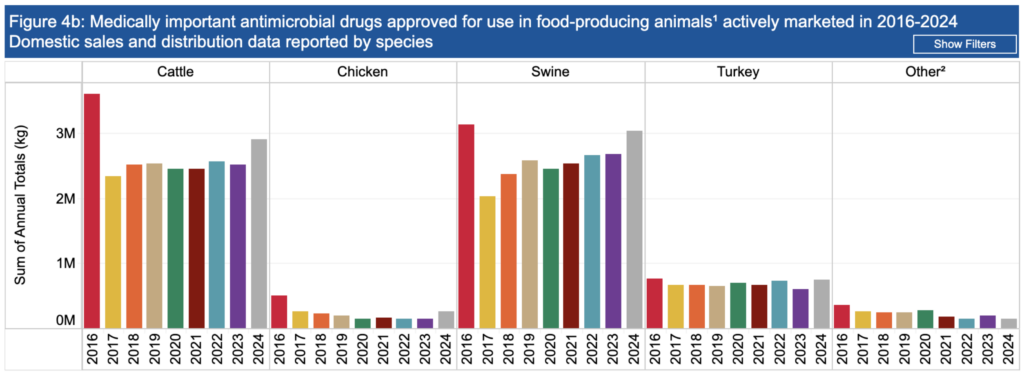
U.S. FDA (2025). 2024 Summary Report On Antimicrobials Sold or Distributed for Use in Food-Producing Animals, Table 4b.
Cattle are sickened by factory farming practices. Antibiotics keep the animals healthy enough to get through the slaughter process. The primary health conditions are bovine respiratory disease and liver abscesses – both of which respond to antibiotics.[1-3]
Risk factors for bovine respiratory disease (aka shipping fever) are transportation events and the high-density comingling of animals in feedlots.[4] Liver abscesses are caused by the unnatural grain-centered diets given to cattle in feedlots.[5]
Virtually all large feedlots use medically important antibiotics, mostly as a feed additive but also by injection.[6] U.S. policies that limit usage are far behind those in Europe.[7]
USDA Animal Plant and Health Inspection Service (2013). Feedlot 2011 Part IV: Health and Health Management on U.S. Feedlots with a Capacity of 1,000 or More Head, p. ii. [“The most common illness of cattle placed in feedlots was respiratory disease…”]
Cameron, A. & McAllister, T. A. (2016). Antimicrobial usage and resistance in beef production. Journal of animal science and biotechnology, 7, 1-22, p. 5. [Bovine respiratory disease “accounts for ~70% of cattle morbidity, and ~40% of all mortality in feedlots.”]
Nagaraja, T. G. & Chengappa, M. M. (1998). Liver abscesses in feedlot cattle: a review. Journal of animal science, 76(1), 287-298, Abstract. [“…averaging from 12 to 32% in most feedlots.”]
Taylor, J. D., et al., (2010). The epidemiology of bovine respiratory disease: What is the evidence for predisposing factors? The Canadian veterinary journal, 51(10), 1095.
Nagaraja, T. G. & Chengappa, M. M. (1998), Abstract. [“Liver abscesses in slaughtered beef cattle result from aggressive grain-feeding programs.”]
USDA Animal and Plant Health Inspection Service (2019) Antimicrobial Use and Stewardship on U.S. Feedlots, 2017, p. 15.
David Wallinga (2020). Better Burgers: Why It’s High Time the US Beef Industry Kicked Its Antibiotics Habit. NRDC, New York, NY, USA. pp. 10-11. [Note: this is a comprehensive overview of usage in the U.S. beef industry.]
The pig factory farming industry is heavily dependent on antibiotics to address respiratory disease and various causes of diarrhea.[1] Almost all operations give medically important antibiotics in water or feed, or both.[2]
The economic benefits of giving antibiotics to factory farmed pigs have been well documented; pigs gain more weight with better feed efficiency, have lower mortality and less disease, and have larger litters.[3] However, the long-term dependence on antibiotics may lead to more prevalent disease.[4]
Despite the FDA’s 2017 ruling that pigs (and other farmed animals) can no longer be given antibiotics for growth promotion, some surveyed operations continue to offer that as their primary reason for giving antibiotics to nursery age pigs.[5] There is not a clear delineation between drugs used for treatment and those used for growth.[6]
Usage by U.S. factory farms is much greater than comparable operations in many European countries.[7]
USDA APHIS (2020) Antimicrobial Use and Stewardship on U.S. Swine Operations, 2017, Tables C.1.a, C.2.a, D.1.a, D.2.a.
Antimicrobial Use and Stewardship on U.S. Swine Operations, 2017, Table B.2, p. 14. [98% of large operations (>5,000 pigs) and 94% of all operations give medically important antibiotics in water or feed or both.]
Gary L. Cromwell (2002). Why and how antibiotics are used in swine production. Animal biotechnology, 13(1), 7-27.
David Wallinga (2018). Better Bacon: Why It’s High Time the US Pork Industry Stopped Pigging Out on Antibiotics. NRDC Issue Brief, Table B, p. 7.
USDA Animal and Plant Health Inspection Service (July 16, 2024) Swine Part II: Reference of Management Practices on Large-Enterprise Swine Operations in the U.S. [See: Individual Tables C.5.g – many operations use antibiotics primarily for growth for nursery pigs.]
Lisa Held (June 12, 2024) Medically Important Antibiotics Are Still Being Used to Fatten Up Pigs, Civil Eats. https://civileats.com/2024/06/12/medically-important-antibiotics-are-still-being-used-to-fatten-up-pigs/
David Wallinga (2018), p. 4. [“U.S. producers use about double the antibiotics per kilogram of pig as are used in the United Kingdom, more than three times as much as in France, and more than seven times the levels used in Denmark or the Netherlands.”]
Pound for pound, pigs receive almost 4 times the amount of medically important antibiotics that humans receive.
Broadly estimated, the biomass of humans (aggregate U.S. weight) is more than 4 times that of pigs.[1] Pigs receive ~85% of the amount of antibiotics humans receive.[2]
Broadly estimated: ~68 million pigs weigh ~140 pounds each (from 3 – 280 lbs. in their 6-month life) = 9.5B lbs.; and ~6M sows weigh ~500 pounds each (most of their lives they are large) = 3B lbs., totaling 12.5B lbs. And 270M adults at 185 lbs. and 65M kids at 80 lbs., totaling 55.2B lbs. / 12.5B = 4.4 ratio.
David Wallinga (September 2023). Antibiotic Use Remains Far too Intensive in U.S. Livestock, NRDC. https://www.nrdc.org/bio/david-wallinga-md/antibiotic-use-remains-far-too-intensive-us-livestock [On average for 2019 and 2020, pigs received about 84% of the antibiotics that humans received. So, .84 x 4.4 = 3.7 ratio, pound for pound.]
There is more consumer demand for antibiotic free chicken, and the vertically integrated broiler industry can more easily respond to that demand.[1] Retailers and restaurants, with encouragement from non-profits, have also seen benefits to marketing chicken products as “no antibiotics.”[2]
Other factors include the short lifespan of broilers, the industry’s use of non-medically important alternatives, and the more uncertain impacts on growth promotion.[3,4]
Surprisingly, the 2024 data shows a 79% increase from 2023 in antibiotic use.[5] There is some evidence that this is at least partially due to due to avian metapneumovirus, which causes bacterial infections.[6,7]
Perdue Farms (n.d.) No Antibiotics Ever: It’s Not the Easy Way, it’s the Perdue Way. https://www.perduefarms.com/en-US/no-antibiotics-ever-chicken.html
Jean Halloran & Meg Bohne (2017). Chain Reaction III, Friends of The Earth. [See also subsequent reports including: Chain Reaction IV: How Top Restaurants Rate On Reducing Antibiotic Use In Their Beef Supply Chain.]
Wallinga, D., et al., (2022). A review of the effectiveness of current US policies on antimicrobial use in meat and poultry production. Current environmental health reports, 9(2), 339-354, p. 343.
Graham, J. P., et al., (2007). Growth promoting antibiotics in food animal production: an economic analysis. Public health reports, 122(1), 79-87. [Note: Although the use of medically important antibiotics for growth promotion is technically disallowed, there are loopholes that add to total usage.]
U.S. FDA (2025). 2024 Summary Report On Antimicrobials Sold or Distributed for Use in Food-Producing Animals, Table 4b.
Gwen Venable & Hannah Keck (December 16, 2025). USPOULTRY Releases Updated Report of Antibiotic Stewardship Within US Poultry Production. U.S. Poultry & Egg Association.
https://www.uspoultry.org/media-center/press-releases/single-view/?id=4603
[“For example, avian metapneumovirus has caused severe morbidity and mortality in some broiler flocks. Infection with this virus can lead to an increased incidence of secondary bacterial infections.Lisa Held (January 20, 2026). Sales of Antibiotics for Farm Animals Spiked in 2024. Civil Eats. [“Most of the increases, he said, are attributable to a surge in a disease called avian metapneumovirus, which often causes chickens to contract secondary bacterial infections.”]